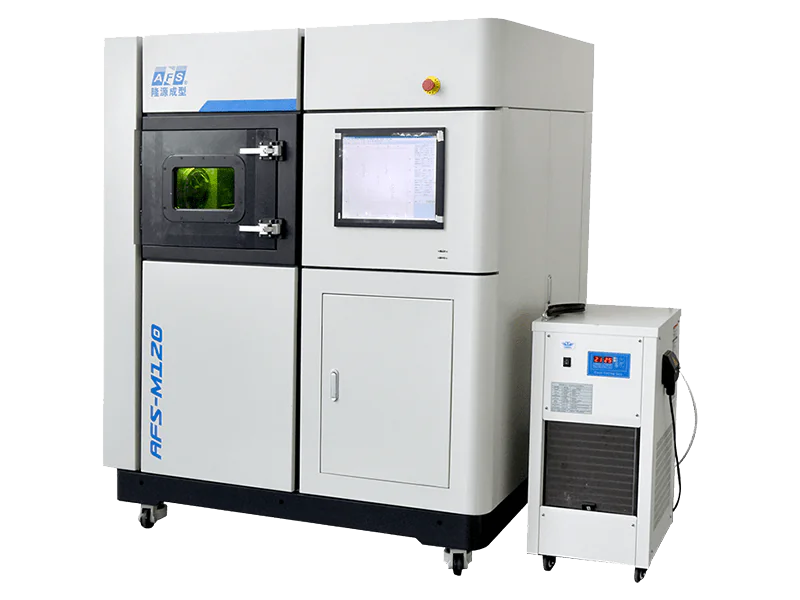
The most accessible route to production-grade binder jetting — a benchtop footprint whose parameters transfer straight to the J400P and J800P.
- Volume de construção
- 160 × 65 × 65 mm
- Resolução
- 400–1200 dpi
- Forming speed
- 165 cc/h
- Precisão
- ±0,1 mm
Two routes on one open platform: impressão por jato de aglutinante for high-throughput batch parts, SLM for fully dense and gradient-metal components. Build volumes from 160 × 65 × 65 mm to 800 × 500 × 400 mm. See how these fit the wider industrial 3D printers range, and compare all five process families — build volumes and 2026 price bands — in the Guia sobre impressoras 3D industriais. For the metal-specific version, the metal 3D printer guide covers both routes and what each costs.

Price tracks two things: the process e the size. A binder jetting system and an SLM system are different machines — printheads and throughput on one side, laser power, optics and gas handling on the other — and build envelope scales the frame, the powder handling and the cost with it. Multi-powder or gradient capability adds a third variable. Configure a machine to your parts and the figure lands inside that band.
Both run on our open material platform with the same 30+ qualified alloys. The difference is throughput versus density, and it decides your cost per part before you ever cut metal.
Deposit binder onto powder layers at inkjet speed, then debind and sinter. No supports, no thermal warping — the whole build tray finishes in one cycle.
A 500 W IPG fibre laser fully melts each layer for wrought-equivalent mechanical properties — plus the only production-ready gradient-metal SLM.
| What matters | Jato de ligante metálico | SLM (selective laser melting) |
|---|---|---|
| How it forms | Printhead deposits binder into a powder bed at inkjet speed; the green part is then debinded and sintered | A 500 W IPG fibre laser fully melts each layer, leaving a wrought-equivalent solid |
| Densidade | Green density ~67%, driven to full density in the sintering furnace | 99.9% relative density straight off the plate |
| Capacidade de processamento | 8 L/h metal, 12 L/h silicon carbide on the J800P | Layer-by-layer; slower per part, faster to a finished metal part |
| Supports | None — the powder bed supports every overhang, so nobody cuts supports off | Supports required and removed afterwards |
| Cost per part at volume | 3–5× lower than SLM — the reason MIM lines switch | Higher per part, higher value per part |
| Gradient / multi-alloy | Metal plus silicon carbide on the same platform | Gradient in X-Y-Z — 2–4+ alloys fused in one build (exclusive) |
| Ideal para | Batch parts, MIM replacement, complex geometries without tooling | Fully dense functional parts, conformal cooling, gradient and refractory work |
Send us your part files and target volumes — our application engineers will recommend the right machine and print your parts before you invest. No machine required: the serviço de impressão 3D em metal covers materials, tolerances and inspection.
Work down this list with your own part in hand. Most buyers have the answer by question three.
If yes, you need SLM — binder jetting reaches density in the furnace, not in the machine. If the part will be sintered and can take the shrinkage allowance, binder jetting is open to you.
Under 120 mm in X and Y points at the AFS-M120 family. Up to 380 mm points at the J400P. Past 500 mm you are in J800P territory at 800 × 500 × 400 mm — and if the part is larger than any build box, it is a design problem, not a machine problem.
At volume, binder jetting is 3–5× cheaper per part than SLM, which is why MIM lines switch. If you make ten parts a month and they are all different, throughput is not your constraint — density and material are.
That is the gradient line: the M120X for 100+ compositions in a single build, the M120XT when you need X and Z control, the M300XAS when the gradient part also has to be machined to tolerance without re-fixturing.
If the volume does not justify capital yet, do not buy — run the parts through our serviço de impressão 3D em metal first. The economics you measure there are the same ones the machine will deliver.
One table, one decision. Every machine below shares the open material platform and the same parameter philosophy, so work proven on a benchtop transfers to production.
| Modelo | Tecnologia | Volume de construção | Energy / heads | Capacidade de processamento | Posicionamento |
|---|---|---|---|---|---|
| 3DPTEK-J160R | Jato de aglutinante | 160 × 65 × 65 mm | 400–1200 dpi | 165 cc/h | Benchtop R&D and education |
| 3DPTEK-J400P | Jato de aglutinante | 380 × 380 × 300 mm | 3 or 6 heads · 1200 dpi | 3.6 L/h metal | MIM-line replacement |
| 3DPTEK-J800P | Jato de aglutinante | 800 × 500 × 400 mm | 4 heads · up to 1200 dpi | 8 L/h metal · 12 L/h SiC | Large-format production |
| AFS-M120 | SLM | 120 × 120 × 150 mm | 1 × 500 W IPG · 6 m/s | — | Compact single-alloy SLM |
| AFS-M120X | SLM | 120 × 120 × 150 mm | 1 × 500 W IPG · dual powder | 100+ compositions per build | Gradient materials R&D |
| AFS-M120XT | SLM | 120 × 150 × 150 mm | 1 × 500 W IPG · dual powder | 3+ powders, X + Z gradient | High-temperature and refractory alloys |
| AFS-M300XAS | SLM + CNC | 300 × 300 × 250 mm | 2 × 500 W IPG | 4+ powders, X-Y-Z gradient | Hybrid AM plus in-process machining |
Accuracy across the SLM range is ±0.1 mm per 100 mm; binder jetting holds ±0.1 mm. Build volumes and head counts above are the published figures for each model.
Print the green part at inkjet speed, then debind and sinter to full density. Benchtop research system to 800 mm production platform — same open materials, parameters that scale.

The most accessible route to production-grade binder jetting — a benchtop footprint whose parameters transfer straight to the J400P and J800P.

A drop-in replacement for the injection-moulding step in an existing MIM line. 15% binder versus 40–50% for MIM — complex parts without tooling.

The flagship: an 800 mm build and four printheads, built to replace MIM tooling at scale — metal at 8 L/h, silicon carbide at 12 L/h.
A 500 W IPG fibre laser fully melts each layer for wrought-equivalent properties — plus the only production-ready gradient-metal SLM systems on the market.

High-density single-alloy SLM for R&D, tooling and small-batch production — a 500 W IPG laser in a footprint that fits a workshop.

Dual-powder gradient feeding prints 100+ alloy compositions in a single build — for materials research and functionally graded parts.

Blend three or more powders along the X-axis and step compositions along Z in one build — full three-dimensional compositional control, including refractory alloys.

Multi-material deposition with in-process precision machining. Four or more powders in full X-Y-Z gradients on one 300 × 300 × 250 mm platform, with 2 × 500 W IPG lasers — print the gradient, then machine it to tolerance without re-fixturing.
View the AFS-M300XASUse certified third-party powder. We publish the parameters, you buy the metal where you like.
| Família | Qualified grades | Utilização típica |
|---|---|---|
| Stainless steel | 304, 316L, 17-4PH | Corrosion-resistant functional parts, marine and food equipment |
| Titânio | Ti6Al4V | Aerospace and medical, where strength-to-weight decides |
| Tool steel | H13, 4140, 2709 | Moulds and dies, including conformal cooling |
| Cobalt-chrome | CoCrMo | Wear surfaces, biomedical, and the hard half of a gradient |
| Nickel superalloy | Inconel 625, 718 | Hot-section and high-temperature service |
| Aluminium | Al alloys | Lightweight housings and heat-transfer parts |
| Copper & tungsten | Cu, W alloys | Thermal management, electrical contacts, radiation shielding |
| Ceramic (BJ only) | Silicon carbide | Wear parts and kiln furniture, printed on the same binder jetting platform |
Full parameter sets — layer thickness, laser or binder settings, debind and sinter recipes — ship with every machine for each qualified material. Materials not listed can usually be qualified on request.
Traditional manufacturing welds, brazes or fastens dissimilar metals — which creates the weak point. Gradient SLM builds the transition atom by atom.
Corrosion-resistant stainless transitions into high-wear cobalt-chrome — biomedical and marine parts that used to be two pieces.
A hard mould face with corrosion-resistant cooling channels behind it, in one build.

Every machine in the range runs in our own manufacturing centres before it ships, so the economics are measured rather than modelled.
Replace injection-moulding tooling with tool-less binder jetting. At 15% binder instead of 40–50%, the debind cycle is shorter and the part geometry is unbounded.
Conformal cooling channels that a drill cannot reach, plus gradient wear surfaces where the mould face meets abrasive melt.
Titanium and superalloy parts where strength-to-weight and certified density matter more than unit cost.
Test a hundred compositions in a single build instead of a hundred builds — the reason materials labs buy the M120X.
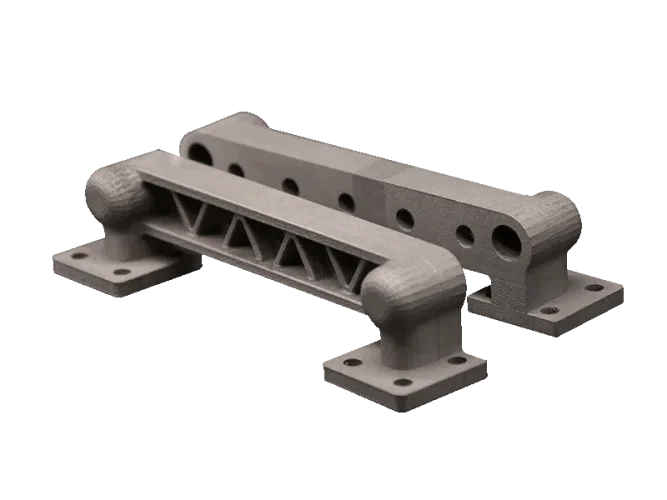
Real parts, not renders. We will print yours before you commit to a machine.


Since 1994. The same systems sit in ten manufacturing centres we operate, so a machine you buy is a machine we have already broken, fixed and improved.
No locked-in powder contracts. 30+ qualified formulations, parameters that scale from R&D to production.
Production-ready gradient SLM: 316L + CoCrMo, or tool steel + 316L, fused in one build. No other OEM does this at scale.
Powder qualification, parameter optimisation, application engineering, 12-month warranty, on-site training and remote diagnostics.
300+ patents, 500+ installations, ten manufacturing centres running our own machines every day.
Prices across the seven-model range run from roughly RMB 850,000 to RMB 4.05 million (≈ US$120,000 to US$570,000), ex-works and dependent on configuration. Three things move the figure: the process (binder jetting and SLM are different machines), build envelope (frame, powder handling and structure scale with it), and multi-powder or gradient capability. The debind-and-sinter furnace that binder jetting needs is quoted separately. Configure a machine to your parts and we will quote that configuration with an ROI model on your own parts.
If you are replacing a MIM line or producing batches of complex parts, binder jetting wins on cost per part — roughly 3–5× cheaper than SLM at volume. If the part must be fully dense as-built, needs conformal cooling in tool steel, or needs two alloys in one monolithic part, SLM is the route. Send a STEP file and we will tell you which process wins for that part.
304/316L stainless, 17-4PH, Ti6Al4V, aluminium, H13/4140/2709 tool steels, cobalt-chrome, Inconel 625 and 718, copper and tungsten alloys — plus silicon carbide on the binder jetting systems. It is an open platform: certified third-party powder is fine as long as it meets the published parameter spec.
Yes. Binder jetting produces a green part that must be debinded and sintered in a controlled-atmosphere furnace. We supply the complete time and temperature profile for every qualified material and can recommend furnace suppliers in your region; furnace integration is quoted with the line.
Yes — that is the usual route. Our manufacturing centres print your parts on the same metal systems, then ship sintered samples with dimensional and density data so you validate quality and economics before committing capital. You can also buy the parts as a service instead.
Twelve-month warranty, on-site installation and commissioning, three to five days of operator training, material qualification and parameter optimisation, application engineering, and remote diagnostics with spare parts held in our warehouse. Extended warranty and furnace integration are optional.
Yes. The J160R, J400P and J800P are dual-purpose: metal green parts and silicon carbide components on the same hardware, with different binders and post-processing recipes. One capital investment, two production lines.
Lead time depends on model and configuration — a benchtop J160R ships far faster than an 800 mm production line with a furnace. Ask for the current lead time for the specific model when you request a quotation; installation, commissioning and operator training are scheduled with the shipment.
Tell us the application, the material and the target volume. Our engineers will recommend the right system and print your parts before you invest.