
Defense Casting Consolidation: One-Piece Parts with 3D Printed Molds

Defense hardware is built from assemblies — and assemblies are where weight, time, and risk accumulate. A bracket that could be one casting is often five machined parts and twelve fasteners. A housing that could be cast in one piece is a weldment of plates and fittings. Every joint adds weight, assembly hours, and inspection burden. It is also a potential failure point. In a world where defense programs must move faster and lighter, consolidation has become a design priority.
Casting is the natural consolidation tool: pour one part that replaces many. But conventional casting has its own gatekeeper — the pattern tooling needed to produce a complex, consolidated casting can cost a fortune and take months. 3D printed molds remove that gatekeeper. A single-piece casting with complex internal geometry can be poured in weeks from a digital file, with no pattern to build and no tooling to amortize.
This article explains how defense casting consolidation works, why printed molds make it practical, and how program teams should approach it. If you are evaluating a part family for consolidation, the workflow and the honest limits below are the starting point.
Why Defense Casting Is Ripe for Consolidation
Defense parts are often over-assembled. The reason has nothing to do with the design. It has everything to do with how the parts were manufactured. A structural bracket might be machined from several forgings because the one-piece casting geometry was deemed too complex for tooling. A housing might be a weldment because the internal passages could not be cored economically. Each compromise shows up later in the program. It shows up as weight, assembly labor, and logistics.
The incentives to consolidate are compounding:
- Weight. Every bolted joint carries fastener and flange weight. Replacing a five-part assembly with one casting removes the flanges, the fasteners, and the overlapping material at every interface.
- Assembly time. Defense programs are increasingly gated by schedule, not just cost. Fewer parts means fewer operations, fewer fixtures, and shorter assembly flow.
- Reliability. Joints are leak paths, crack initiation sites, and tolerance stacks. A one-piece casting eliminates the interfaces where these defects live.
- Inspection and documentation. Each part in a defense assembly carries its own inspection record, traceability, and documentation. Consolidation shrinks that paperwork proportionally.
The obstacle has never been the desire to consolidate — it is the tooling. A consolidated casting merges features that a pattern shop must build as separate pattern pieces and cores, which is why complex one-piece castings were historically either impossible or prohibitively expensive.
What Consolidation Means in Casting
Consolidation is a design for manufacturability exercise. Take a set of parts that bolt, weld, or mate together. Then ask whether one casting can replace them. In defense, the classic candidates are:
- Bracket and mounting assemblies merged into single structural castings
- Housings that combine body, bosses, ports, and mounting lugs in one pour
- Manifolds and ducting where internal passages replace external pipework
- Mounts and pedestals that currently require multiple machined details
The casting itself is not the hard part. Sand casting can make almost any shape. The hard part has always been the tooling for the mold. A consolidated casting typically has re-entrant features, internal passages, and thin walls. A conventional pattern cannot easily produce them. The pattern must be withdrawn from the mold, and the cores must be blown in a core box.
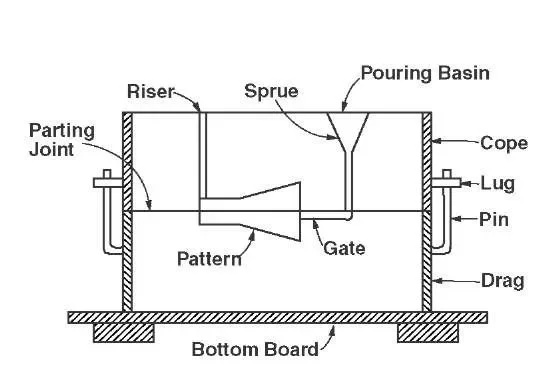
That is exactly where 3D printing changes the answer. In 3D sand printing, the mold and its cores are built layer by layer directly from the CAD file. Features that defeat a pattern — undercuts, curved internal channels, thin deep webs — are printed as easily as anything else. The sand casting process itself, from pouring to finishing, remains conventional; only the mold-making is digital.

How 3D Printed Molds Remove the Tooling Barrier
The mechanism is simple, and it is the same one that drives patternless casting across the industry. Remove the pattern, and the cost and time of tooling disappear from the consolidation decision.
On the conventional route, a consolidated part needs a pattern set and core boxes sized to its complexity. For a large, thin-walled, structurally demanding part, that tooling runs into six figures and months of lead time. And that is before the first test casting exists. If the consolidated design fails its structural test, the tooling rework cycle starts again. This is the economics that keeps over-assembled designs alive. The tooling bill is so large that teams prefer to assemble from proven parts rather than risk a consolidated casting.
On the printed-mold route, the consolidated part pours from a mold built in days. The design can be changed by editing the file; the next mold prints overnight. Programs can actually iterate the consolidated design — thicker here, lighter there, better gating after the first pour — instead of freezing it to protect the tooling investment. The mechanics of that iteration — file prep, slicing, printing, depowdering, and pouring — are explained step by step in our how sand 3D printing works guide. This is the same iteration advantage that drives patternless prototyping, but applied to a final, load-bearing part.
Production examples confirm the technology on demanding alloys. A large, thin-walled structure has been cast in GLH-5 high-chromium alloy from a 3D printed sand mold as a single piece. The geometry and wall control were beyond what the conventional route could hold at acceptable yield. The same approach is documented across the 3DPTEK production network. It forms thin-wall and complex-cavity parts in one piece, with better surface quality and fewer defects. The network includes foundries serving aerospace and defense programs.
The Consolidation Playbook
Consolidation is a program, not a one-off decision. The sequence that works:
- Audit the part family. Identify assemblies with high part counts, repeated fastening, weight problems, or assembly-critical joints. Rank them by consolidation payoff — part count, assembly hours, weight, and failure history.
- Merge in CAD. Combine the assembly into a single solid model, preserving functional interfaces: mounting surfaces, sealing faces, bolt-hole patterns. Use simulation to validate the merged geometry early. The whole point is to iterate cheaply while it is still a file.
- Design the mold digitally. The provider designs the split, gating, risering, and core layout for the consolidated casting. With printing, the split plane and cores are software decisions. They are not tooling constraints.
- Print, pour, and test. The mold prints in days. The part pours in the specified alloy. The first article goes through inspection and structural testing. The guide to choosing a casting service provider explains how to set up this step with the right qualification controls.
- Ramp on the same file. Once validated, the same digital mold geometry produces pilot and low-volume runs. When volume grows, production tooling reproduces a proven design.
The payoff structure is consistent across programs:
| Assembly attribute | Multi-part assembly | Consolidated casting |
|---|---|---|
| Part count | 5–20+ parts | 1 casting |
| Fasteners | Many | Few or none |
| Weight | Flanges + fasteners + overlap | Only functional material |
| Assembly hours | Fixturing, aligning, fastening | None |
| Failure points | Every joint | Internal, cast integrity |
| Inspection load | Per-part records | One casting record |
| Change cost | Redesign + rework multiple parts | Edit the file, reprint |
The table is deliberately general, because the exact numbers depend on the part. But the direction is consistent: consolidation trades assembly complexity for casting complexity, and 3D printed molds are what make the casting side of that trade affordable.

What Consolidation Delivers on the Program Level
Beyond the part itself, consolidation changes program logistics. A single casting replaces a supply chain of machined details. There are fewer purchase orders, fewer suppliers to qualify, and fewer inventory line items. There is also less risk of parts arriving out of sync. For defense programs with strict configuration control, one part number is a measurable simplification.
Schedule is where consolidation compounds. The conventional path — design the assembly, tool each part, machine, finish, assemble, test — stretches over many months. The consolidated path — design one casting, print the mold, pour, test — compresses the critical path dramatically. Development-cycle math for this exact pattern, with before/after timelines, is in our CAD-to-casting guide.
Weight is the headline benefit, and it is real. But it must be earned. A consolidated casting is lighter than the assembly it replaces when the design is optimized. Wall thicknesses are tuned, and metal is placed only where loads flow. Printing enables that optimization because the design is iterated digitally against simulation. It is not frozen early by tooling. The result is a part that is genuinely lighter.
None of this requires exotic casting. The parts pour through the same sand casting lines that make commercial castings, which means the yield, quality, and inspection methods are well understood. What changes is the mold-making route — and that is why defense casting consolidation has become a practical strategy rather than a design aspiration.
Materials and Routes: Sand vs. Investment
Consolidation candidates in defense span a wide alloy range, and the right molding route follows the alloy:
- Aluminum and steel structural parts. 3D printed sand molds serve these directly. High-chromium alloys like GLH-5, stainless steels, and aluminum alloys pour from printed sand molds with casting-grade accuracy (about ±0.3 mm up to 300 mm, ±0.5 mm above on the J1800/J2500 class machines, and ±0.5 mm/0.1% on the J4000 series).
- Complex internal passages. Where consolidation produces fine oil, coolant, or pneumatic passages, laser-sintered sand cores print them in one piece. These cores reach flexural strength ≥ 2 MPa, with gas evolution ≤ 10 ml/g and refractoriness up to 1700 °C.
- Titanium and superalloys. These high-value alloys are typically poured through investment casting, where the pattern is consumed and the metal fills a ceramic shell. Here the 3D printing role shifts to the pattern. SLS wax patterns are printed directly from CAD. This eliminates the metal die that investment casting usually requires. Titanium castings for defense are a case in point — the investment route with printed wax patterns avoids tooling while keeping the precision the alloy demands.
| Molding route | Alloys | Best for | Tooling |
|---|---|---|---|
| 3DP printed sand mold | Aluminum, steel, stainless, high-chromium, cast iron | Structural one-piece castings, thin walls, complex cavities | None — digital file |
| Laser-sintered sand core | Any sand-cast alloy | Fine internal oil, coolant, pneumatic passages | None — printed core |
| Printed wax pattern + investment casting | Titanium, superalloys, precision steel | High-value alloys, thin sections, tight tolerances | None — printed wax replaces die |
The material takeaway: whatever alloy your consolidated part requires, there is a printed-mold route — sand for aluminum/steel/high-chromium, printed wax for titanium and superalloys. The five differences between the printed and conventional routes, from cost to geometry freedom, are compared side by side in our traditional vs. patternless sand casting guide. The full range of alloys and processes is covered in our digital casting guide.
Qualification, Quality, and Standards
Defense parts live or die on qualification, and consolidation must survive the same scrutiny as the assembly it replaces. The good news: printed-mold castings are qualified with the same tools as any casting — first-article inspection, dimensional verification against the CAD master, mechanical testing from cast coupons, and non-destructive examination where specified.
The quality case for printed molds is strong. Because the mold is built from the file, there is no pattern wear to distort geometry. There is also no pattern draft. The digital mold is identical every time it prints. Documented advantages over the conventional route include smoother casting surfaces and higher mold-closing accuracy. The mold also delivers lower gas evolution and better permeability. That means fewer defects and less fettling afterward. For a consolidated part replacing multiple details, that quality lands where it matters most: at the interfaces that used to be joints.
The technology has also matured to formal standards. National standards now cover both equipment and performance. GB/T 42156-2023 defines the technical requirements and acceptance rules for sand 3D printing equipment. GB/T 43365-2023 specifies test methods for sand mold performance: tensile, compressive, flexural, and shear strength, high-temperature properties, gas evolution, permeability, and loss on ignition. A qualified provider works to these standards, which means the printed mold is a documented, repeatable manufacturing step — not a lab experiment.
The qualification flow itself is unchanged from conventional casting practice. That is precisely why consolidation is low-risk to introduce. The foundry that already qualifies commercial castings for defense uses the same gating, pouring controls, heat treatment, and inspection gates for a printed-mold casting. The mold route is new. The quality system is the same one the program already trusts.
Program teams should ask three questions of any provider. Which standards are the molds produced and tested to? How is first-article inspection verified against the CAD file? And how is the digital mold geometry revision-controlled? Those answers determine whether consolidation passes program review. Our guide to choosing a casting service provider turns these questions into a full evaluation checklist.
Where Consolidation Is Not the Answer
Consolidation has limits, and naming them keeps the strategy credible:
- Very high volumes with existing tooling. If the assembly already has proven tooling and the volume is large, the tooling route is cheaper per part. Printed molds earn their keep on programs, low volumes, and complex geometry.
- Components with conflicting material requirements. If two parts in an assembly need different alloys or heat treatments, they cannot be merged into one casting.
- Maintenance and field-replaceable subcomponents. Some assemblies are designed to be disassembled for maintenance; consolidation removes that access by design.
- Size beyond the printer envelope. Very large one-piece castings may need segmented molds, which adds assembly joints. The J4000Pro’s 4,000 × 2,500 × 1,500 mm build volume covers most defense parts, but verify the plan with the provider for parts near the limit.
There is also a crossover to respect. Below roughly 15–18 parts per job, printing every mold is cheaper than buying a pattern. Above that, conventional tooling becomes the cost-efficient route. The exception is geometry so complex that tooling is disproportionately expensive. The crossover math, with worked examples, is in our sand binder jetting vs. traditional tooling analysis.
These limits are narrow compared with the opportunity. For the typical defense candidate, consolidation with printed molds is faster, lighter, and lower-risk than the conventional route. The candidate is usually a complex, medium-volume assembly that is overweight, over-assembled, or slow to build.
Frequently Asked Questions
What is casting consolidation in defense? Casting consolidation replaces a multi-part assembly with a single cast part. The assembly might be brackets, housings, manifolds, and their fasteners. 3D printed molds make the consolidated casting affordable. No pattern tooling is required for the complex geometry.
Why haven’t defense programs always consolidated castings? The pattern tooling for a complex one-piece casting was expensive and slow to build. It was also risky if the design changed. Teams chose proven assemblies over unaffordable tooling. Printed molds remove the tooling cost and risk from the decision.
Which alloys work with 3D printed molds for defense parts? Aluminum, steel, stainless steel, high-chromium alloys (e.g., GLH-5), and cast iron pour from printed sand molds. Titanium and superalloys typically use investment casting with printed wax patterns.
How much weight does consolidation save? It depends on the assembly. The structure is consistent, though: consolidation removes flanges, fasteners, and overlapping material at every joint. The weight saving is earned through digital design iteration. Walls are optimized against simulation, and printed molds make that cheap. Changes cost a reprint, not a tooling cycle.
How fast is a consolidated casting from printed molds? The mold prints in days, and first castings typically follow in one to three weeks, versus months for pattern tooling. The same digital file produces pilot runs and, later, production tooling.
Is a consolidated casting as reliable as the assembly it replaces? For structure, yes — often better. A one-piece casting eliminates the joints where leaks, cracks, and tolerance stacks develop, and printed molds produce consistent, high-quality surfaces with fewer defects.
Can printed-mold castings pass defense qualification? Yes. They go through the same first-article, dimensional, mechanical, and NDT controls as any casting. The molds are produced and tested to national standards such as GB/T 42156-2023 and GB/T 43365-2023.
How do I start a consolidation program? Audit a part family with high part counts and assembly hours. Merge the assembly in CAD. Then run one pilot casting through a qualified provider. The foundry integration blueprint and CAD-to-casting guide cover the workflow in detail.
Conclusion
Defense casting consolidation has always been the right design answer held back by the wrong economics. The tooling bill for a complex one-piece casting made consolidation a gamble; printed molds make it a routine decision. Assemble fewer parts, cast one — with the mold printed from the file, the part iterated against simulation, and the quality documented to standard.
The benefits are exactly what defense programs need: less weight, shorter assembly, fewer failure points, simpler logistics, and faster schedules. The route is straightforward — audit, merge, print, pour, qualify — and it works across the alloy range from high-chromium steel to titanium.
If you have a part family that could become one casting, send us a quote request with your assembly data. You will get a consolidation feasibility review, a printed-mold casting plan, and a schedule that puts the first single-piece part in your hands in weeks, not months.


