
SLS vs. 3DP Sand Printing for Foundries: Which Wins in 2026?

Two names dominate the sand 3D printing conversation in foundries: SLS and 3DP. Both turn a CAD file into a sand mold or core without tooling — but they are completely different machines, with different accuracy, speed, material costs, and sweet spots. Pick wrong, and you either pay precision pricing for parts that did not need it, or you try to hold a tolerance your process cannot reach.
The good news: after a decade of real production use, the decision rule is now clear. This guide compares selective laser sintering (SLS) and inkjet binder jetting (3DP) for sand casting — accuracy, speed, strength, cost per mold, and the applications each one actually wins. By the end you will know which process fits your parts, and when the smartest move is to use both.
This is not a marketing comparison. Both technologies are in daily production at foundries around the world, and both have clear, defensible use cases. We will also cover the hybrid workflow that leading foundries increasingly run — using 3DP for the mold and SLS for the cores — because in 2026 the question is rarely “SLS or 3DP” but “which one, for which part.”
What SLS and 3DP Sand Printing Actually Are
The two processes look similar from the outside — a machine spreads sand, then builds the shape layer by layer — but the binding mechanism is fundamentally different.
3DP (binder jetting) uses a printhead that selectively deposits liquid binder onto thin layers of foundry sand, the same way an inkjet printer puts ink on paper. The sand stays loose except where the binder lands, and the mold or core is solid when the build finishes. 3DP systems print with furan or phenolic binders and produce molds at high volume — 3DPTEK’s large-format printers are rated in liters per hour, not cubic centimeters. For the full technical breakdown, see our binder jetting technical guide.
SLS (selective laser sintering) replaces the printhead with a laser. The machine spreads a pre-coated sand — sand particles already coated with a resin layer — and the laser sinters the resin wherever the part should be solid. Because a laser can be positioned more precisely than a binder printhead, SLS sand molds and cores hold tighter tolerances, but the laser also makes the process dramatically slower and limits the build volume. SLS sand printing is the technology behind 3DPTEK’s LaserCore-5300 and LaserCore-6000 machines.
If the sand printing fundamentals are new to you, start with our 7-step guide to how sand 3D printing works, then come back to the comparison.
Accuracy: SLS Wins the Tolerance Race
Accuracy is the single clearest differentiator between the two processes.
SLS sand printing holds device accuracy of ±0.1 mm on features up to 100 mm and ±0.1% beyond that — roughly pattern-quality tolerance, straight from the printer. The 3DP inkjet line holds ±0.3 mm up to 300 mm (and ±0.5 mm above that) on the J1800/J1800S/J2500 class, with the large-format J4000 and J4000Pro rated at ±0.5 mm up to 500 mm and 0.1% beyond. In other words, SLS is roughly three times more precise on small features.
But precision has a context. Most sand castings carry drawing tolerances in the ±0.5–1 mm band, and both processes hold that comfortably. SLS precision only becomes the deciding factor when the feature itself is small — thin sections, fine surface detail, or cores whose internal geometry must register tightly against the mold. If your parts are standard foundry work with tolerances in the millimeter range, the accuracy gap will not show up in the castings.
Surface finish follows the same pattern. SLS works with layer thicknesses of 0.08–0.35 mm, while production 3DP sand printing runs at 0.2–0.5 mm. Finer layers mean smoother walls and crisper detail on thin sections — a 0.08 mm layer leaves a far finer step pattern on the casting surface than a 0.4 mm layer. For cosmetic or near-net surfaces on precision castings, that is a real advantage; for machined or shot-blasted surfaces, it rarely matters.
Speed & Build Volume: 3DP Wins at Scale
This is where the two technologies diverge most sharply, and it drives almost every cost comparison that follows.
| Metric | SLS (LaserCore-5300) | SLS (LaserCore-6000) | 3DP (J2500) | 3DP (J4000) |
|---|---|---|---|---|
| Build volume | 700 × 700 × 500 mm | 1,050 × 1,050 × 650 mm | 2,500 × 1,500 × 1,000 mm | 4,000 × 2,000 × 1,000 mm |
| Forming speed | 150–400 cm³/h | 80–300 cm³/h | 14–20 s/layer | 130–360 L/h |
| Layer thickness | 0.08–0.35 mm | 0.08–0.35 mm | 0.2–0.5 mm | 0.2–0.5 mm |
| Accuracy | ±0.1 mm (≤100 mm) | ±0.1 mm (≤100 mm) | ±0.3 mm (≤300 mm) | ±0.5 mm (≤500 mm) |
Read the units carefully. SLS is measured in cubic centimeters per hour; production 3DP sand printers are measured in liters per hour. One liter is 1,000 cubic centimeters. A J4000 printing at its rated speed produces roughly as much bonded sand in a few hours as a LaserCore-6000 produces in a full week of running. The J4000Pro is another step up at 1,090–1,744 L/h.
SLS is also capped on part size: the largest SLS sand machine in the 3DPTEK range, the LaserCore-6000, has a 1,050 × 1,050 × 650 mm build box. Production 3DP machines reach 2,500 × 1,500 × 1,000 mm (J2500) and 4,000 × 2,000 × 1,000 mm (J4000), with the J4000Pro extending to 4,000 × 2,500 × 1,500 mm and flexible 4 m+ forming. If you print engine blocks, pump housings, or anything that does not fit inside a one-meter cube, SLS is not the answer — 3DP is.
Operationally, the speed gap changes how you schedule the floor. A J1800-class 3DP machine can batch several small molds in one build box and run on a production schedule, which makes it a daily tool rather than a specialty cell. An SLS machine is typically running one carefully scheduled precision job at a time, producing a fraction of the volume per cycle. If throughput is your constraint, the answer is 3DP; if tolerance is your constraint, SLS.

Strength & Material Systems: SLS for Demanding Cores
Sand strength depends on the binder system, and here the two processes use different chemistry.
SLS sand parts are built from pre-coated sand (coated sand) with a resin layer that the laser fuses. The result is high green strength — 3DPTEK documents roughly 4–6 MPa flexural strength for SLS sand bodies, with sand cores from phenolic systems reaching ≥2 MPa bending strength, gas evolution ≤10 ml/g, and a refractoriness of 1,500–1,700 °C. That combination — strong, low-gas, high-temperature — is why SLS sand cores are preferred for long, thin, heavily loaded core passages where a core must survive turbulent pouring without distorting.
3DP sand molds and cores use furan or phenolic binders deposited at roughly 1.8–2.5% resin content, delivering 1.5–2.5 MPa tensile strength and gas evolution of 8–11 ml/g. Furan systems serve aluminum, iron, and copper castings; phenolic adds hot strength for steel and high-temperature alloys. For most molds, 3DP strength is entirely sufficient — the mold carries the pour, not the other way around. The exceptions are slim, high-aspect-ratio cores where SLS’s higher strength and lower gas make the difference between a first-shot pour and a scrap core.

This is why the two processes are rarely in direct competition on a well-run foundry floor. SLS handles the cores that carry the load; 3DP handles the mold that carries the pour. In the composite pipeline 3DPTEK runs in production, the external mold is printed on a 3DP machine while the internal pipeline cores are printed on a LaserCore SLS machine — each process doing the job it is best at.
Cost Per Mold: Where Each Process Wins
Cost follows directly from speed and material. SLS is more expensive per kilogram of printed sand for three reasons: the coated sand feedstock costs more than loose foundry sand plus liquid binder; the machine is slower, so labor and floor-time per mold are higher; and the build box is smaller, so you cannot batch as many parts per cycle. As a rule of thumb, SLS precision sand costs several times more per mold than 3DP inkjet sand at production scale.
That premium buys you something real — accuracy and strength you cannot get from 3DP at the same feature size. The economics resolve to a simple rule:
- Volume favors 3DP. Any mold or core you print repeatedly, or in large batches, is cheaper on an inkjet machine. This is the overwhelming majority of foundry work.
- Precision favors SLS. Small, complex cores where one scrap casting costs more than the printing premium — high-value cores for steel and alloy castings — justify the SLS price per part.
For industry benchmarks on foundry operating costs, the American Foundry Society publishes annual data that foundries use to sanity-check their own numbers. Apply the same discipline to technology selection: model the same job on both processes at your real volumes before committing, because the crossover point between precision pricing and volume pricing sits at a different part count for every foundry.
For the full per-mold math on the 3DP route, including machine amortization, sand, binder, and labor, our 3D sand printing cost guide walks through a transparent worked example, and the sand 3D printer ROI guide shows how utilization drives payback on the inkjet side.
Head-to-Head: SLS vs. 3DP Sand Printing
| Decision factor | SLS (laser) | 3DP (binder jetting) |
|---|---|---|
| Accuracy | ±0.1 mm on small features | ±0.3–0.5 mm typical |
| Speed | 80–400 cm³/h | Liters per hour; 100×+ faster at scale |
| Build volume | Up to ~1 m envelope | Up to 4,000 × 2,500 × 1,500 mm |
| Sand system | Pre-coated sand, phenolic | Loose sand + furan/phenolic binder |
| Strength | ~4–6 MPa bodies, strong cores | 1.5–2.5 MPa tensile |
| Cost per mold | Higher (feedstock + slow cycles) | Lower at volume |
| Best fit | Complex cores, fine detail, precision castings | Molds and cores at production scale, large parts |
The honest answer to “which wins” is that neither does — the two processes are complementary. That is not a diplomatic hedge; it is how leading foundries actually run them. A common production pattern is the composite approach: print the external mold on a 3DP machine for speed and scale, and print the demanding internal cores on an SLS machine for precision and strength. 3DPTEK’s 3DP+SLS composite pipeline — 3DP outer mold plus SLS pipeline cores — has been selected into China’s Ministry of Industry and Information Technology (MIIT) typical application list for additive manufacturing, which tells you how mature the combination is in production. For a broader look at how patternless processes are replacing tooling, see our patternless sand casting guide and the digital casting overview.
When to Choose SLS, When to Choose 3DP
Use this decision flow on your actual part list:
- Does the part fit in a 1 m envelope and need tolerance tighter than ±0.3 mm? Consider SLS — this is the precision niche.
- Is it a slim, high-strength core with demanding thermal load? SLS coated-sand cores are the proven answer, especially for pipeline and oil-passage structures.
- Is the part large, repeated, or volume-produced? 3DP wins on cost per mold and throughput, every time.
- Do you need both precision cores and a large mold? Run the composite approach — 3DP shell, SLS core.
- Are you still validating the process? Print test parts on the actual machine type before committing, and compare quotes for the same part on both routes. Our buyer’s guide to sand 3D printers covers the questions to ask any vendor.
One more consideration that rarely appears on spec sheets: consumable supply. 3DP uses open sand-and-binder systems on 3DPTEK machines, so you can qualify multiple suppliers — the economics of open vs. closed material systems are worth reading in our open vs. closed material systems guide before you sign anything.
Post-Processing & Pouring: What Changes on the Floor
The workflow difference between SLS and 3DP is smaller than the printing difference, but it affects staffing and scheduling.
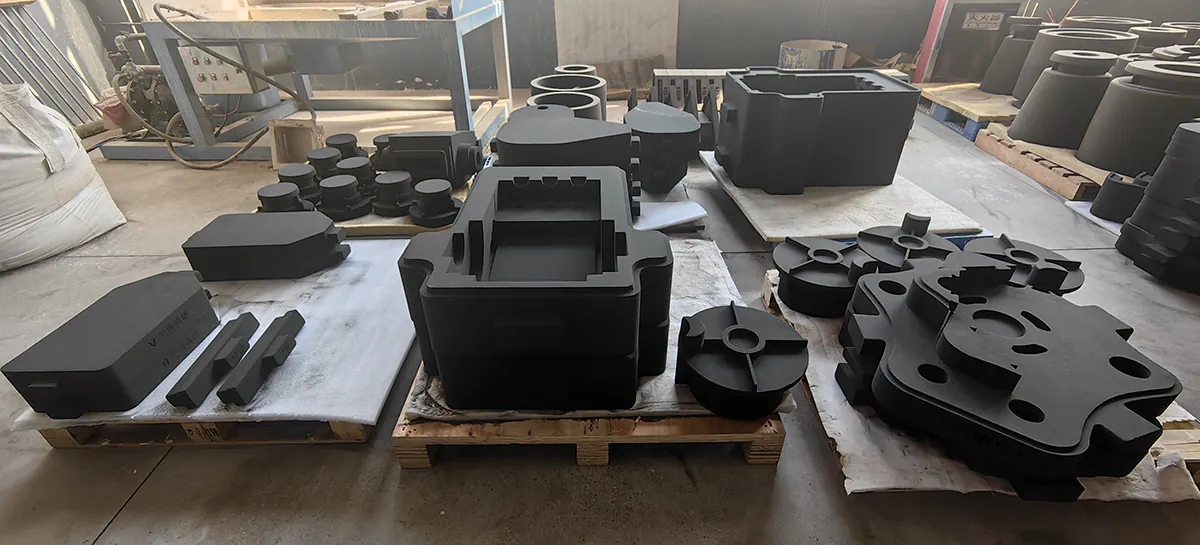
3DP molds come out of the machine as bonded sand with loose powder still inside the cavities. They are depowdered at a vacuum and brush station, then cured so the binder fully develops strength, coated to control surface finish and metal penetration, and sent to assembly. Because the mold is printed fast, the bottleneck for large 3DP parts is often this post-processing line, not the printer itself.
SLS parts emerge fully sintered. Loose powder is brushed and vacuumed off, and because the resin is already fused by the laser, there is no separate curing step — the part goes from the build box to inspection and assembly much faster relative to its print time. The LaserCore machines also print wax patterns in PSB material for investment casting, which is why the same SLS platform serves both sand cores and precision casting patterns.

In both cases, the core and mold meet at the same place: core assembly, mold close, and pour. The casting process downstream is identical — the difference is entirely upstream, in how fast and how precisely the tooling was made.
The 3DPTEK Lineup for Each Route
If you are evaluating equipment, 3DPTEK covers both processes with production machines.
On the SLS side, the LaserCore-5300 (700 × 700 × 500 mm, 150–400 cm³/h) is the precision workhorse for complex sand and wax patterns, and the LaserCore-6000 (1,050 × 1,050 × 650 mm, up to 120 W CO₂ laser) scales the same precision to larger parts and cores. Both use the same coated-sand material system, so you can qualify one feedstock across two machines.
On the 3DP side, the sand 3D printer lineup spans the practical foundry envelope: the J1800 and J1800S for small-to-medium molds and prototypes, the J2500 as the production workhorse, and the J4000/J4000Pro for large one-piece molds. Accuracy, speed, power, and footprint for every model are laid out in our sand 3D printer buyer’s guide.
Budget and payback are the other half of the decision. Our break-even analysis for sand 3D printers gives you the spreadsheet math, and the comparison against traditional pattern tooling is quantified in our sand binder jetting vs. traditional tooling guide.
For the SLS route the platform is the AFS-500 or LaserCore-5300; the 3DP route runs on the 3DPTEK J1800 and 3DPTEK J2500.
Frequently Asked Questions
Is SLS sand printing more accurate than 3DP binder jetting? Yes, on small features. SLS sand printing holds ±0.1 mm up to 100 mm, while 3DP inkjet systems are rated at ±0.3 mm up to 300 mm. For most foundry tolerances in the ±0.5–1 mm band, both processes pass — precision only matters at the tolerance edge.
Is SLS or 3DP faster for sand molds? 3DP by a wide margin. SLS forms 80–400 cm³ per hour; production 3DP sand printers are rated in liters per hour, with the large-format J4000 at 130–360 L/h and the J4000Pro at 1,090–1,744 L/h. SLS is a precision process, not a volume process.
Which is cheaper: SLS or 3DP sand printing? Per mold, 3DP is cheaper at any meaningful volume — the feedstock and cycle time are both lower. SLS’s higher per-mold cost is justified only when precision and core strength create value that offsets it, such as complex high-value cores.
Can SLS print large sand molds? Not like 3DP can. The largest SLS sand machine in the 3DPTEK range, the LaserCore-6000, has a 1,050 × 1,050 × 650 mm build box. 3DP machines reach 4,000 × 2,500 × 1,500 mm with flexible 4 m+ forming on the J4000Pro.
What are SLS sand cores used for? Slim, high-strength cores with demanding thermal loads — pipeline and oil-passage structures, thin sections, and cores that must survive turbulent pours. SLS coated-sand cores combine high strength with low gas evolution and refractoriness up to 1,700 °C.
Can you combine SLS and 3DP in one casting? Yes, and it is a proven production pattern: print the external mold with 3DP for speed and scale, and the demanding internal cores with SLS for precision. 3DPTEK’s 3DP+SLS composite pipeline has been selected into China’s MIIT typical application list for additive manufacturing.
Conclusion
SLS and 3DP sand printing are not rivals — they are two tools with different strengths. SLS wins on accuracy (±0.1 mm), core strength, and fine detail; 3DP wins on speed, build volume, and cost per mold at production scale. The right answer for your foundry depends on your part mix: precision cores and small tight-tolerance castings point to SLS, large or repeated molds point to 3DP, and the most demanding work is often a combination of both.
Related Reading
More process comparisons: metal binder jetting vs SLM, sand vs metal 3D printer for foundries, and sand casting vs investment casting.
The 3DPTEK range covers both routes, from the LaserCore SLS machines to the J1800-to-J4000Pro inkjet line, so you can match the process to the part instead of forcing one technology to do everything. Send us your quote request with a part list and current drawings — we will price the same job on both processes and let the numbers decide.


