
3Dプリントの砂型で何を作れるのか? 合金、部品、そして限界

Short answer: a 3D printed sand mold will cast just about any alloy your foundry can pour into a conventional sand mold — aluminum, gray and ductile iron, carbon and low-alloy steel, stainless steel, bronze and copper alloys all run in binder-jetted furan or phenolic sand. The printing step does not change the alloy; it replaces the pattern and the core box. What changes is the geometry economics: an internal oil gallery that once needed a dozen tooled core prints becomes one printed core, a draft-free surface stops costing anything, and a mold that would have waited 4–8 weeks on a €3,000–€15,000 machined pattern is on the pouring floor in days. The alloy table below is the honest per-alloy map for what you can cast with 3D printed sand molds — which metals cast superbly, which cast with caveats, and which belong to investment casting instead.
The direct answer: the mold doesn’t change the alloy, it changes the geometry economics
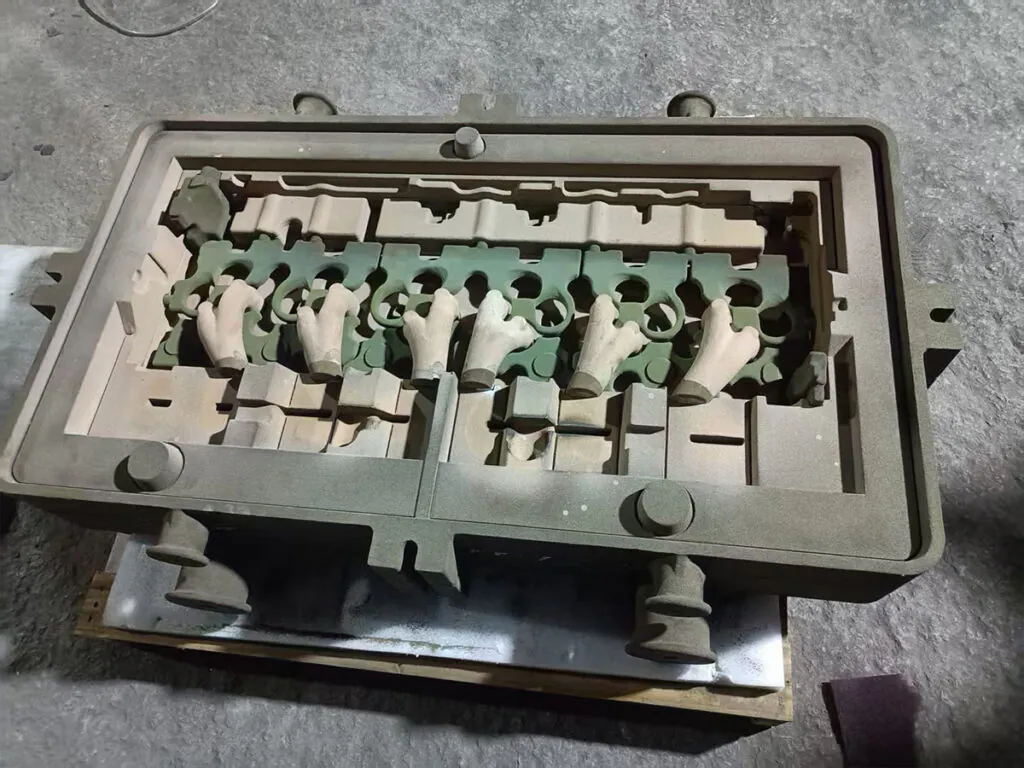
Sand binder jetting prints the same material foundries already pour into: silica sand bonded with furan or phenolic resin, the chemistry of conventional no-bake sand casting. A printed mold and a tooled no-bake mold are thermally and chemically equivalent. An A356 charge at roughly 720 °C, gray iron near 1380 °C, or steel at 1550–1650 °C does not know how its cavity was made. If your melting deck and pouring crew can cast an alloy in a conventional sand mold, they can cast it in a printed one.
The differences are mechanical, not metallurgical. Printed furan molds are hard and rigid — excellent for tall vertical walls and slender cores — but less permeable than rammed green sand, so venting and gas escape deserve more thought. You may adjust gating, add risers, or choose a coarser sand for heavy iron work, but you never choose a different alloy because of the printer. A foundry that pours steel pours steel into a printed mold; the feeding engineering is the same job it always was.
What genuinely changes is the geometry you can afford. No pattern means no draft angle to pay for and no parting line to design around. No core boxes means an impeller’s three-dimensionally curved vanes, or a cylinder head’s water jacket — conventionally eight to twelve separate cores assembled into a fragile core package — become one piece printed in one pass. That is why the question “what can you cast with 3D printed sand molds” is usually answered in practice by geometry and quantity rather than by alloy.
The real constraint is almost never the mold. It is the foundry around it: melting capability, pouring temperature control, cleaning and heat-treat capacity. If your shop already pours a given alloy for conventional sand castings, it already has everything needed to pour it into a printed mold. If it does not, the printer will not fix that — the investment that matters is on the melting side, not the printing side.
The alloy table: what casts well, what casts with caveats
Here is the honest matrix, based on what our customers and the wider foundry industry pour into printed sand molds. Ratings assume a properly set-up machine, sensible sand grain size, and a foundry that already casts the alloy conventionally.
| Alloy family | Castability with 3D printed sand molds | Typical parts |
|---|---|---|
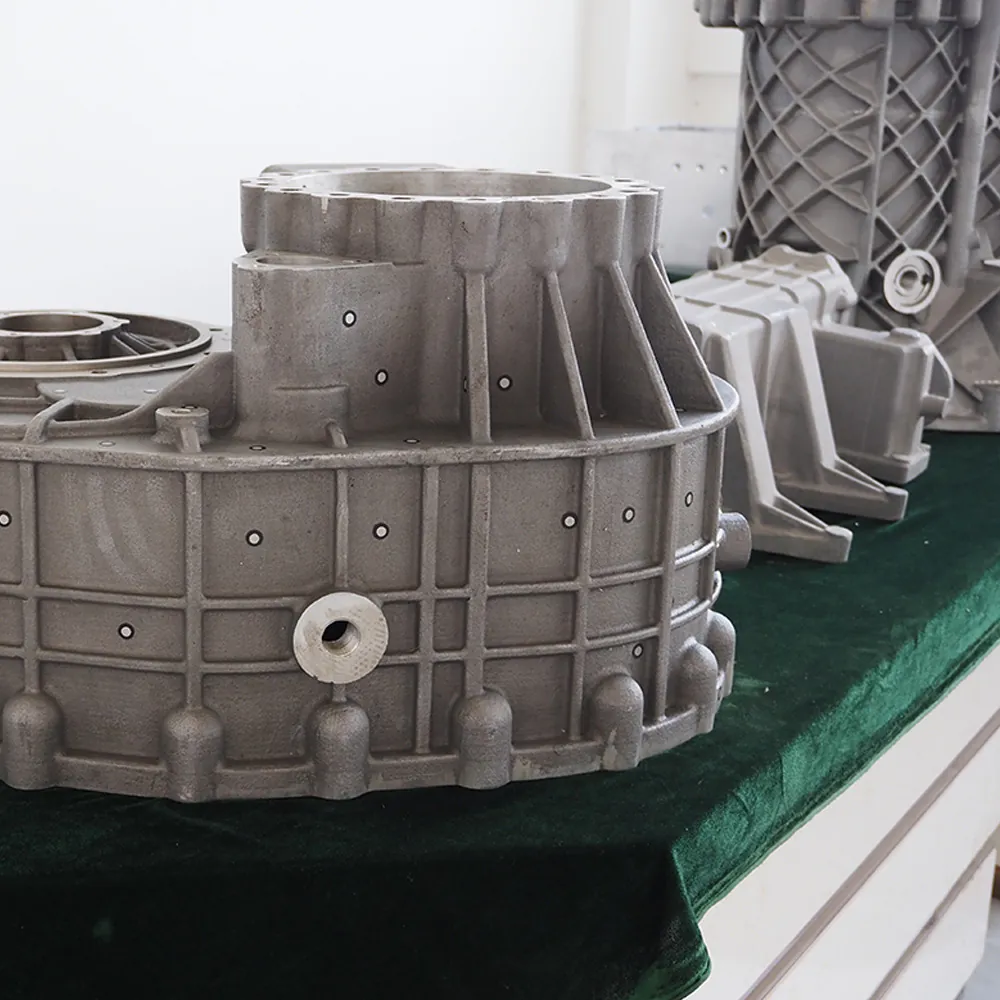
| Aluminum alloys (A356, A380, A206) | Excellent — low pour temperature (~700–750 °C), good fluidity, minimal mold-metal reaction | Engine blocks, cylinder heads, EV motor housings, gearboxes, impellers, structural brackets |
| Gray iron (GG25, class 30–45) | Excellent — the classic sand-casting alloy; predictable shrinkage and fluidity | Cylinder blocks and heads, valve bodies, brake components, machine bases |
| Ductile iron (GGG40/50, 60-40-18) | Excellent — strong, tough housings; nodulizing is foundry-side, not mold-side | Gear housings, pump casings, wind turbine components, hydraulic manifolds |
| Carbon & low-alloy steel (WCB, 1020, 4140) | Good — high pour temperature (~1550–1650 °C) and higher shrinkage demand sound risering | Pump and valve bodies, impellers, heavy equipment castings |
| Stainless steel (CF8, CF8M, 316L) | Good — same high-temperature care as steel; fluidity can be tighter in thin sections | Sanitary, marine and process valve and pump bodies, marine hardware |
| Bronze & copper alloys (C95800, C95400, tin bronze) | Good — moderate pour temperature; copper’s thermal conductivity can chill thin sections | Marine propellers, valve seats, bushings, bronze art and sculpture |
| Magnesium (AZ91, AM60) | Possible — low pour temperature, but oxidation and burn risk demand flux and protective handling | Lightweight housings, covers and brackets where weight is critical |
| Nickel-based superalloys (Inconel 718, 625) | Possible, but usually investment casting territory — high pour temperature, reactive metal, tight aerospace tolerances | Turbine hardware and aerospace structural parts (see the aerospace cores work below) |
Read “excellent” as routine foundry practice: standard print parameters, ordinary gating, first-pour success you can plan a production schedule around. “Good” means the same mold material with more attention to risering, gating and venting — steel’s solidification shrinkage and stainless’s tighter fluidity punish sloppy feeding. “Possible” means the mold is not the blocker; the foundry’s melting and handling capability is. Magnesium needs flux and protective practice before it ever sees the mold, and a nickel superalloy pour is an exotic operation regardless of what the mold is made of.
One clarification while we are here, because the phrase “casting alloys for 3D printing” causes real confusion: you do not 3D print the alloy. The alloy is poured, molten, exactly as it would be in any sand foundry. What is 3D printed is the mold and the cores. The practical consequence is that your existing alloy inventory, heat-treat schedules and material certifications carry straight over — a printed mold is not a new material qualification, it is a new way of making the cavity.
Typical parts by industry: where printed molds earn their keep
Automotive and powertrain sit at the center of this technology. Cast iron sand casting of cylinder blocks and heads remains the largest single application, and cylinder head casting with printed water-jacket cores is now routine work in foundries that supply tier-one and OEM programs. Our lightweighting case study shows a block redesigned around printed cores rather than tooled ones, cutting wall thickness where a pattern could never reach. BMW’s Landshut light-metal plant has run printed sand cores in production engine casting for years, which is a useful counter to anyone who still thinks binder jetting is prototype-only.
The EV transition has added a second powertrain pillar. Electric motor housings need thin, consistent walls for cooling, integrated coolant channels, and cast-in features that hold motor and gearbox tolerances — exactly the geometry that costs a fortune in tooling and almost nothing in print. Our EVモーターハウジングの事例研究 walks through a housing that shed weight and machining by redesigning the core package.
Pumps, valves and hydraulics are the quiet workhorses. Impellers with sculpted, three-dimensionally curved vanes are nearly impossible to tool economically and trivial to print, which is why pump and valve makers were among the earliest production users of printed molds; the complex impeller case study covers the design-to-pour flow. Valve bodies in cast iron, ductile iron and stainless CF8M — for process, sanitary and marine duty — follow the same logic: complex internal flow passages, modest quantities, long service life.
Energy equipment leans on the same strengths at larger scale. Wind turbine housings and gearbox components are poured in ductile iron from printed molds — see the 風力タービンハウジングの事例研究 — and gas-insulated switchgear (GIS) manufacturers cast aluminum housings for ultra-high-voltage applications with integrated bushing and cable ports that a pattern simply cannot form; the GIS casting case study details the tolerances involved.
Defense work rarely appears in case studies for obvious reasons, but it is a steady user: single-piece housings, thin-wall enclosures, and small-run components where tooling spend is unjustified and delivery speed matters. And at the opposite end of the scale, bronze art and sculpture — one-off pieces where a pattern would be pure waste — is a growing niche; the bronze art casting study shows a commissioned piece going from CAD to bronze in days.
Aerospace uses printed sand in two ways: directly, for structural castings in aluminum and steel where the part geometry justifies it, and indirectly, where printed sand cores are used inside investment-cast components to form passages that wax tooling cannot. The aerospace sand cores case study explains both routes.
What you cannot cast: the honest limits
Furan and phenolic sand molds are strong, but they are still sand. Three families of parts do not belong on a printed mold, and any vendor who tells you otherwise is not quoting your geometry honestly.
Massive, heavy sections. A sand mold feeds a casting through risers and chills, and beyond a certain section size the mold itself cannot cool the metal fast enough to avoid hot spots and shrinkage porosity. The fix is chills, densifiers, or a different process — not a bigger printer. If your part is essentially a solid block of metal with a few features, sand casting in any form is the wrong tool, printed or not.
Extremely thin, tight-tolerance walls. Below a practical minimum wall thickness, mold surface roughness and alloy fluidity make consistent thin sections unreliable, and the tolerance you can hold in sand casting is what it always was — sand castings get machined where it matters. Parts that need near-net thin-wall geometry with tight tolerances are investment casting territory, with ceramic shells, and sand printing does not pretend otherwise. If your drawing is full of ±0.1 mm thin-wall features, this is the wrong conversation.
High-volume simple parts. If the part is a simple open shape and you need tens of thousands a year, pattern tooling amortizes down to pennies per part, while a printed mold costs roughly the same whether you make one or ten thousand. The breakeven logic — complexity and quantity against tooling cost — is worked through in our 費用ガイド, and it is the question we ask before we quote.
Alloys that need special molding conditions. Titanium reacts with silica sand and is cast in dedicated reactive-metal foundries with special mold materials — not a binder-jetting job. Very high-melting or highly reactive alloys generally belong in investment casting with ceramic shells, and nickel superalloys, although physically pourable into sand, are almost always investment-cast because aerospace tolerance and surface requirements exceed what any sand mold holds.
How part geometry drives the decision
Geometry is the real selector, more than alloy or quantity. Complex internal geometry — cores — is where printing wins outright. An impeller with sculpted vanes, a cylinder head water jacket, a manifold with crossing passages: these used to be tooling projects measured in weeks and tens of thousands of euros. Printed, they are measured in days. The more core complexity in the part, the stronger the case for binder jetting, and the more of the part’s value lives in the mold rather than the pattern.
Simple open shapes flip the math. A flat plate, a bracket, a housing with no internal passages: the pattern is cheap, reusable, and at any meaningful quantity the tooled route wins on cost per part. Nobody prints a flange. The honest rule of thumb we give customers: if the part’s complexity is on the outside and there is nothing inside, it probably belongs on a pattern; if the value is inside — cores, passages, draft-free walls — it belongs on a printer.
Quantity is the second axis, and it interacts with geometry. Prototypes, first articles, low-volume production and spares all favor printing, because the per-mold cost is flat and the lead time is days. Volume production of a stable design favors tooling, because the pattern cost spreads across thousands of parts. And the most common production pattern of all is the hybrid: print only the complex cores, keep a conventional pattern mold for the outer shape. That is how many production foundries actually run it, and it is the lowest-risk way to adopt the technology.
Build envelope sets the outer limit. A 3DPTEK J1800 prints an 1,800 × 1,000 × 700 mm block; the J2500 stretches that to 2,500 × 1,500 × 1,000 mm; the J4000Pro handles 4,000 × 2,500 × 1,500 mm molds. That is why large wind turbine and GIS housings can be printed in one piece instead of segmented and doweled, and it is worth checking against your largest mold envelope before you commit to a machine — the sand 3D printer product line page lists the full range with build volumes and configuration options.
If you are weighing whether a specific part — or a basket of parts — belongs on a printed sand mold, send us the drawing and the annual quantity. We quote honestly, and when a part is better as a pattern job we say so and show the math. Request a formal quotation at our contact page and you will get a mold-versus-tooling comparison for your actual geometry, not a generic sales pitch.
3DPTEKのエンジニアリングチームによる執筆です。このチームは、当社の鋳造所や砂型3Dプリンターを日常の生産現場で運用しているのと同じチームです。 3DPTEKについて.
よくある質問
Can you cast aluminum with 3D printed sand molds?
Yes — aluminum is the most common alloy poured into printed sand molds, and it is the easiest to work with. A356, A357 and similar sand-casting alloys pour at around 700–750 °C, comfortably inside what furan-bonded sand handles, with good fluidity for complex thin-walled cores. Typical parts are engine blocks and cylinder heads, EV motor housings, gearboxes, impellers and structural brackets, all cast with standard foundry practice. Because the pour temperature is low, aluminum also shows the best surface finish of the common alloys.
Can you cast iron with 3D printed sand molds?
Yes — gray and ductile iron are among the best-suited alloys, and iron foundries were the earliest production adopters of sand binder jetting. The mold is the same furan-bonded silica sand used in conventional iron casting, poured at roughly 1350–1450 °C. Gray iron (GG25 and similar) is the classic choice for cylinder blocks, heads, valve bodies and machine bases; ductile iron (GGG40/50, 60-40-18) adds strength and toughness for gear housings, pump casings and wind turbine components. Shrinkage behavior is predictable, which makes first-pour success high.
Can you cast steel or stainless steel?
Yes, with the caveats you would expect from any steel sand casting. Carbon and low-alloy grades (WCB, 1020, 4140) and stainless cast grades (CF8, CF8M, 316L) pour at 1550–1650 °C, and the printed mold survives those temperatures — but steel’s solidification shrinkage demands sound risering, and stainless’s tighter fluidity makes very thin sections harder to fill. Steel and stainless are “good” rather than “excellent” in the table above: same mold material, more feeding discipline, and a foundry that already melts steel. Pump and valve bodies, impellers and marine hardware are the common applications.
Can you cast bronze and copper alloys?
Yes. Tin bronze, aluminum bronze (C95800), and other copper alloys pour around 1050–1150 °C, and they cast cleanly in printed sand molds. The one thing to manage is copper’s high thermal conductivity, which pulls heat out of thin sections quickly and can cause chill defects if sections are unbalanced — the same issue you would have in a conventional mold. Bronze is the classic material for printed-mold art casting, where one-off sculptures would make a pattern absurd; marine propellers, valve seats and bushings are the industrial uses.
What can’t you cast with a 3D printed sand mold?
The same things you cannot cast in any sand mold: massive heavy sections that a sand mold cannot feed without shrinkage porosity; extremely thin, tight-tolerance walls that belong in investment casting with ceramic shells; and alloys that need special molding conditions, such as titanium, which reacts with silica sand. High-volume simple parts are also a poor fit — pattern tooling beats printing on cost per part once quantities climb. The mold does not create new limits; it inherits all the normal limits of sand casting, and the honest conversation is about geometry and quantity, not alloy.
What surface quality can you expect?
Surface quality from a printed sand mold is comparable to a good no-bake sand casting: visibly rougher than machined or investment-cast surfaces, and suitable for parts that will be machined on functional faces. Layer thickness on the machine (0.28–0.4 mm) can faintly imprint on flat mold surfaces, but in practice the coating and the pour wash most of that away, and the dominant factors are sand grain size and mold wash, exactly as in conventional casting. Expect the same tolerance reality as sand casting generally: hold the macro geometry, machine the datums. Our 購入ガイド goes into accuracy expectations in more depth.


