
Gravity casting: the cheapest sound route to an aluminum or copper part
Gravity casting pours metal into the mould under nothing but its own weight. That sounds like a limitation and is actually the point — no pressure vessel, no die set, and no pattern bill, which is why it is usually the lowest-cost way to make a medium-complexity part from a drawing.
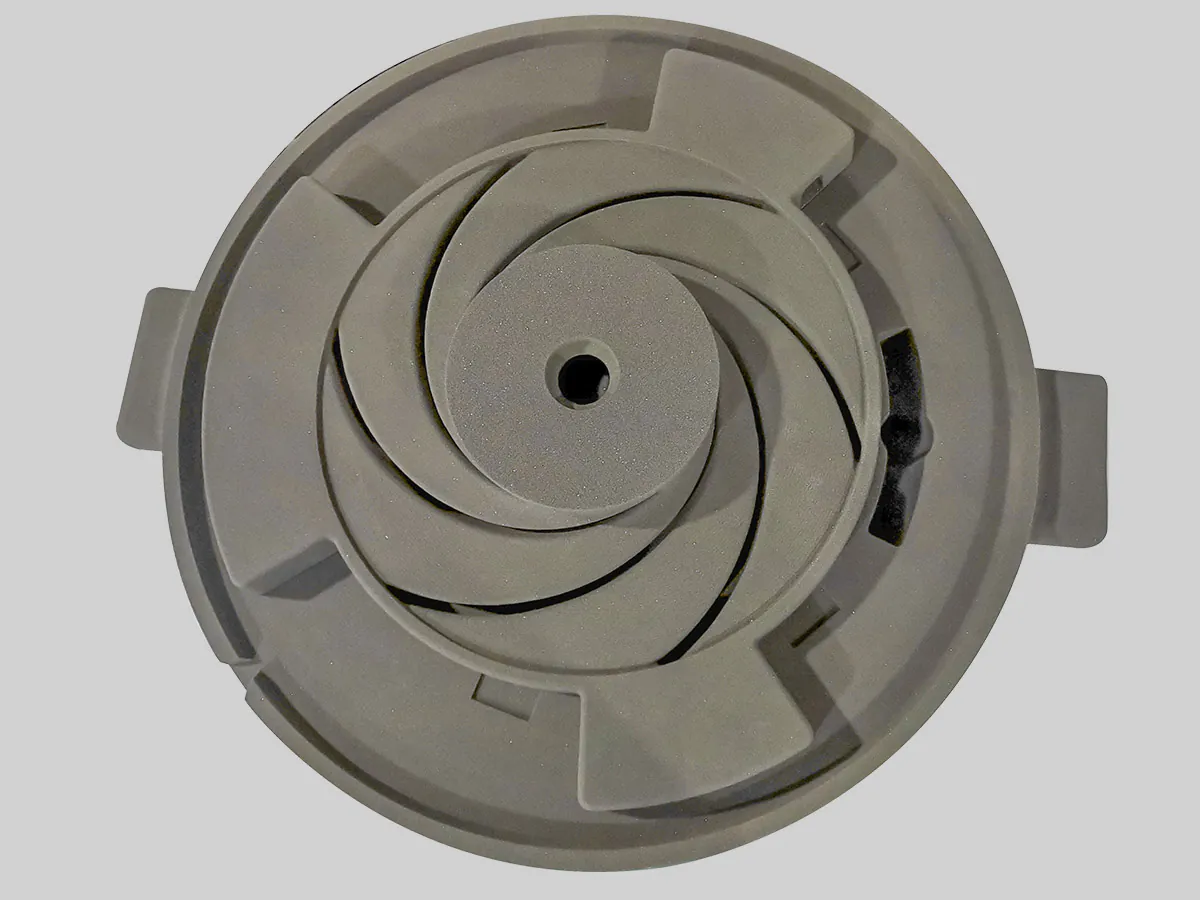
Printed from your CAD
The mould is printed directly from the model — no pattern, no tooling, which is what makes a single casting economic.

Cores set into the mould
Printed sand cores go into the mould as one assembly, so there is no joint line in the internal passages or the water jacket.

Poured, cleaned and machined
Metal enters under its own weight, the casting is knocked out, shot blasted, heat treated and machined to the faces that need it.
Gravity casting is the process of pouring molten metal into a mould cavity and letting its own weight fill the shape, with no applied pressure and no vacuum. It works in sand moulds, in machined steel moulds and in graphite. We run it for aluminum and copper alloys, in both sand and permanent moulds, and it is the route we recommend first whenever a part is thick-walled, medium in complexity and cost-sensitive.
Why gravity casting is usually the cheapest sound route
Three costs decide a casting project: the tooling, the metal, and the yield. Gravity casting is competitive on all three, and it is the only route where the first two are close to zero for a one-off part.
No pressure vessel, no die set
Low-pressure casting needs a sealed furnace and a riser tube; die casting needs a hardened steel die. Gravity casting needs a mould. If the mould is sand, and we printed it, there is no pattern and no tooling to amortise at all.
Thicker sections are not a problem
Gravity is at its best where the metal is thick. Feeding a heavy section from a riser works, because there is time and thermal mass to do it. Thin walls are where gravity struggles — that is a different process.
Reusable moulds pay back fast
In a permanent steel mould the same cavity runs for thousands of parts. Above a few hundred pieces the mould cost per part falls below the cost of printing a fresh sand mould each time.
Metal choice stays open
Because there is no pressure system to seal and no die to erode, gravity casting handles aluminum and copper alloys in the same shop with the same tooling philosophy. We pour both.
Two ways to run it: sand mould or metal mould
Gravity casting is not one process. The mould decides almost everything about cost, tolerance and surface finish, so this is the first question on any gravity job.
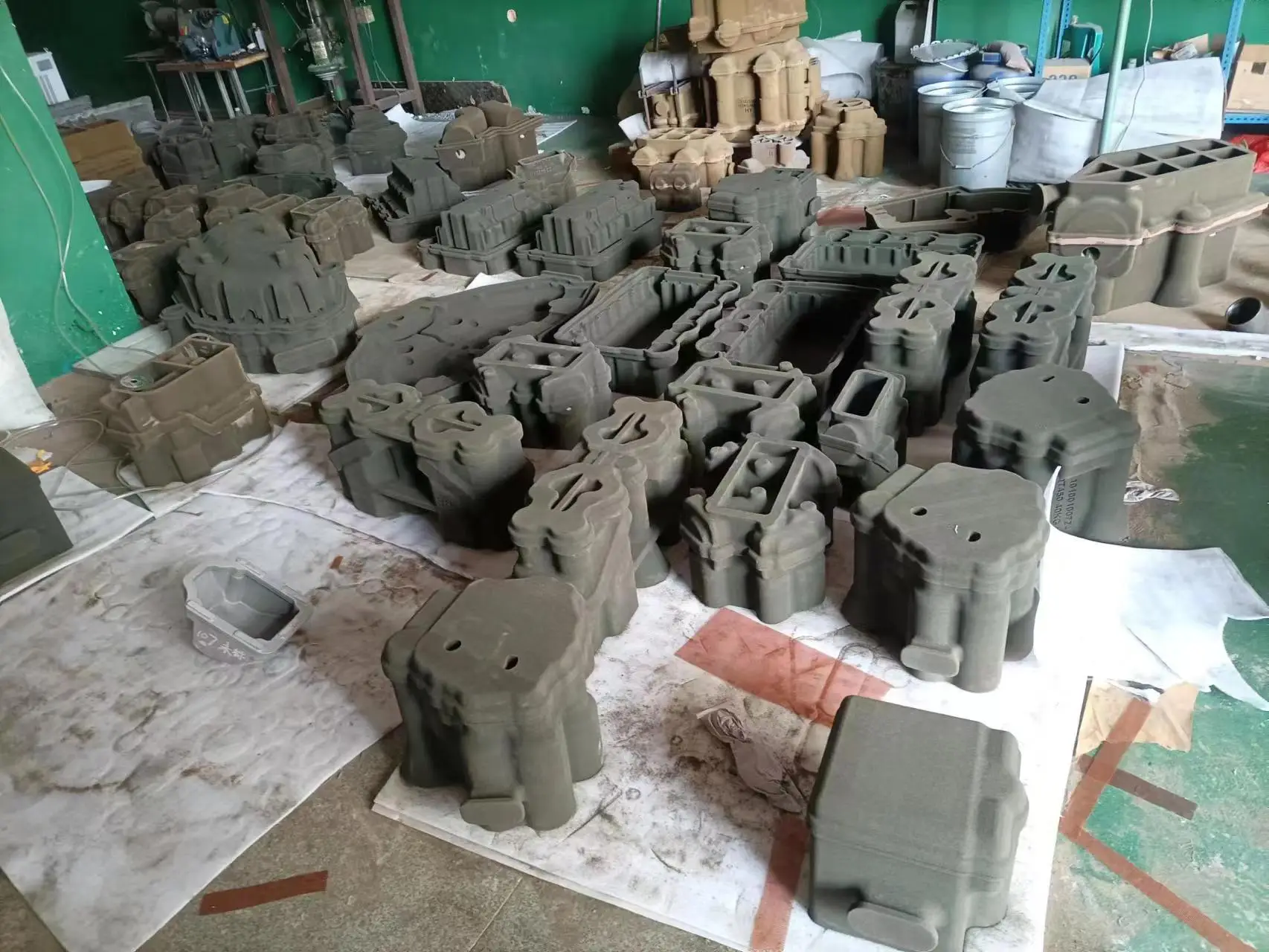
Gravity casting in sand moulds
The cavity is formed in bonded sand and destroyed when the part is knocked out. The mould costs almost nothing per unit, so this is the route for prototypes, one-offs and anything still being changed.
- No pattern cost when the mould is printed from CAD
- Better for large parts and for heavy sections
- CT8 to CT12 as cast, Ra 12.5 to 25
- Design changes cost a reprint, not a new die
- Aluminum to a 5 m envelope, copper to 3 m
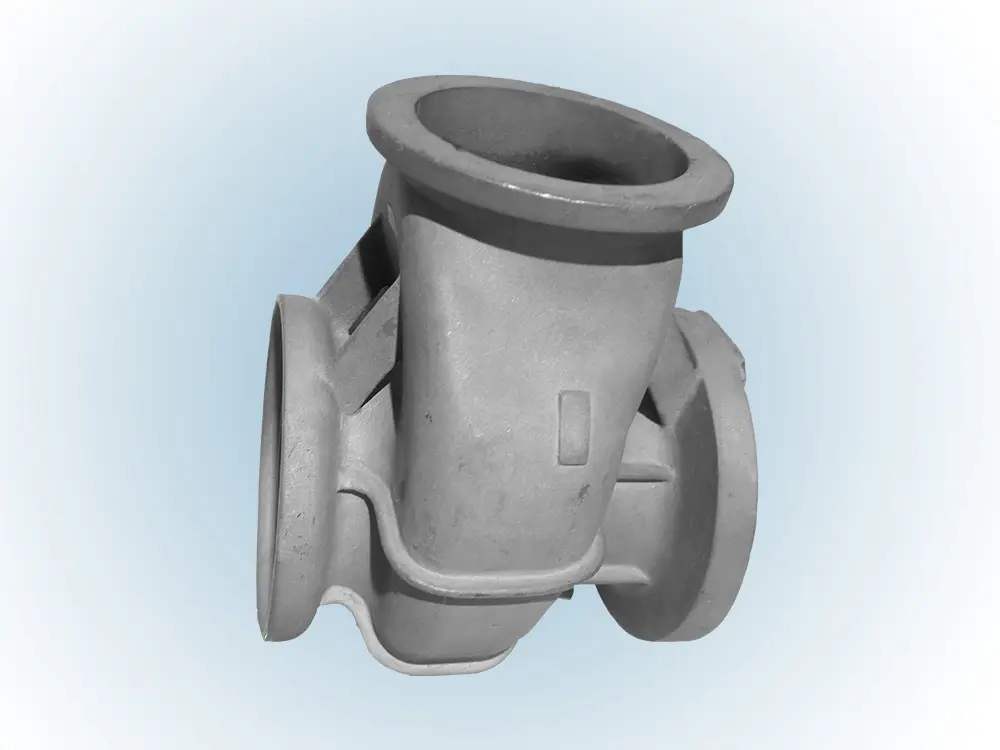
Gravity casting in permanent moulds
Also called gravity die casting or permanent mould casting: the cavity is machined into a steel mould that is reused. You pay once, then the per-part cost drops sharply.
- Better surface and tighter tolerance than sand
- CT7 to CT9 as cast, Ra 6.3 to 12.5
- Finer grain from the faster chill of a steel mould
- Economics improve sharply above a few hundred pieces
- Geometry must release from the mould — no undercuts
We run both, so the recommendation is not a sales preference. If your part sits on the line between them, we will quote both and tell you where the crossover volume falls.
Does gravity casting need a sand 3D printer?
It depends on which mould your part needs — the fork from the section above — and the answer is different for each.
Sand mould: yes, and it is the whole point
Gravity casting in sand normally needs a pattern: a positive made by a patternmaker, used to form the cavity. We print the mould and its cores straight from your CAD file instead. No pattern, no pattern cost, no pattern lead time — which is what makes a single gravity casting economic rather than a special case.
Permanent steel mould: no
That mould is machined, not printed, and the printer plays no part in it. The economics of permanent-mould gravity work are driven by the die and the volume, and we will tell you where that crossover sits for your part.
The printers that make gravity moulds
We build the machines as well as run them, so the equipment on our own gravity line is the equipment we sell to foundries. Two models cover the gravity work: one for moulds and cores up to about a metre, one for the large moulds behind a 5 m aluminum envelope.

3DPTEK-J1800
The workhorse. Covers most gravity moulds and cores, and every one-off pattern you would otherwise have to make.
- Build size
- 1800 x 1000 x 700 mm
- Printheads
- 8
- Build rate
- 18 to 23 s / layer
- Accuracy
- ±0.3 mm

3DPTEK-J4000
Large format. For the moulds behind oversize gravity castings, printed in one piece instead of assembled from sections.
- Build size
- 3800 x 1850 x 1000 mm
- Printheads
- 16
- Throughput
- 130 to 360 L / h
- Accuracy
- ±0.5 mm
Both machines print silica or ceramic sand with furan or phenolic resin, hold a mould tensile strength of 1.5 to 2.5 MPa and keep gas evolution between 8 and 15 ml/g at 850 °C. That is the same chemistry a traditional no-bake line runs, so a printed mould behaves like a mould your foundry already knows.
What we pour by gravity
Gravity casting carries two of our four alloy families. The limits below are the real ones from our own foundries, not catalogue maxima.
| Alloy family | Grades | Processes on this metal | Largest single pour | Largest size | Capacity a year |
|---|---|---|---|---|---|
| Aluminum | ZL101A, ZL114A, A356, A360 | Gravity, low-pressure, permanent-mould low-pressure, plaster-mould precision | 1 t | 5 m | 1,000 t |
| Copper alloys | Silicon bronze and related | Gravity, investment casting | 2 t | 3 m | 2,000 t |
Copper is the reason gravity casting matters more than people expect. Silicon bronze pours at a higher temperature and is far less tolerant of turbulence than aluminum, so a bottom-gated gravity pour with a properly fed riser is often the only route that produces a sound pump body, valve or marine fitting without porosity.
Aluminum, up to 5 m
Housings, covers, brackets, gearbox cases and impellers. Heat treated to T5 or T6 in the same building, in a 2 m diameter furnace, so quench delay stays a process variable rather than a shipping decision.
Copper alloys, up to 3 m
Pump bodies, valve bodies, marine fittings and wear parts in silicon bronze. Poured with a 1 t medium-frequency furnace dedicated to copper, so the melt is not shared with aluminum.
Gravity castings we have poured
A sample of recent gravity work across both alloy families. Every one of these started as a CAD file, and the mould or core behind it was printed rather than cut from a pattern.


The gravity line
Gravity casting only works if the metal arrives at the right temperature and the mould is strong enough to hold it. That is an equipment question, so here is the equipment.
Pouring
- Gravity pouring machine
- Reverse pouring machine
- 500 kg low-pressure casting machine
- 30 kg liquid-squeeze casting machine
Melting
- 1 t tilting aluminum melting furnace
- 1 t medium-frequency furnace for copper
- Medium-frequency furnaces, induction stirred
- Spectrographic chemistry check per heat
Moulding
- 10 t resin sand mixer, strength to 9.5
- 958 coated-sand shell core machine, 1 core / 5 min
- Continuous sand mixer
- Printed sand moulds and cores from CAD
Finishing and heat treatment
- 25 t heat treatment and ageing furnace
- 2 m diameter solution furnace
- Explosion-proof hook-type shot blaster
- 10 t crane, cutting and table saws


Gravity casting against low-pressure and die casting
Most gravity casting projects are really a choice between these four routes. The table is the whole decision, so read the row that constrains your part rather than the column you prefer.
| What decides it | Gravity, sand mould | Gravity, permanent mould | Low-pressure | High-pressure die casting |
|---|---|---|---|---|
| Tooling cost | None if the mould is printed | One steel mould, reused | Sealed furnace plus riser tube | Hardened steel die, highest of the four |
| Best volume | 1 to a few hundred | A few hundred upward | Hundreds to thousands | Tens of thousands |
| Minimum wall | 8 mm and up is comfortable | 5 to 6 mm | 4 mm on a good day | Under 2 mm possible |
| As-cast tolerance | CT8 to CT12 | CT7 to CT9 | CT6 to CT9 | CT4 to CT7 |
| Surface, as cast | Ra 12.5 to 25 | Ra 6.3 to 12.5 | Ra 6.3 to 12.5 | Ra 1.6 to 6.3 |
| Leak-tight parts | Possible with proper feeding, not automatic | Better than sand, still feed-dependent | Best of the four for porosity | Good, but gating is unforgiving |
| Large parts | Best — 5 m in aluminum | Limited by the machine and the die | Limited by furnace size | Smallest of the four |
| Do we run it | Yes | Yes | Yes | No |
We do not run high-pressure die casting, and we will say so rather than quote around it. If your part is designed for a die-cast wall thickness, the honest answer is that gravity casting will not hold it and you should stay with a die caster. If it is thicker-walled and the volume is under a few thousand, gravity casting is usually the cheaper answer.
Tolerance, draft and machining allowance
Casting drawings are usually specified to a tolerance grade from GB/T 6414, the Chinese adoption of ISO 8062-3. Lower numbers are tighter.
| Mould type | As-cast tolerance grade | Surface roughness, as cast | Minimum draft |
|---|---|---|---|
| Sand mould, no-bake | DCTG 8 to 12 | Ra 12.5 to 25 | 1 to 1.5 degrees |
| Permanent steel mould | DCTG 7 to 9 | Ra 6.3 to 12.5 | 1.5 to 2 degrees, must release |
| Our working range | CT8 to CT9 | Ra 6.3 to 12.5 | Agreed per face at quotation |
| Minimum wall, aluminum | 5 mm permanent mould, 8 mm sand | — | — |
| Minimum wall, copper alloy | 6 mm permanent mould, 10 mm sand | — | — |
Draft is the difference between a gravity job that works and one that tears the mould. A permanent mould has to be able to open, so a vertical face with no draft will drag and scrap the part. On printed sand moulds draft still helps, because the sand has to survive the pour without a weak edge breaking off into the cavity.
Machining allowance is agreed per face rather than applied as a blanket number. A face that will be milled needs enough metal to clean up after the casting moves; a face that stays as cast needs none, and adding it wastes both metal and machining time.
Defects gravity casting is prone to, and what we do about them
Gravity casting has no pressure to push metal into the last place it freezes, so its failure modes are predictable. All six of these are designed out at the gating stage rather than inspected out afterwards.
Shrinkage porosity
The heavy section freezes last with nothing left to feed it. Gravity has no pressure to push metal into that last pocket, so it either gets fed by a riser or it becomes a void.
Misruns and cold shuts
Metal freezes before it reaches the far end of the cavity, or two streams meet and fail to fuse. Usually a pour-temperature or fill-time problem rather than a design one.
Gas porosity
Hydrogen absorbed by the melt and released as it solidifies. Worse in humid weather and with damp charge material, and invisible until the part is machined.
Sand burn-on and veining
Metal penetrates the mould surface, or a thin fin forms along a core edge. Driven by resin content and mould hardness more than by the sand itself.
Hot tears
The casting is restrained while it contracts and cracks at a sharp internal corner. Made worse by mould strength that is higher than the geometry can tolerate.
Dimensional drift after machining
Residual stress releases when metal is removed, so a face that measured true moves after the first cut. Or the temper is wrong for the service temperature.
Where gravity casting pays off
Gravity casting wins on thick-walled, medium-complexity parts where the volume does not justify a die and the geometry does not demand low-pressure density.
Pumps, valves and marine fittings
Body and impeller castings in silicon bronze and aluminum, where corrosion resistance matters and the wall is thick enough to feed properly. Pressure tested before dispatch.
Industrial machinery housings
Gearbox cases, bearing housings and machine frames in aluminum. Medium complexity, modest volume, and often still being iterated — which is exactly where a printed sand mould beats a die.
Electrical and switchgear parts
Copper and aluminum conductors, shields and enclosures where conductivity and pressure-tightness decide the process. Gravity and low-pressure run side by side on this work.
Architectural and decorative bronze
Plaster and sand moulds for statuary and architectural components, where surface finish and alloy colour matter more than dimensional tolerance.
Wear parts and bushings
Bronze bushings, wear plates and sliding components, where the alloy is chosen for bearing behaviour and the shape is simple enough that a permanent mould pays for itself.
Large one-off aluminum parts
Up to a 5 m envelope at a single piece. No other route gets there without a pattern, which is why gravity plus a printed mould is the standard answer for oversize aluminum.
Gravity casting or something else?
Four questions settle it. None of them require you to know the process names first.
Is the wall thinner than 5 mm?
Then gravity is the wrong answer and low-pressure casting is the right one. Gravity cannot reliably fill a thin section before it freezes, and no amount of gating cleverness fixes that.
Does it have to hold pressure with no leaks?
Low-pressure or squeeze casting first. Gravity can be made leak-tight with a properly fed riser, and often is, but it is the harder route to get there and we will say so at quotation.
How many, and will the design change?
One to a few hundred, or anything still moving — gravity in a printed sand mould. Above a few hundred with a frozen drawing — gravity in a permanent steel mould, and the mould pays for itself.
Is it bigger than about 1.5 m?
Gravity in a sand mould, almost regardless of volume, because the die or permanent mould for a part that size would cost more than the whole production run.
Related casting routes
- Low pressure casting
The same printed mould, filled from below — the route for pressure-tight aluminium housings.
- Ductile iron casting
Ferrous instead of aluminium: QT400 to QT700 sand cast in printed moulds.
- Cast steel casting
Carbon, low-alloy and stainless steel when aluminium will not carry the duty.
- Bronze and brass casting
Copper alloys on the same gravity route, for bearings, marine and art work.
- Precision investment casting
The wax route, when the geometry is thin-walled and intricate rather than heavy.
Questions we get before a first gravity order
What is the difference between gravity casting and gravity die casting?
Same filling principle, different mould. Gravity sand casting uses a bonded sand cavity that is destroyed to release the part. Gravity die casting — also called permanent mould casting — uses a machined steel mould that opens and is reused. The metal still enters under its own weight in both.
Which alloys do you pour by gravity?
Aluminum — ZL101A, ZL114A, A356 and A360 — and copper alloys, mainly silicon bronze. Aluminum runs up to 1 t in a single pour and a 5 m envelope; copper runs to 2 t and 3 m.
What tolerance can you hold as cast?
CT8 to CT12 in a sand mould and CT7 to CT9 in a permanent mould. Where a feature needs tighter than that, the economical answer is almost always to machine the feature rather than tighten the whole casting.
Do you need a pattern?
No. We print the sand mould and cores directly from your CAD file, so there is no pattern to make and no pattern cost to write off if the design changes. That is what makes a single gravity casting economic.
Can you heat treat it?
Yes, in house. T5, T6 and T7 run in the same building as the casting, in a 2 m diameter solution furnace alongside a 25 t heat treatment and ageing furnace. Quench delay stays under our control rather than becoming a shipping decision.
How thick does the wall need to be?
For aluminum, 8 mm and up is comfortable in a sand mould and 5 to 6 mm in a permanent mould. For copper alloys add a couple of millimetres, because the metal is less fluid and freezes faster in a cold mould.
Is gravity casting cheaper than low-pressure casting?
Usually, for a part gravity can actually make. There is no sealed furnace to build and no riser tube to maintain, and if the mould is printed there is no tooling at all. The moment the part needs a thin wall or guaranteed leak-tightness, low-pressure becomes the cheaper route because it works the first time.
What is the smallest batch?
One piece. Printing the mould removes the pattern, so a single gravity casting is a normal order rather than a special case.
Send the drawing, get a route and a price
Send a model and we will come back within 24 hours with the route we would run, the alloy we would specify, the machining allowance we would leave, and a price. If gravity is the wrong process for your part, we will tell you which one is.