
¿Es la impresión 3D con arena más barata que la fundición tradicional? El cálculo real de los costes

Is 3D sand printing cheaper than traditional casting? For small runs, complex cores, and short lead times, yes — often by a wide margin. For simple, high-volume parts, no: a machined pattern costing €3,000–€15,000 with a 4–8 week lead time is still the cheapest way to produce ten thousand molds. Everything in between is a breakeven calculation, and most complex parts cross that line well before 50–100 pieces, because 3D printing removes the pattern entirely. The full breakdowns live in our traditional vs. patternless casting comparison, the tooling cost math in our sand binder jetting vs. traditional tooling guide, and the complete sand 3D printing cost guide. This page gives you the verdict and the decision rule.

The direct answer: yes for small runs and complex cores, no for simple high volume
Treat this as a decision rule, not a blanket claim. You can settle most quotations in under a minute by asking two questions: how complex is the part, and how many do you need in the next twelve months? If the answer is “complex” and “less than a few hundred”, 3D sand printing is cheaper before you finish the sentence. If the answer is “simple” and “thousands”, traditional tooling wins. The middle ground — simple parts in small quantities, or complex parts in genuinely large quantities — is where the breakeven table below decides.
The industry is already voting with purchase orders. At INTERMOLD Nagoya 2025, an industry survey found that roughly 40% of large Japanese foundries use 3D-printed sand molds in prototyping, and the standard comparison was a wooden pattern taking two weeks versus a printed mold in two days — a tenfold reduction. Toyota’s supply chain has been insourcing complex castings rather than re-tooling them overseas, precisely because small batches no longer justify a pattern investment. Even in Europe, where pattern shops are the backbone of tooling supply, a 4–8 week pattern lead time is quoted as routine — time a printed mold simply does not consume.
BMW’s Landshut light-metal foundry has produced complex cylinder-head cores additively for more than a decade. Those cores — thin, angled water-jacket passages that are brutal to tool — are exactly the geometry where conventional core boxes become expensive and fragile. The economics that justified Landshut are the same ones this page describes: when tooling cost and tooling risk are the biggest line items, eliminating them beats optimizing them. If a Tier-1 automotive foundry runs sand printing for production cores, the question is no longer whether it can be cheaper, but when your part crosses the line.
The Japanese data also shows why this matters for small shops: the Japan Foundry Engineering Society reports that roughly 75% of iron foundries employ 30 people or fewer. A €10,000 pattern is a serious capital decision for a 25-person foundry; a printed mold that costs tens of euros and arrives in two days is not. Batch sizes in that segment are small by definition, which is precisely the regime where 3D sand printing wins.
Where the cost difference actually comes from
The entire cost difference reduces to one fixed cost: the pattern. A machined pattern — the wooden or resin master used to ram green-sand or no-bake molds — typically costs €3,000–€15,000 and takes 4–8 weeks to make. If the casting needs cores, the tooling multiplies: every core requires its own core box, and complex cores can cost more than the pattern itself. That money is spent before a single mold exists, and it is spent again every time the design changes.
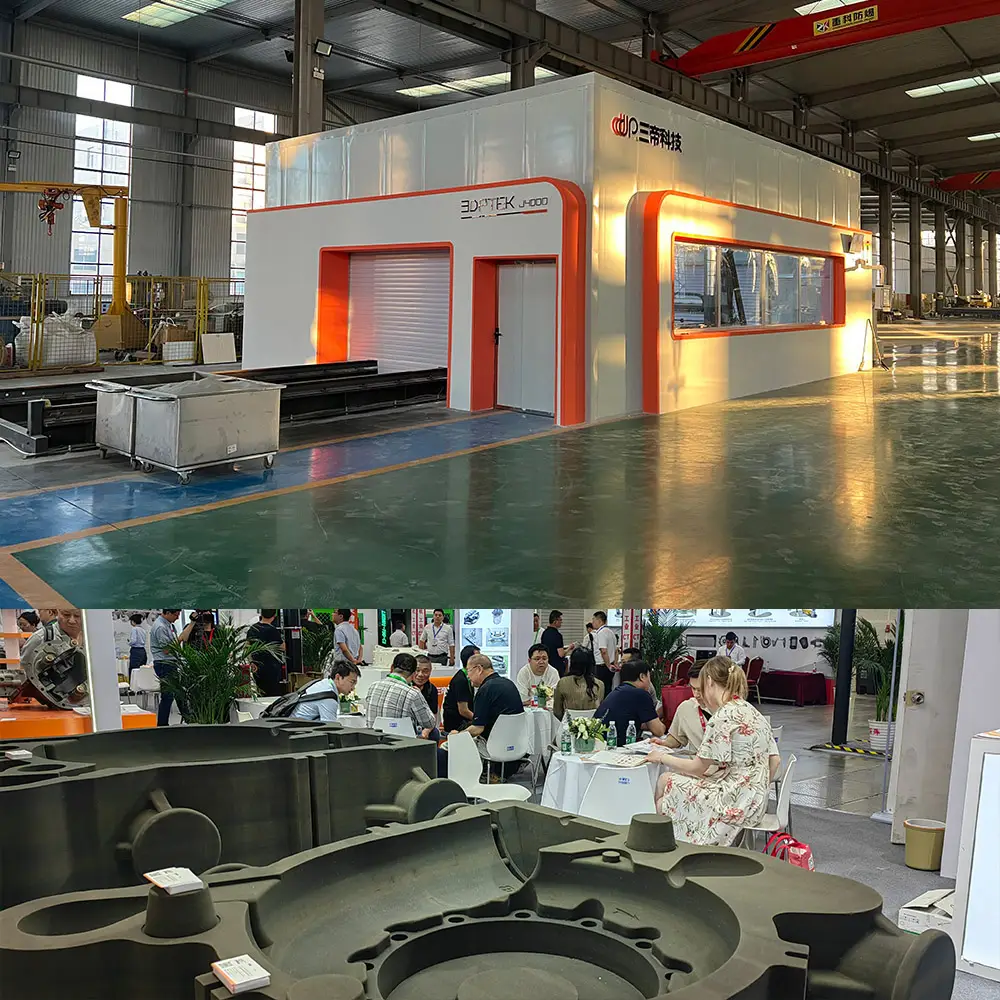
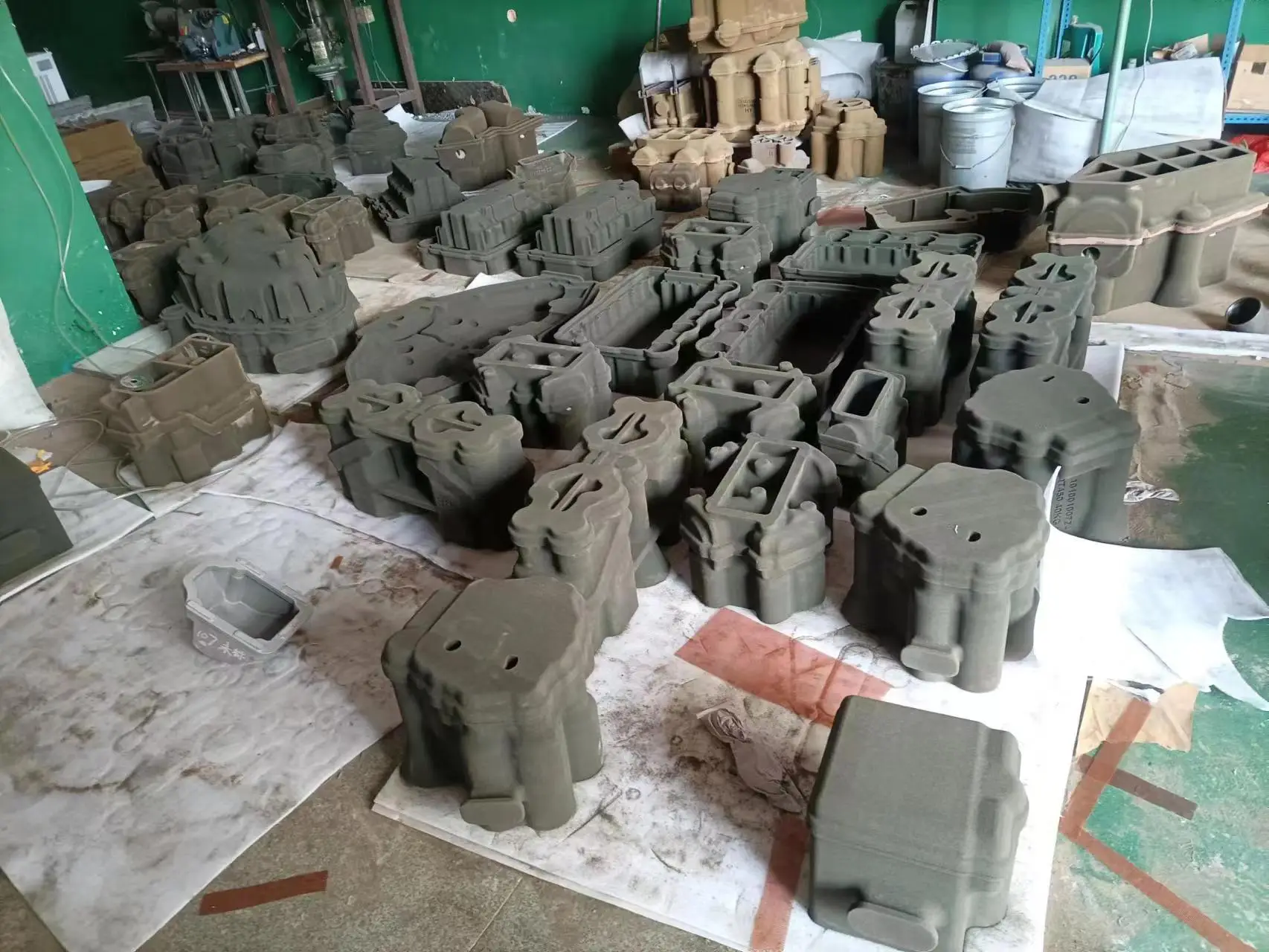
Sand 3D printing spends none of it. The printer builds each mold and core directly from the CAD model, layer by layer, typically at 0.28–0.4 mm per layer. There is no pattern, no core box, and no toolmaker in the loop. A design revision becomes an edit in the CAD file and a reprint overnight, instead of a new pattern order with another four to eight weeks attached. This is the whole patternless argument in one paragraph, and it is why prototyping and small-series foundries adopted the technology first.
Once the pattern exists, traditional casting is cheap per mold: sand, binder, labor, and the pattern amortized across every mold it makes. A €10,000 pattern across 10,000 molds adds €1 per mold. The same pattern across 50 molds adds €200 per mold — before the actual molding cost. A printed mold carries no amortization at all: its cost is sand, binder, and machine time, and it stays roughly flat whether you print one mold or fifty. Those two curves cross somewhere, and the crossing point is your breakeven quantity.
Labor and rework push the comparison further. Pattern making is skilled, slow, and increasingly hard to source; for small series, a printer operator replaces most of the pattern shop. Printing does not replace the rest of the foundry, though: a printed core still travels the same route through washing, dipping, and assembly that a core shot on a Laempe line does, so you gain tooling freedom without losing process discipline. When a casting fails — a wall that shifted, a core that collapsed, a gate that starved the part — the traditional response is “modify the pattern, wait, and re-run”, repeating the tooling cost and the delay. The printed response is “edit the file, reprint tonight, pour tomorrow”. Foundries running both workflows describe the difference as fixing a problem in days versus weeks.
The breakeven table: when printing beats the pattern
The breakeven logic, summarized by part complexity, is below. These are decision rules, not quote-level numbers — the exact crossover depends on part weight, binder price, sand type, and labor rates. The one anchor that holds everywhere is the pattern: €3,000–€15,000 and 4–8 weeks.
| Complejidad de las piezas | Simple (1–50 pcs) | Moderate | Complex |
|---|---|---|---|
| Traditional pattern cost | Machined pattern €3,000–€15,000, 4–8 weeks | Pattern plus core boxes, upper end of the €3,000–€15,000 band | Multi-part tooling €15,000+, fragile core boxes, months of lead time |
| 3D printing | No tooling; pays per mold — competitive only at the low end of the range | No tooling; per-mold cost stays flat across the whole run | No tooling; the only economical option below a few hundred pieces |
| Breakeven point | Around 10–30 pcs; the amortized pattern wins above that | Roughly 20–50 pcs | From the first part; wins through a few hundred pcs |
Read the top row carefully. If your pattern is already paid off and sitting on a shelf, ignore the anchor entirely — your marginal cost is sand and labor, and printing rarely beats that above tiny quantities. If you are buying tooling new, the €3,000–€15,000 figure is the number that decides everything, and the higher your tooling quote comes in, the earlier printing wins. Worked examples with realistic assumptions are in our sand 3D printer breakeven guide.
When traditional casting is still cheaper
Be honest about the other side, because it is what makes the verdict credible. Traditional casting is still clearly cheaper for simple parts at high volume. A brake disc, a pipe flange, a manhole cover: geometry a pattern shop machines in days, castings needed by the tens of thousands. The pattern amortizes to cents per part, and a well-run molding line produces a mold every few seconds. No binder-jetting machine on the market approaches that per-mold cost.
The second case is tooling you already own. If the pattern and core boxes for a stable product are sitting in the foundry, their cost is sunk; the marginal cost of the next mold is sand, binder, and labor. Printing cannot beat that for any but the smallest quantities. The breakeven table assumes the pattern is bought new — when it is not, the calculation flips completely.
The third case is thin-wall mass production, where a rigid pattern and core-box line guarantee repeatable sections. Green-sand molding against a machined pattern compacts sand against a precise, hard surface; a printed mold has measurable surface roughness from grain size and layer steps, and lower green strength. When every millimeter of wall thickness is a design requirement and the part runs continuously, the pattern is not a cost — it is the technology.
The practical rule: keep the pattern for products that are stable, simple, and high-volume; use printing for everything that is new, complex, or urgent. Pump and valve makers quote cored bodies in small series, and aerospace primes use printed sand molds for development castings where design iterations outpace tooling — both are print-first territory. Most foundries end up running both: the conventional molding line for the runners, the printer for new-product and service work.
What “cheaper” really means: total cost of ownership
Per-mold cost is the visible number; total cost of ownership is what decides whether the machine pays for itself. Start with acquisition. A 3DPTEK J1800 (1,800 × 1,000 × 700 mm build volume) sits in the mid price range, configuration-dependent; the J2500 (2,500 × 1,500 × 1,000 mm) is mid-to-large range, configuration-dependent; the J4000Pro (4,000 × 2,500 × 1,500 mm) is the large-format, seven-figure class. Against that, public estimates for the equivalent Western platforms run much higher: the ExOne S-Max Pro at roughly 2–3× the J1800’s price, and the voxeljet VX1000 at about €750,000 once delivered and installed, per a published academic purchase record.
Delivery lead time is part of the TCO as well. The J1800 ships in 6–8 weeks, the J2500 in about two months, and the J4000Pro in 2–3 months including sea freight, customs, and installation; comparable ExOne and voxeljet platforms are quoted at 4–9 months. For a foundry that has already sold the castings, four idle months is real money.
Run the five-year picture — acquisition, consumables, maintenance, training, utilization — and the J1800 or J2500 typically lands at roughly half the total cost of the equivalent Western platform. Two structural reasons drive the gap. First, open material systems: the 3DPTEK machines accept a range of commercially available sands and binders, so consumable pricing stays competitive, whereas a closed system locks you into one vendor’s pricing for the life of the machine. Second, sand reclamation above 95% makes the sand itself a minor cost once the loop is running, so machine-hour rate, not material, dominates the per-mold number.
To be fair to the competition: ExOne’s software is mature and its install base is large, and the voxeljet VX1000, while the most expensive per build volume of the three, is a proven machine — BMW’s Landshut foundry has produced cores on voxeljet platforms for over a decade. If software maturity or a familiar team matters more than the price delta, paying Western pricing is a legitimate decision. The honest tradeoffs are laid out in our 3DPTEK vs. ExOne vs. voxeljet comparison, and the five-year math is in our Guía sobre el retorno de la inversión de las impresoras 3D de arena.
Before you buy, read the Guía de compra de impresoras 3D de arena and walk the machine lineup on our sand 3D printer product pages. A mid-range J1800 with open materials and a six-week delivery covers most foundries’ first three years of work, and the J2500 and J4000Pro are the upgrade path when the parts grow.
The risk most buyers miss
The cost most buyers underestimate is the binder. Sand is cheap and, at 95%+ reclamation, nearly free in the loop; the organic binder that glues each layer is the recurring consumable on every mold. Binder consumption scales with surface area, not volume, so a thin-walled, intricate core consumes more binder per kilogram of sand than a solid block — the jobs that look cheapest on paper can be the most expensive in binder. Quote binder price and consumption before you quote the part, and check whether the machine lets you shop binders competitively; our open vs. closed material systems comparison explains why that matters.
Sand reclamation is a workflow, not a feature. The 95%+ recovery figure assumes you actually run the loop — knock-out, thermal or mechanical reclamation, classification, and back to the hopper. Foundries that skip it buy fresh sand on every mold and quietly lose the cost advantage this article describes. If you have never operated a reclamation line, budget for floor space and training, not just the printer.
Operator training is the third underestimated line item. Binder jetting is a process, not a desktop printer: print parameters, de-powdering, curing time, and core handling all change the outcome, and someone has to own them. Plan for a process engineer in the first year, not a machine operator. This is also where delivery lead time shows up in human terms — with a 6–8 week machine, your people can be trained and running jobs before a Western platform would clear customs.
Finally, utilization decides the payback. A sand printer is not a warehouse asset; it is a small factory that needs a queue of work. The foundries with the worst ROI bought a machine for one contract, let it sit, and then measured the payback. The ones with the best ROI feed it a steady pipeline of prototypes, service castings, and new-product work — the mixed setup our Guía de integración de fundición walks through in detail.
If your part sits in the middle of that breakeven table, the fastest way to settle the math is a quotation with real numbers. Send the part weight, quantity, and alloy, and we will price the printed molds and the machine package together. Request a formal quotation and you will get a per-mold cost, a delivery date, and an honest recommendation — including the cases where we tell you to keep the pattern.
Written by the 3DPTEK engineering team — the same team that operates our own foundries and sand 3D printers in daily production. Acerca de 3DPTEK.
Preguntas frecuentes
¿Es la impresión 3D con arena más barata que la fundición en arena tradicional?
Usually, for the parts that motivate the question: short runs, complex cores, and anything with a deadline. The pattern — €3,000–€15,000 and 4–8 weeks — disappears, so complex parts commonly break even below 50–100 pieces and are cheaper from the first part. For simple parts at high volume, traditional casting still wins. The deciding factor is always the same: how much tooling would you otherwise buy, and how many parts amortize it.
At what quantity does 3D sand printing become cheaper?
There is no single number; the crossover depends on complexity, because complexity drives pattern cost. For simple parts it is around 10–30 pieces, for moderate parts roughly 20–50, and for complex cored castings printing is usually cheaper from the first part through a few hundred pieces. The pattern anchor — €3,000–€15,000 — is what moves the breakeven: the higher your tooling quote, the earlier printing wins.
Is it cheaper for a single prototype?
Yes, without qualification. A one-off printed mold costs tens of euros in sand and binder plus a day or two of machine time, versus a €3,000–€15,000 pattern that produces one casting and then sits idle. At INTERMOLD Nagoya 2025 the industry comparison was a wooden pattern at two weeks versus a printed mold at two days. If you need one piece, printing is not just cheaper — it is the only economical option.
How much does pattern tooling cost compared to 3D printing a mold?
A machined pattern typically costs €3,000–€15,000 and takes 4–8 weeks, and core boxes add to that. A 3D-printed mold costs sand, binder, and machine hours — typically tens of euros for a small mold. The comparison is one-time tooling versus a recurring per-mold cost, which is why the breakeven table exists: at low volumes the pattern cost swamps everything; at high volumes the per-mold cost decides.
Is the total cost of ownership lower over five years?
For the platforms in this comparison, yes: a 3DPTEK J1800 or J2500 typically lands at roughly half the five-year total cost of ownership of the equivalent Western platform. The gap comes from acquisition price (the J1800 is mid range, configuration-dependent, against public estimates of roughly 2–3× for the S-Max Pro), open material systems that keep binder pricing competitive, and 6–8 week delivery instead of 4–9 months. The caveat is utilization — an idle machine has a poor TCO at any price.
Is 3D sand printing cheaper than investment casting?
They replace different things. Investment casting uses wax-pattern tooling and ceramic shells to reach thin walls, fine detail, and high-value alloys that sand casting cannot touch; for those parts it is often the right process regardless of cost. For iron and aluminum castings with complex internal cores — the territory where sand casting lives — 3D printing the sand molds is usually cheaper than either conventional sand tooling or investment casting tooling, because both carry their own tooling investment. Match the process to the alloy and geometry first; the cost comparison only makes sense inside the same process family.
Lecturas relacionadas
See the full 3D sand printing cost breakdown, the binder jetting vs traditional tooling math, and how ROI y break-even change the decision.


