
Sand 3D Printer Comparison 2026: 3DPTEK vs ExOne vs voxeljet

Two of the three names on this page are now one company. ExOne and voxeljet — historically the two best-known brands in industrial sand 3D printing — were combined under ExOne Global Holdings in October 2025, a move announced by their owner, U.S. investment firm Anzu Partners. The combined business claims more than 500 industrial printers installed across every inhabited continent — a figure repeated in the October 23, 2025 press release and in independent trade coverage since. For a foundry buyer, that changes what “comparing the market leaders” means: the two leaders are one vendor. This guide compares the combined ExOne–voxeljet portfolio against 3DPTEK’s J-series line on the same yardstick — build volume, speed, materials, price, and five-year cost of ownership — including the manufacturer-direct price data the Western brands do not publish. For a strictly two-way comparison of the Western brands themselves — build volume, software, and price of voxeljet vs ExOne — see our separate head-to-head without the 3DPTEK angle.
Why Compare 3DPTEK, ExOne, and voxeljet at All?
Because the two market leaders buyers used to pit against each other are now the same company, and no independent source publishes an apples-to-apples spec-and-price comparison. The merger, announced October 23, 2025 on voxeljet’s press site, folded the two portfolios into one holding structure with combined R&D, cross-selling, and a unified product catalogue. Buyers who believed they were choosing between competitors are now choosing between configurations of a single vendor.
The information gap is real on both sides. Vendor sites promote only their own machines. Media guides such as All3DP’s “Best Sand 3D Printers for Molds & Cores” predate the merger and carry no price figures at all. Forum threads trade anecdotes, not data. What a buyer needs is one table that lists the machines side by side, using the same units, with the same cost categories. That is what this article provides, and where a number is not public, we flag it instead of guessing. Every figure below carries its source and its date, and anything we could not verify is marked as such — the same standard you should hold any vendor to before you sign.
The Three Sand 3D Printer Lines at a Glance
All three lines target the same job: printing molds and cores for sand casting, straight from CAD, with no tooling. The product lines below are the current portfolios as of 2026. 3DPTEK builds the J-series; the ExOne–voxeljet combination offers the S-series and the VX series under one roof, plus its first post-merger product, the S-Print Pro entry-level system launched in June 2026.
| Brand | Product line | Representative machines | Build-envelope class | Typical role |
|---|---|---|---|---|
| 3DPTEK (independent) | J-series | J1800, J1800S, J2500, J4000, J4000Pro | 1.8 m to 4.0 m length class | Prototype to one-piece large molds |
| ExOne | S-series | S-Max Pro, S-Max, S-Print, S-Print Pro | 1.8 m class (S-Max Pro); 1.2 m (S-Print Pro) | Production molds and cores; entry-level production |
| ExOne (formerly voxeljet) | VX series | VX200, VX1000, VX2000, VX4000 | 0.3 m to 4.0 m length class | Small jobbing to world’s largest builds |
The practical difference is not technology — all three use binder jetting, where a printhead deposits binder onto layers of foundry sand. The differences are build envelope, throughput, materials compatibility, price, and how the vendor’s business model affects your operating cost. The rest of this article walks through each one. If you are new to the process itself, start with our how sand 3D printing works guide before comparing machines.
How Do Build Volumes Really Compare?
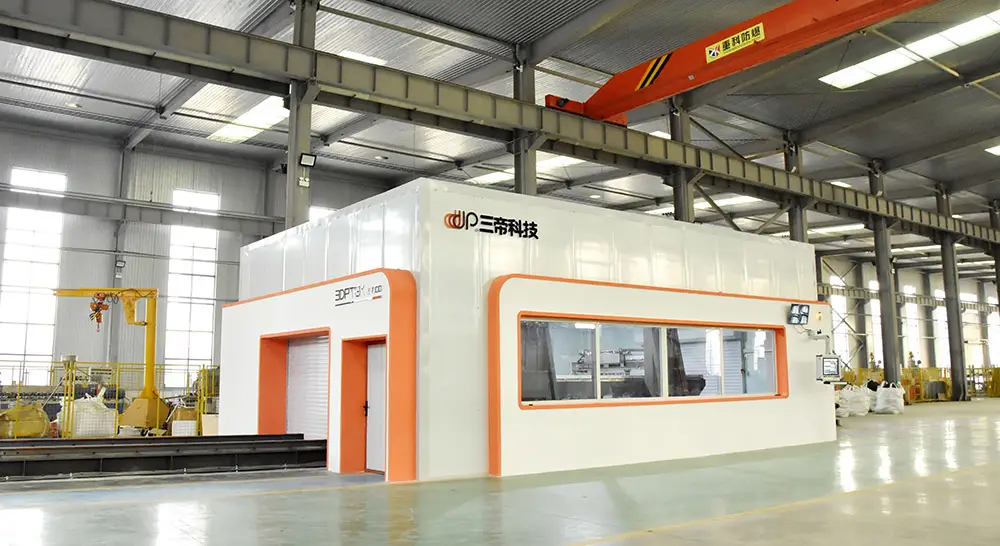
Build volume is the first filter because it is the hardest to change later: the largest mold that fits the build box in one piece sets your ceiling on part size. In the large-format class, the two competitors are close but not identical once you read the fine print. The VX4000 — marketed as the world’s largest sand 3D printer — offers a build envelope of 4 × 2 × 1 m (8,000 L). The 3DPTEK J4000’s build chamber matches that envelope at 3,800 × 1,850 × 1,000 mm, but its no-sandbox “flexible area forming” design gives a usable forming size of 3,800 × 1,850 × 1,000 mm; the J4000Pro extends the usable envelope to 4,000 × 2,500 × 1,500 mm (15,000 L) for molds that do not fit a standard 2 m-wide box. All figures below are from the vendors’ official product pages and data sheets, dated 2026 (see Sources).
| Machine class | Maschine | Build envelope (L × W × H) | Notes |
|---|---|---|---|
| Groß | ExOne VX4000 | 4,000 × 2,000 × 1,000 mm (8,000 L) | ≈123 L/h, 600 dpi, 120/300 µm layers (official data sheet) |
| Groß | 3DPTEK J4000 | Chamber 3,800 × 1,850 × 1,000 mm; usable forming 3,800 × 1,850 × 1,000 mm | No-sandbox flexible-area forming; price near the 2.5 m class |
| Groß | 3DPTEK J4000Pro | 4,000 × 2,500 × 1,500 mm (15,000 L) | 17 printheads; largest usable envelope in the class |
| Mid | ExOne S-Max Pro | 1,800 × 1,000 × 700 mm (1,260 L) | Up to 145 L/h; ExOne’s flagship sand system |
| Mid | 3DPTEK J2500 | 2.500 × 1.500 × 1.000 mm | Production workhorse; 16–20 s/layer |
| Small–mid | voxeljet VX2000 | 2,000 × 1,000 × 1,000 mm (2,000 L) | Up to 47 L/h; now in the combined catalogue |
| Entry | 3DPTEK J1800 / J1800S | 1.800 × 1.000 × 700 mm | Prototype and small-batch molds |
| Entry | ExOne S-Print Pro | 1,200 × 750 × 500 mm | Launched June 2026; ExOne’s most affordable entry |
Two conclusions fall out of the table. First, in the large-format segment the J4000Pro is the only standard machine that prints wider than 2 m — the VX4000’s usable envelope is 4 × 2 × 1 m, and the J4000’s usable forming area is 3.8 × 1.85 × 1 m. Second, the mid-size decision (S-Max Pro versus J2500) is decided by throughput and cost per part, not by envelope. Our Ratgeber zum Kauf eines Sand-3D-Druckers explains how to match build box to your recurring part mix rather than your largest theoretical part.
What Does Each Machine Actually Cost to Run?
Purchase price is less than half the story. Over five years, sand, binder, energy, labor, and maintenance typically exceed the machine’s sticker price, so the honest comparison is total cost of ownership (TCO). This is also where the two sides of this comparison behave most differently: 3DPTEK publishes price ranges, while ExOne and voxeljet quote “on request” — and a vendor that will not share a price band is asking you to compare against a blank.
| Cost line | 3DPTEK J-series | ExOne / voxeljet |
|---|---|---|
| Machine list price (indicative) | J1800 ≈ ¥1.5–1.8M (≈US$210–250k); J2500 ≈ ¥2.8–3.2M (≈US$390–450k); J4000Pro ≤ ¥5.0M (≈US$700k); J4000 priced near the 2.5 m class. Indicative exhibition-quote ranges (2026) — confirm with vendor. | Not published — all models quoted on request. S-Print Pro is positioned as ExOne’s lowest-priced industrial sand printer (no public figure). Our 2026 planning ranges: 1.2 m class ≈US$400–700k; 1.8–2.5 m class ≈US$700k–1.2M; 4 m class ≈US$1.5M+. |
| Foundry sand | Standard silica/quartz, vitrified, ceramic sands — open, sourced locally | Open too: S-Max Pro runs natural and synthetic sands; VX2000 runs quartz sand, cerabeads and chromite; VX4000 runs quartz sand. No vendor locks the sand itself. |
| Ordner | Furan resin at a published per-kg price; standard foundry hardener (open system) | Vendor-branded systems: S-Max Pro furan / CHP / HHP / inorganic; VX2000 furan + phenolic; VX4000 furan. Per-kg prices not published — request the consumables price list in writing. |
| Printhead modules | Not published; 3DPTEK states it stocks 1,000+ printhead units for rapid spares. Confirm module price and expected life in the quote. | Not published. Our 2026 analysis describes Western printheads as captive, premium-priced parts with long replacement lead times; confirm price and lead time in writing. |
| Maintenance contract | Not published — annual service contract quoted per installation; request alongside the machine quote. | Not published — annual service contracts quoted per installation. Plan facility space accordingly: VX4000 needs a 25 × 12 × 4.5 m installation area. |
| Installation & training | Quoted per package; standard configurations deliver from stock in weeks. | Quoted per package; imported machines are routinely quoted at 3–6 months delivery (some lines have exceeded six months — see below). |
The five-year TCO model has the same shape for every machine: purchase price plus consumables plus maintenance plus downtime, divided by realistic output — not brochure speed. We break every cost line down in our sand 3D printing cost guide, and the Break-even-Tabelle turns it into a fill-in-the-blanks calculation. The material-system question is the one to resolve first, because it decides whether your operating cost tracks the open market or a vendor’s price list — covered in depth in our offene vs. geschlossene Materialsysteme analysis. Delivery is part of the cost equation too: a machine that ships in weeks starts paying for itself, while a machine quoted months out sits in your capex plan and delays the first pour. The verified 2026 picture: 3DPTEK quotes standard J-series configurations from stock in weeks, while imported ExOne/voxeljet machines are routinely quoted at 3–6 months — one of our documented case studies cites Western quotations with delivery lead times of several months that threatened a casting season. Confirm the lead time in writing before comparing prices.
Where Each Machine Wins: Speed, Accuracy, and Materials
On paper, the machines are closer than the marketing suggests — the physics of inkjet binder jetting is the same for every vendor. The differences show up in three numbers and one business model. Speed is quoted either in seconds per layer or liters per hour, and comparing across vendors means converting to one unit first. The gap between 16 and 20 seconds per layer (the J2500’s official range) looks small on paper, but across a 3,000-layer mold it is hours per build, and across a year of three-shift production it is days of capacity — throughput differences compound exactly where they hurt. The table below uses each vendor’s own official figures; where a vendor publishes no dimensional-accuracy number, we say so.
| Metrisch | 3DPTEK J2500 | ExOne S-Max Pro | voxeljet VX2000 | ExOne VX4000 |
|---|---|---|---|---|
| Druckgeschwindigkeit | 16–20 s/layer (official product page) | Up to 145 L/h (official data sheet) | Up to 47 L/h = 21.6 mm/h (official data sheet) | ≈123 L/h = 15.4 mm/h (official data sheet) |
| Genauigkeit | Up to ±0.3 mm (official) | ±0.5 mm (official data sheet) | Not published; print resolution 200/300 dpi | Not published; print resolution 600 dpi |
| Schichtdicke | 0,2–0,5 mm | 0,2–0,5 mm | 250–400 µm | 120 / 300 µm |
| Sand compatibility | Quartz, vitrified, ceramic sands (open) | Natural and synthetic sands | Quartz, cerabeads, chromite | Quartz sand |
| Binder system | Open: furan resin at published per-kg price; standard hardener | ExOne furan / CHP / HHP / inorganic (vendor-certified; price on request) | Furan + phenolic; “open source material options” per data sheet | Furan resin (voxeljet) |
The pattern across the market is that the real differentiator is materials openness. A machine that runs the same sand and resin the foundry already uses for conventional molding keeps operating cost flat; a machine locked to proprietary consumables turns every future job into a vendor-priced transaction. In practice every vendor here runs standard foundry sands — the sand is not the lock-in. The binder is: 3DPTEK sells its furan resin at a published per-kilogram price and uses a standard hardener, while ExOne and voxeljet certify their own binder systems (furan, phenolic, and for the S-Max Pro also CHP, HHP and inorganic). Before comparing any two quotations, extract the same three numbers from both vendors: cost per kilogram of sand and binder, cost and expected life of a printhead module, and the list of materials you may run without voiding the warranty.
What Did the ExOne–voxeljet Merger Change for Buyers?
On October 23, 2025, Anzu Partners announced that ExOne Global Holdings had combined ExOne and voxeljet under one structure, integrating operations, R&D, and product portfolios, with more than 500 industrial printers installed worldwide on every inhabited continent. For most buyers, this is good news for the vendor and a real change for the market: the two brands that historically competed for every large sand printer tender now cross-sell each other’s machines, unify service and spare-part logistics, and share a single catalogue spanning the S-series (S-Max Pro, S-Max, S-Print) and the VX series (VX200, VX1000, VX2000, VX4000). The first product launched after the merger — the S-Print Pro, introduced June 2026 — signals where the combined vendor intends to grow: smaller foundries. ExOne Global Holdings also began producing its Spectra Mono-Z printheads in Detroit in April 2026.
What it means in practice:
- Fewer independent choices at the top. Tenders that used to be two-vendor are now one-vendor-plus-alternatives. Independent suppliers such as 3DPTEK are the only real outside option at scale.
- One service network. Support, training, and spare parts are consolidating around a single organization — convenient, but it removes the backup of a genuinely independent second brand.
- Cross-selling, not neutral advice. A sales engineer now has every incentive to steer you to whichever of the two brands fits their combined margin, not necessarily your foundry.
- Second-hand and upgrade risk. With one portfolio owner, the used-machine market and upgrade paths will be governed by one commercial strategy.
None of this makes the combined brand a bad choice — it has an installed base no newcomer can match. It means the decision deserves the same scrutiny you would apply to any single-vendor dependency. In practical terms, ask the merged vendor for a written commitment on spare-part pricing and availability for both brands, and for the product roadmap, because a portfolio in consolidation can strand a buyer who chose a platform that gets retired. Our Western vs. Chinese 3D printers analysis frames this trade-off in full.
How Should a Foundry Choose? A 5-Step Decision Path
A defensible decision follows a fixed sequence, and it applies the same way to all three vendors. Do not start with the brand; start with the parts.
- Define the part envelope. List your recurring molds and cores — not your largest theoretical part. This sets the build-box class.
- Convert everything to one unit. Get s/layer and L/h from every vendor in the same unit, at the same layer thickness, so throughput is comparable.
- Model five-year TCO. Machine price, sand, binder, energy, labor, maintenance, downtime — over realistic utilization. The Kostenübersicht und ROI model give you the structure.
- Verify materials openness. Confirm which sands and binders are allowed without voiding warranty, and their prices.
- Stress-test support. Response-time commitments, spare-part stock, training, and a refund or trial clause — in writing, before the deposit.
Applied to typical scenarios, the answer differs by buyer. A prototype shop printing a few molds a week may not need a 4 m machine at all — the J1800 class (1.8 m) or the new S-Print Pro (1.2 m) wins on entry cost, while voxeljet’s VX200 is a 300 mm desktop-class unit for R&D rather than production molds. A production foundry pouring engine blocks and pump housings lives in the 2.5–4 m class, where the J2500 and J4000 compete directly with the S-Max Pro and VX4000, and TCO per liter of printed sand decides. A group standardizing across plants should weight customization and consumables consistency — an area where newer manufacturers quote configurable build boxes and control software rather than fixed product lines. If the model says two machines land within about 10% on cost per part, decide on the tiebreakers: consumables openness, spare-part lead times, training depth, and whether the vendor can show a reference running your alloy and your part complexity. The five-step path is the same for every scenario; only the numbers change.
Real Installations: What Foundries Are Actually Running
Installed base is the one thing marketing cannot fake, and both sides publish references worth reading. On the ExOne–voxeljet side, documented production references include Liberty Pattern with six S-Max-class printers and growing (the company’s own newsroom), Kimura Foundry Group with ten ExOne sand systems including its third S-Max platform and an S-Print running phenolic binder, TEI (Tooling & Equipment International) with at least two VX4000s printing GM Cadillac CELESTIQ casting cores, and BMW’s serial-production water-jacket cores. Those are genuine production references and a credit to the merged brand. The corresponding evidence on the 3DPTEK side is documented in our case-study series and in public tender awards, each with the customer’s problem, the machine, and the measured result.
| Vendor | Reference customer | Machines | Source |
|---|---|---|---|
| ExOne (combined) | Liberty Pattern | 6+ S-Max-class sand printers | libertypattern.com newsroom |
| ExOne (combined) | Kimura Foundry Group | 10 ExOne sand systems incl. 3× S-Max, plus S-Print (phenolic) | TCT Magazine, Mar 2022 |
| ExOne (combined) | TEI (Tooling & Equipment Intl.) | 2+ VX4000 (GM Cadillac CELESTIQ cores) | Fabbaloo / voxeljet, 2023 |
| ExOne (combined) | BMW | Serial-production water-jacket cores | AMPulse / ExOne reference |
| 3DPTEK | Wuhan Heavy Duty Machine Tool Group (武重集团) | J2500 — won “3D sand printer” tender, May 2026 | Nanji Bear / NetEase, May 2026 |
| 3DPTEK | Shaanxi Shuangli Foundry | J4000 | Nanji Bear / NetEase, May 2026 |
| 3DPTEK | Liuzhou Dongrui Machinery | J1800 | Nanji Bear / NetEase, May 2026 |
| 3DPTEK | Shandong Yuzhong Auto Tech; Qufu Longxiang; Qingdao Jinnuowei | J1800S (one each) | Nanji Bear / NetEase, May 2026 |
When you evaluate references, ask the same question of every vendor: which customers run machines like the one you are considering, at a similar utilization, and can you visit or call them? A thousand installed units in another size class is weaker evidence than three running your exact part mix. Where possible, ask for the reference’s part mix, alloy, and utilization — a machine running one job a week proves less than one on a three-shift production schedule. For documented 3DPTEK production results, see our case studies, for example western-grade stability at lower TCO und die defense casting consolidation series.
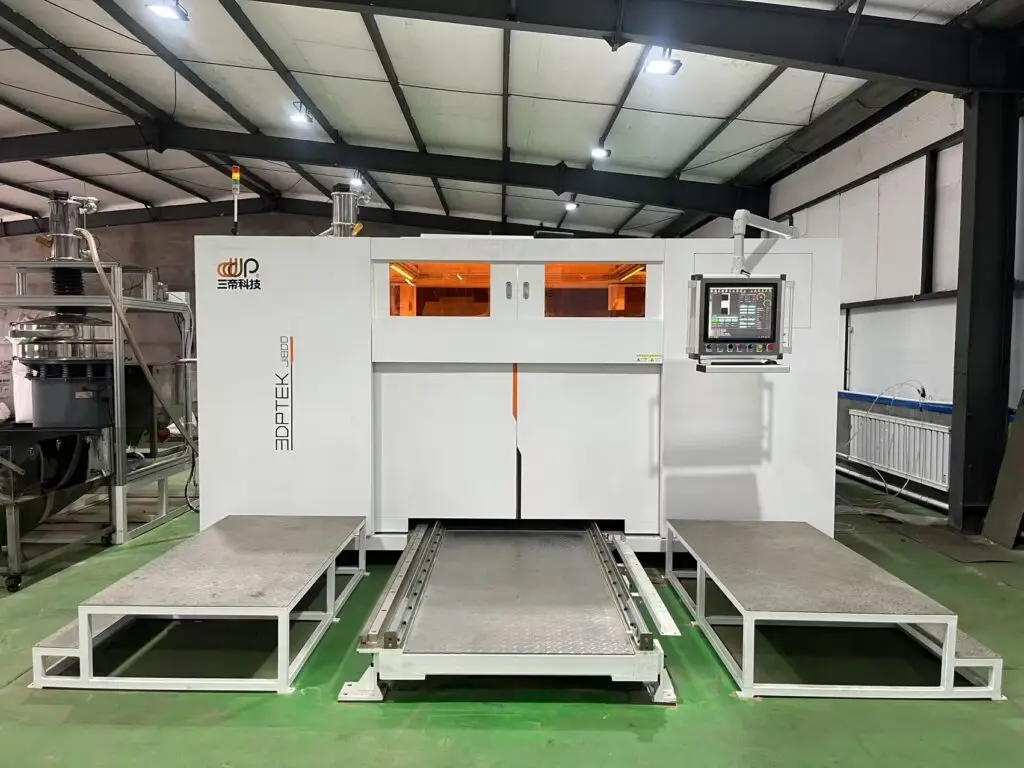
The 3DPTEK line in this comparison: 3DPTEK J1800, 3DPTEK J2500, 3DPTEK J4000 and the larger 3DPTEK J4000PRO.
Häufig gestellte Fragen
Is voxeljet the same company as ExOne? Yes. In October 2025, Anzu Partners combined the two brands under ExOne Global Holdings. They now operate as one organization with a unified product catalogue, shared R&D, and a single service network. “voxeljet vs ExOne” is therefore no longer a real competitive choice — both are configurations of the same vendor.
Which sand 3D printer is the biggest? The VX4000 holds the marketing title “world’s largest” with a build envelope of 4,000 × 2,000 × 1,000 mm (8,000 L). But the 3DPTEK J4000Pro’s usable forming envelope is larger — 4,000 × 2,500 × 1,500 mm (15,000 L) — making it the only standard machine that prints wider than 2 m in the large-format class. The 3DPTEK J4000’s build chamber is 3,800 × 1,850 × 1,000 mm with a usable forming size of 3,800 × 1,850 × 1,000 mm.
Wie viel kostet ein Sand-3D-Drucker? Prices vary by build volume, printheads, and automation, and most Western vendors quote on request. As planning ranges (2026), 3DPTEK’s J-series is quoted around: J1800 ≈ ¥1.5–1.8M (≈US$210–250k), J2500 ≈ ¥2.8–3.2M (≈US$390–450k), J4000Pro ≤ ¥5.0M (≈US$700k), with the J4000 priced near the 2.5 m class — installation and training included or quoted per package; confirm with the vendor. ExOne and voxeljet quote on request; our 2026 planning ranges are 1.2 m class ≈US$400–700k, 1.8–2.5 m class ≈US$700k–1.2M, and 4 m class ≈US$1.5M+. Full package price is only the start — five-year TCO includes sand, binder, energy, labor, and maintenance, so compare on cost per liter of printed sand.
Can a sand 3D printer use standard foundry sand? Yes — every vendor in this comparison runs standard foundry sands: 3DPTEK’s J-series runs quartz, vitrified and ceramic sands; the S-Max Pro runs natural and synthetic sands; and the VX2000 runs quartz sand, cerabeads and chromite. The lock-in risk sits in the binder, not the sand: 3DPTEK sells its furan resin at a published per-kilogram price with a standard hardener, while ExOne and voxeljet certify their own binder systems. Confirm the allowed materials list and their prices in writing before purchase, because this decision fixes your operating cost for the life of the machine.
How fast is sand 3D printing compared with traditional tooling? Sand 3D printing eliminates the pattern and core-box tooling step entirely. Where a machined tool typically takes weeks, a printed mold is ready for the pour deck in days, which is why foundries use it for prototyping and low-volume production. For the full workflow and timing, see our how sand 3D printing works guide.
Conclusion: Buy the Machine That Wins Your Numbers
Three takeaways from this comparison. First, the market’s two top brands are now one vendor — “voxeljet vs ExOne” is a choice between configurations, not competitors, and the only real alternative at scale is an independent supplier such as 3DPTEK. Second, the spec sheets are closer than the marketing: convert everything to one unit, and the differences shrink to build envelope, throughput, and materials policy — with the J4000Pro the only large-format machine that prints wider than 2 m. Third, price transparency is the biggest differentiator left — the vendor that publishes prices lets you run the numbers; the vendor that quotes on request asks you to trust instead of calculate.
Run the five-step decision path with your own part mix and utilization. If you want the comparison done with your numbers, send your part portfolio and volumes to our team and we will return a process and cost proposal covering both routes — request a quote or review the 3DPTEK J-series sand printers first.
Sources
- Anzu Partners — “ExOne Global Holdings Unifies ExOne and voxeljet”, press release, October 23, 2025. https://www.anzupartners.com/2025/10/23/ (retrieved 2026-08-21)
- Business Wire (via Yahoo Finance) — same release, October 23, 2025. https://finance.yahoo.com/news/exone-global-holdings-unifies-exone-130000150.html (retrieved 2026-08-21)
- 3Dnatives — “ExOne and voxeljet Unite Under ExOne Global Holdings”, October 30, 2025. https://www.3dnatives.com/en/exone-and-voxeljet-unite-under-exone-global-holdings29102025/ (retrieved 2026-08-21)
- Additive Manufacturing (Gardner Business Media) — “ExOne and Voxeljet Combine to Advance Large Format AM Casting”, October 24, 2025. https://www.additivemanufacturing.media/news/exone-and-voxeljet-combine-to-advance-large-format-am-casting (retrieved 2026-08-21)
- ExOne — “S-Max Pro” data sheet (X1_Datasheet_S-Max Pro_EN_2022-04): job box 1,800 × 1,000 × 700 mm, 1,260 L, up to 145 L/h, 0.2–0.5 mm layers, ±0.5 mm, furan/CHP/HHP/inorganic binders. (retrieved 2026-08-21)
- voxeljet — “VX4000 — The large-format 3D printing system”, data sheet rev. 01/2013: 4,000 × 2,000 × 1,000 mm, 600 dpi, 120/300 µm, 15.4 mm/h ≈ 123 L/h. (retrieved 2026-08-21)
- voxeljet — “VX2000 — The industrial 3D printer”, data sheet rev. 03/2015: 2,000 × 1,000 × 1,000 mm, 200/300 dpi, 250–400 µm, up to 21.6 mm/h ≈ 47 L/h. (retrieved 2026-08-21)
- voxeljet — “VX200” data sheet rev. 01/2021: 300 × 200 × 150 mm, 254 dpi, 300 µm, sand (furan) and ceramic. (retrieved 2026-08-21)
- WESTCAM Group — “Voxeljet VX2000” product page (furan/phenolic binders; quartz, cerabeads, chromite). https://www.westcam-group.com/en/products/3d-printing/sand-casting-voxeljet/voxeljet-vx2000/ (retrieved 2026-08-21)
- 3Dnatives — “VX4000 3D Printer: Prices, Specs, News” (“Price on demand”). https://www.3dnatives.com/3d-materials/en/3d-printers/vx4000/ (retrieved 2026-08-21)
- 3DPrint.com — “voxeljet’s VX4000: The Largest Industrial 3D Printer Arrives…”, April 26, 2016 (build space 4,000 × 2,000 × 1,000 mm; 300 µm quartz sand layers). https://3dprint.com/131394/voxeljet-vx4000-north-america/ (retrieved 2026-08-21)
- 3DPTEK — J-series official product pages (J1800, J1800S, J2500, J4000, J4000Pro): forming sizes, speeds, layer thickness, accuracy, printheads. https://www.3dptek.com/industrial-3d-printers/sand-3d-printer/ (retrieved 2026-08-21)
- Nanji Bear 3D Printing News (via NetEase) — “大尺寸砂型3D打印金属铸造越发成熟,三帝科技又获大订单”, May 9, 2026 (J2500 tender win at Wuhan Heavy Duty Machine Tool Group; J4000/J1800/J1800S customer signings). https://www.163.com/dy/article/KSGQ2SG8051186GP.html (retrieved 2026-08-21)
- Liberty Pattern — “Boosting Production at Liberty Pattern: Welcoming Our Sixth ExOne S-Max Sand Printer”. https://libertypattern.com/general/boosting-production-at-liberty-pattern-welcoming-our-sixth-exone-s-max-sand-printer/ (retrieved 2026-08-21)
- TCT Magazine — “Kimura Foundry Group orders tenth ExOne sand 3D printing system”, March 28, 2022. https://www.tctmagazine.com/kimura-foundry-group-orders-tenth-exone-sand-3d-printing-sys/ (retrieved 2026-08-21)
- Fabbaloo — “TEI Acquires Another Massive voxeljet VX4000 3D Printer to Supply Parts to GM”. https://www.fabbaloo.com/news/tei-acquires-another-massive-voxeljet-vx4000-3d-printer-to-supply-parts-to-gm (retrieved 2026-08-21)
- 3D Adept — “ExOne launches the S-Print Pro, its lowest-priced industrial sand 3D printer”, June 23, 2026 (1,200 × 750 × 500 mm; 400 dpi CoreBoost; furan + silica sand). https://3dadept.com/exone-launches-the-s-print-pro-its-lowest-priced-industrial-sand-3d-printer/ (retrieved 2026-08-21)
- AMPulse — “ExOne Global Holdings” company profile (product lineup, 500+ installed base, BMW/Kimura/Motorola references, Detroit printhead production). https://www.ampulse.online/company/exone-global-holdings (retrieved 2026-08-21)
- All3DP — “The Best Sand 3D Printers for Molds & Cores”. https://all3dp.com/2/sand-3d-printer-what-is-it/ (retrieved 2026-08-21)
- Aniwaa — “ExOne S-Max Pro review” (build envelope 1,800 × 1,000 × 700 mm; price “upon request”). https://www.aniwaa.com/product/3d-printers/exone-s-max-pro/ (retrieved 2026-08-21)


