
Cast steel, sand cast or investment cast, without a pattern
Steel is the hardest of the common casting alloys to get sound, because it has no graphite expansion to help feed the shrinkage. We print the sand mould, or print the wax pattern, from your CAD file, so a single steel casting is economic and the rigging is designed around your part instead of around a pattern.
- 2 tLargest single steel pour
- 3 mMaximum casting envelope
- 1,500 tSteel capacity a year
- Carbon to duplexSteel and stainless grades
Cast steel, and which casting route your part needs
Cast steel covers everything from a plain carbon steel bracket to a 17-4PH pump component. What all of it has in common is the reason it is difficult: steel contracts hard on solidifying and there is no graphite forming inside it to push back. So the feeder has to do all the work, the pouring temperature is around 100 °C higher than iron, and the mould has to survive both.
There are two routes, and the choice matters more than the alloy. Sand casting in a printed mould suits anything with a cavity, a flange or a bore you would otherwise machine, at wall thicknesses from about 4 mm up. Wax investment casting suits thin-walled, fine-detail geometry where the part is closer to net shape — impellers, vanes, small precision components. If you are not sure which yours is, send the drawing and the annual quantity and we will say.
Looking specifically for corrosion-resistant stainless? The stainless steel casting service covers 304, 316L, 17-4PH and duplex 2205 in depth. This page is about steel castings generally, and about choosing between the two routes.
Sand casting or wax investment? How we choose
Both routes start from your CAD file and both avoid a pattern, so the decision is about geometry and tolerance rather than about lead time or cost structure. In practice it comes down to four questions, and the answers usually point the same way.
Sand casting in a printed mould
Your CAD model is printed directly as a sand mould and as sand cores on a binder-jetting printer, then poured under gravity. No pattern, no core box.
Choose it when the part has an internal cavity, an integral water or oil passage, a wall of 4 mm or more, or a finished weight above a few kilograms.
Wax investment casting
A wax pattern is printed from your CAD model, shelled in ceramic, and the wax is burnt out before the steel is poured. The shell becomes the mould.
Choose it when the geometry is thin-walled and intricate, the detail is finer than a sand surface can hold, or you need a smoother as-cast finish on complex vanes and profiles.
| Your part | Sand casting | Wax investment |
|---|---|---|
| Integral cavity or internal passage | Yes, printed cores | Limited |
| Thin walls, intricate vanes | Limited below about 4 mm | Yes |
| As-cast surface | Ra 12.5–25 µm | Smoother |
| Heavy sections, several hundred kg | Yes, to 2 t | Not practical |
| Large envelope | To 3 m | Smaller |
| Pattern cost | Нет | Нет |
| Minimum order | 1 piece | 1 piece |
The steel grades we pour
Three families, and the family you pick is decided by the duty rather than by the tensile number. Carbon and low-alloy steel cover structure and wear; the stainless family covers corrosion; duplex covers both at once.
| Family | Grades | Why you would pick it |
|---|---|---|
| Carbon steel | Plain carbon, weldable | Structure, brackets, bases and machine frames where strength and cost govern and corrosion is not the issue. |
| Low-alloy steel | Chromium and molybdenum bearing | Higher strength and hardenability than carbon, for wear parts, gears and load-bearing components. |
| Stainless steel | 304, 316L | Corrosion resistance in chemical, food, marine and pump duty. Full stainless service here. |
| Precipitation hardening | 17-4PH | High strength plus corrosion resistance, where you need both and can accept a heat treatment step. |
| Duplex stainless | 2205 | Chloride stress corrosion plus roughly double the yield of 316L. Offshore, desalination and process plant. |
Steel grades are specified with a heat treatment condition attached, and the same alloy can be supplied soft, normalised or quenched and tempered. Tell us the duty and the hardness you need rather than only the alloy, and the casting and the treatment will be specified together.
Why steel is harder to cast than iron
Ductile and grey iron both form graphite as they solidify, and that graphite occupies volume — it pushes back against the contraction and partly feeds the shrinkage for you. Steel forms no graphite. The whole contraction has to be fed from a riser, so the rigging is heavier, the yield is lower, and the window between a sound casting and a shrunk one is narrower.
Three other things change with steel, and all three are process decisions rather than wishes:
- 01
Metal at 1,500 °C and above
Steel pours about 100 °C hotter than iron. The sand has to take it, so we print moulds for steel from higher-refractoriness silica — above 96% SiO₂ on the large parts — instead of the lower-grade sand that is fine for iron and aluminium.
- 02
A different binder
Furan resin is the right binder for aluminium, copper and iron. Steel runs on phenolic resin, which holds its strength at the higher pouring temperature and breaks down more cleanly afterwards.
- 03
Nitrogen under 3%
The binder carries nitrogen, and nitrogen causes gas porosity. The ceiling for steel is 3% — tighter than the 5% that cast iron tolerates — so the printed mould is dried and vented rather than left to breathe on its own.
- 04
Hot tearing, not just shrinkage
Steel is weaker while it is hot and still contracting, so a mould that restrains it will tear the casting. Printed sand is more collapsible than rammed sand, which helps, but the rigging still has to let the part move.
Everything else on this page follows from it. Heavier feeders, a lower casting yield, tighter control on pouring temperature, and a greater premium on getting the rigging right before the first pour rather than after it.
What the printed mould changes for steel
A conventional steel job starts with a pattern, and the pattern is what sets your lead time and your minimum order quantity. Printing removes it, and for steel that matters more than for any other alloy — the rigging is the hard part, and with a printed mould you can test the rigging on the real geometry without first paying for a pattern.

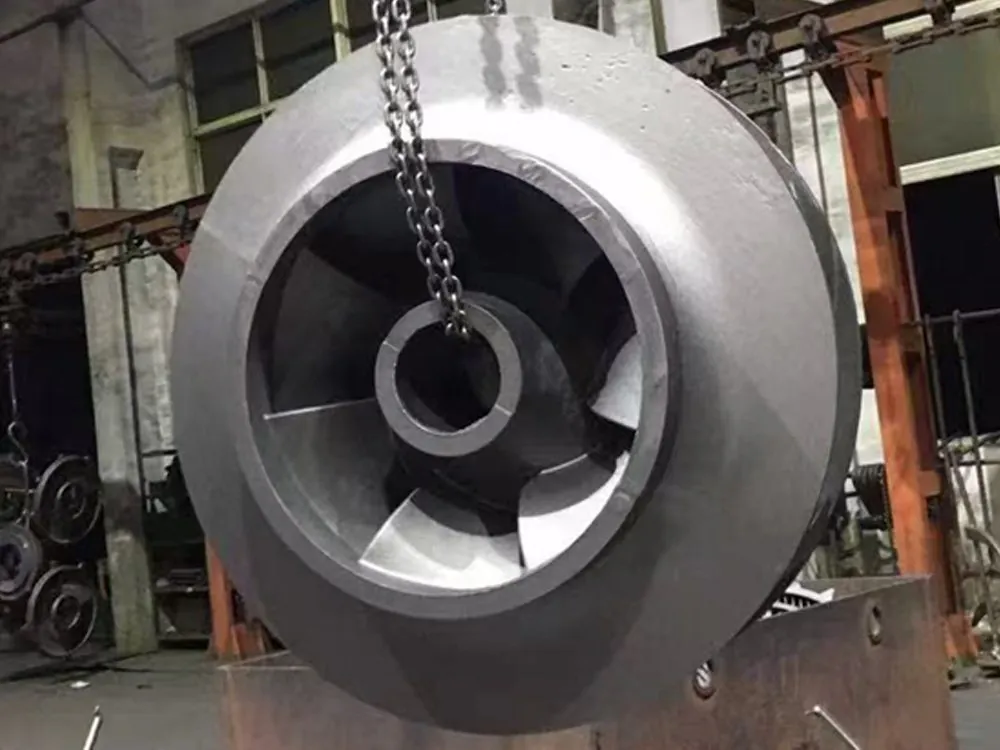
Printed mould for an impellerSand route, cores included 
Printed mould for a pump bodyWall thickness held as printed 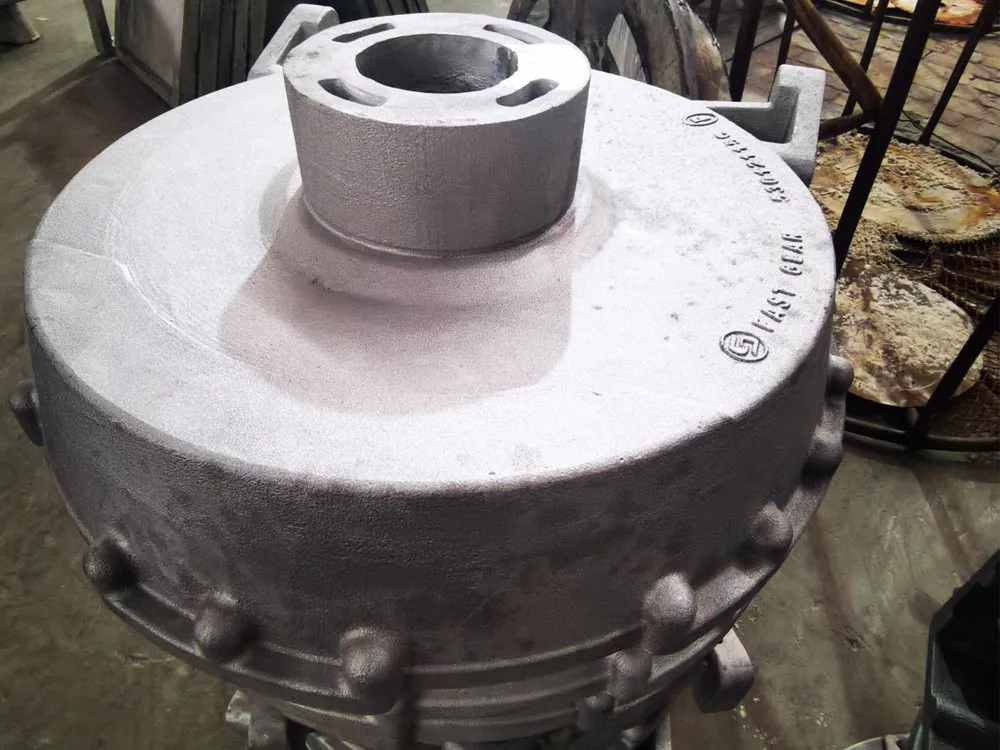
Poured from a printed mouldSteel casting after knock-out
The mould-making cycle runs about 70% shorter than the traditional route, and because there is no pattern there is nothing to amortise: one casting costs what one casting costs. The first part you receive is a real part in the real alloy, not a pattern and a promise.
The moulds are printed on our own binder-jetting sand printers — the 3DPTEK-J1800 for the moulds and cores up to about a metre, and the 3DPTEK-J4000 for the large steel casings printed in one piece instead of assembled from sections. Both run the phenolic resin that steel needs, and both are machines we build as well as operate. See the full sand printer range.
Defects cast steel is prone to
Steel has its own defect list, and it is a longer one than iron's. These six are the ones that actually decide whether your part passes, and every one of them is designed out at the rigging and melting stage rather than inspected out afterwards.
- 01
Shrinkage porosity
With no graphite expansion to offset contraction, an unfed heavy section will pull a void. Steel needs the largest feeders of any alloy we pour.
What we do. Size every riser against the section modulus and add chills where the geometry cannot be fed from one direction.
- 02
Hot tearing
A crack that opens while the casting is still hot and contracting, usually where a thin section meets a thick one or across an internal corner.
What we do. Radius the transitions in the rigging design, and use printed sand's collapsibility instead of fighting it.
- 03
Sand burn-on and veining
At steel temperatures the sand itself starts to react, fusing to the casting surface or forming veins where the mould cracked.
What we do. Higher-refractoriness silica, a coating where the section is heavy, and a controlled pour rather than a fast one.
- 04
Gas porosity
Nitrogen from the binder and moisture from the sand both end up as blowholes in the last metal to freeze.
What we do. Hold nitrogen below 3% for steel, dry the printed mould, and vent it rather than relying on the sand to breathe.
- 05
Distortion and warping
Steel moves more on cooling than iron does, so a long flat part can bow and a thin flange can pull out of flat.
What we do. Allow for the movement in the printed mould, and stress relieve before machining so the part stays where it is cut.
- 06
Segregation in low-alloy grades
Alloying elements can concentrate as the casting freezes, leaving a band that machines differently from the rest of the part.
What we do. Control the carbon equivalent and the cooling rate, and verify the chemistry on the heat before the casting is released.
Heat treatment and machining
A steel casting is almost never supplied in the condition it comes out of the mould. The as-cast grain structure depends on how the section cooled, the hardness depends on the carbon and alloy content, and the dimensions move when you cut it. The treatment and the machining are part of the casting, not an extra.
Normalising
Heated above the critical range and air cooled, to refine the grain and give a uniform structure. The usual starting point for a carbon or low-alloy steel casting before machining.
Quenching and tempering
For the strength and hardness a low-alloy or 17-4PH grade is specified for. The tempering temperature is set by the hardness you need, and we agree it with the drawing.
Stress relief
Before machining, always. Residual stress from cooling is what makes a part that measured true at the foundry fail to fit at assembly, and steel carries more of it than iron.
Machining
CNC from 3-axis to 5-axis in the same chain, after the treatment rather than before it. Carbon steel machines freely; the stainless and duplex grades work-harden, so the cutting strategy is set accordingly.
Inspection runs alongside it: nine methods in house, including CMM and 3D scanning, a chemical analysis on the heat, and non-destructive testing where the duty calls for it. The dimensional report and the material certificate come with the parts.
The steel foundry behind these castings
Steel is poured on our own steel line at the Shaanxi Xianyang plant, alongside the aluminium and copper lines. Melting, heat treatment and inspection stay inside one steel foundry, and the records ship with the casting.
- Melting and composition. Medium-frequency induction melting, with a spectrograph sample taken from every heat before it is poured. The carbon and alloy window is narrower in steel than in iron, so a heat that drifts is corrected while it is still in the furnace rather than after the casting has set.
- Moulds and cores from our own printers. The printed sand mould, or the printed wax pattern for the investment route, comes off machines on the same site. Nothing travels between suppliers between your CAD file and the pour.
- Heat treatment on site. Normalising, quenching and tempering, or solution treatment for the austenitic and duplex grades — in our own furnaces, with the metallurgical laboratory in the same plant. A grade is verified before the part is machined, not after.
- Testing and records. Spectrographic composition per heat, tensile and hardness testing, dimensional inspection on a coordinate measuring machine, and non-destructive testing before shipping. The heat number stays with the casting and the records are exported with it.
- Scale. The steel line runs about 1,500 tonnes a year, quoted from a few kilograms up to 2 t per pour in a 3 m envelope. Beyond that we will say so rather than quote a casting the line is not sized for.
Steel castings we have poured
Impellers, casings and bodies — the shapes that made steel worth casting in the first place. Because the mould or the wax pattern is printed, a different part every week costs nothing extra.
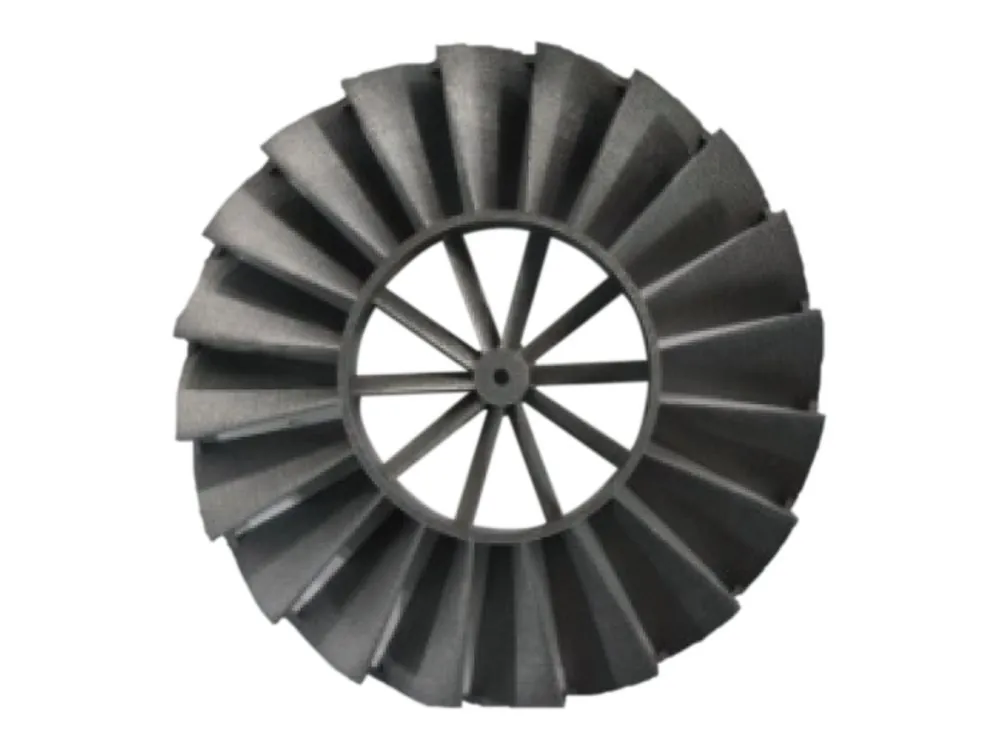
Turbocharger impellerInvestment route 
Turbine housing and engine caseLarge section, printed mould 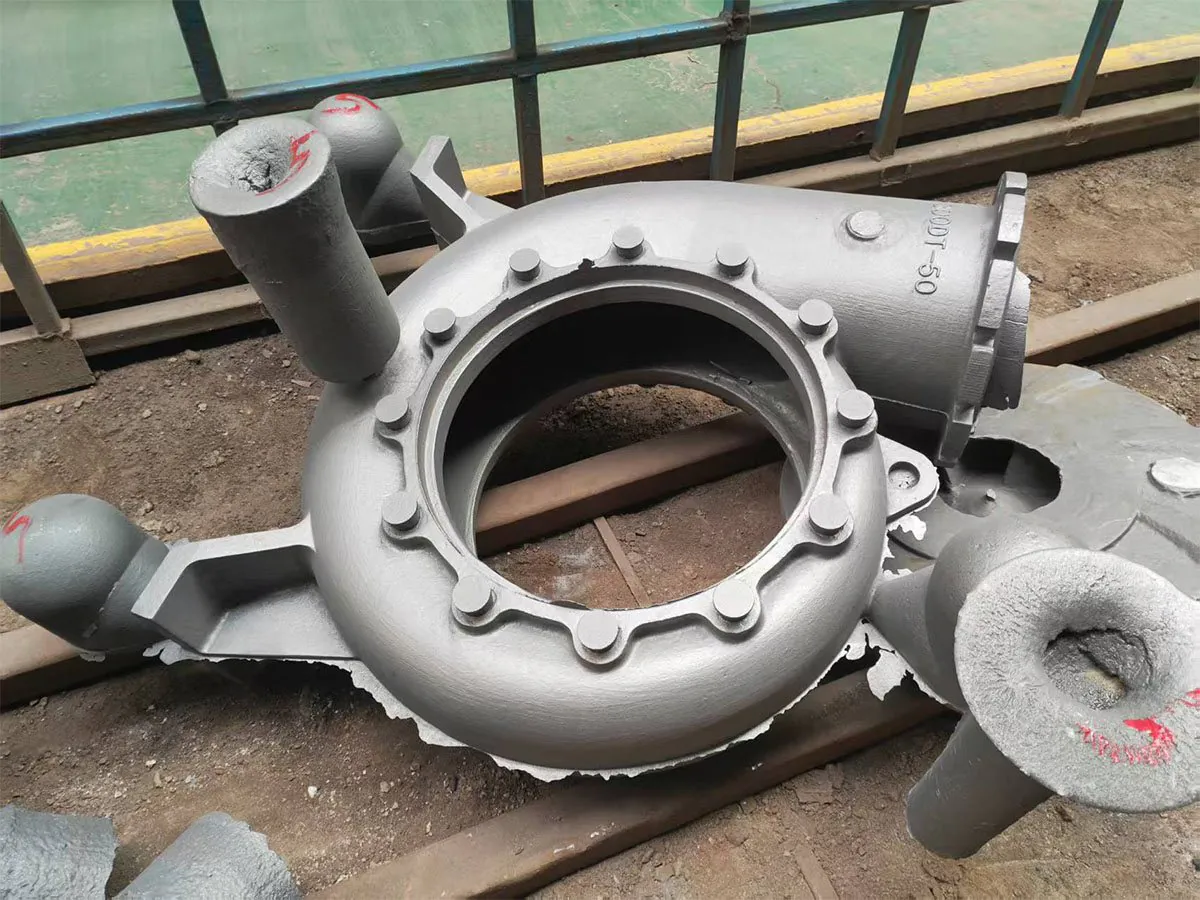
Thin-walled impellersWall held at print 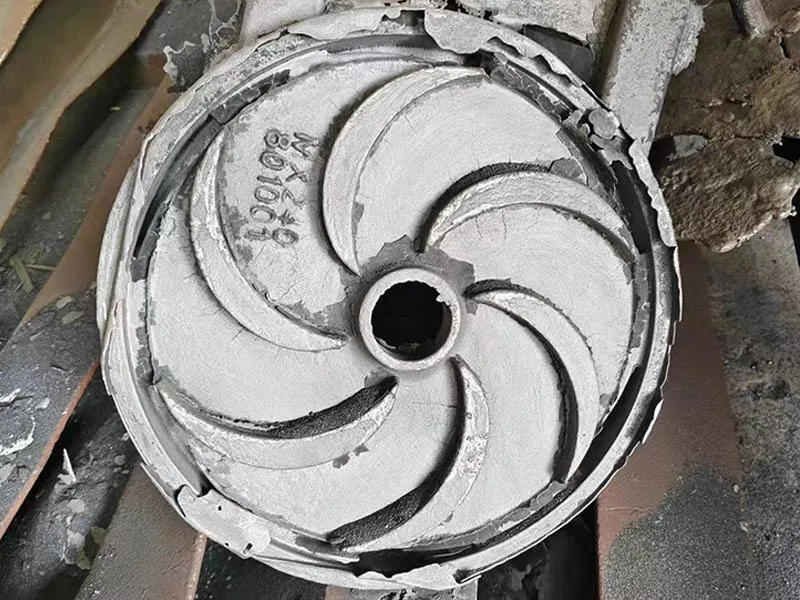
Impeller bowlAs-cast, from the foundry floor 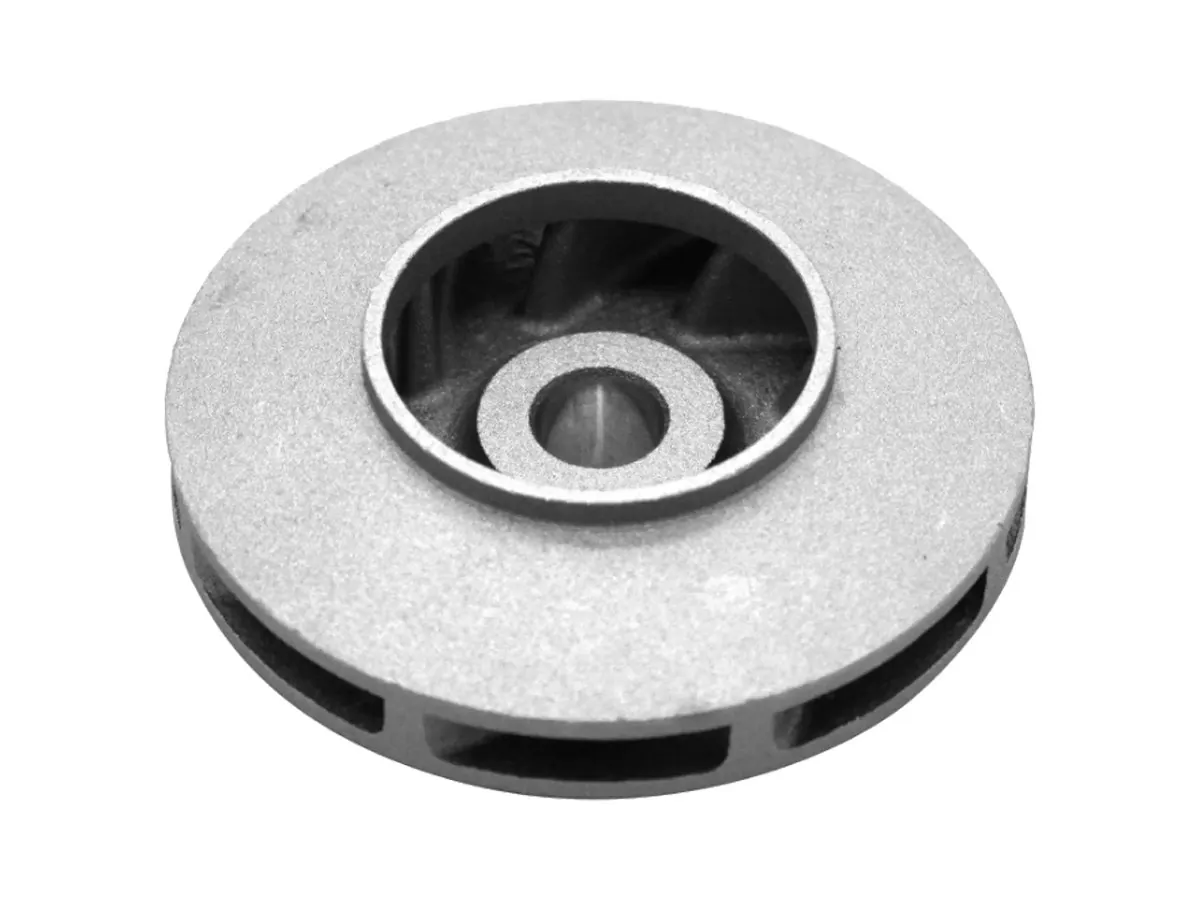
Closed impellerFuel pump duty 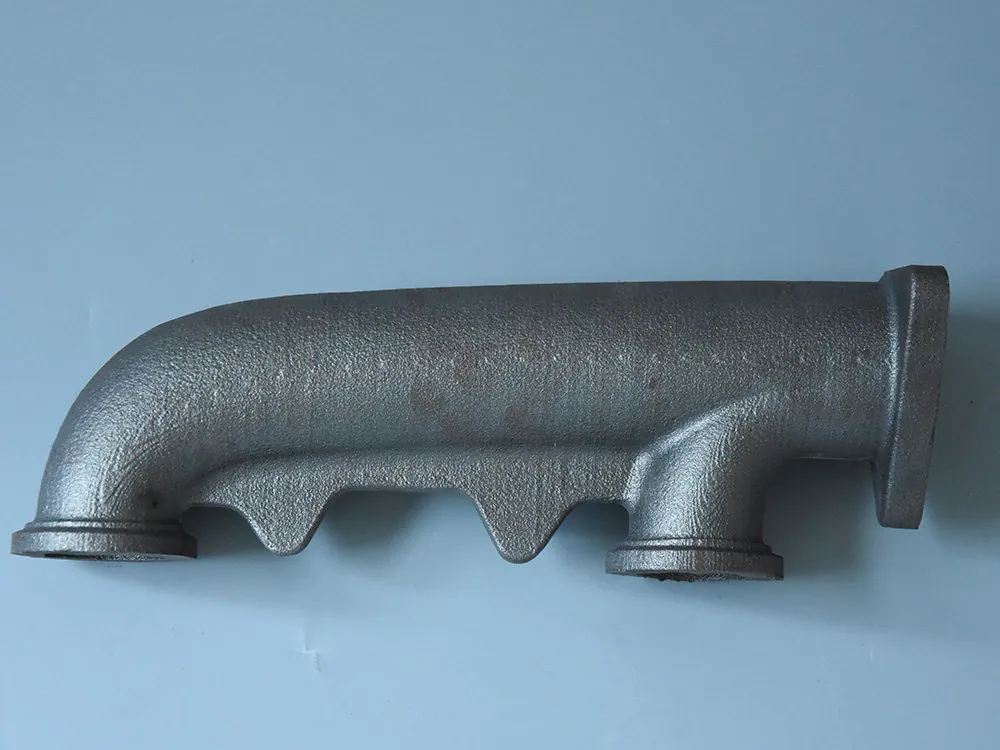
Intake manifoldFinished from a printed mould
Where cast steel pays off
Cast steel wins where the part needs strength, wear resistance or corrosion resistance in a shape that cannot be machined from solid economically, at a quantity that would never justify a pattern. In practice that is these:
Pump bodies and impellers
Thin-walled, curved, internal passages. The pump body that opened this page is exactly this family, and it is why the printed mould matters.
Valve bodies and trim
Pressure-retaining walls with flanges and bores in one casting, in carbon steel or in duplex where the medium is aggressive.
Turbine and engine casings
Large ring sections with bolt patterns and internal features. The casing in the gallery above is one of these.
Wear parts
Liners, plates and teeth in low-alloy or manganese steel, where the duty is abrasion rather than load.
Gears, levers and brackets
Load-bearing parts where cast steel replaces a forging or a weldment, at one-off quantities.
Marine and offshore hardware
Duplex 2205 for chloride duty, from deck hardware to process components.
There is also a family of parts where steel is simply the cheaper way to get a shape: an oversized bracket, a one-off machine component, a replacement part for plant that is no longer supported. Those never justified a pattern before. They do now.
What we do not do
Steel is the alloy where it is most tempting for a supplier to overstate what they can do, so it is worth being precise. These are the cases where we are the wrong answer, and we will say so in the first reply.
We are not a heavy steel foundry
Our steel line is built around printed moulds and printed patterns, which suits one-off and low-volume work to 2 t. If you need large steel castings in the tens of tonnes, or a supplier whose core business is steel, we are not it and we will tell you at enquiry.
We do not die cast or forge
High-pressure die casting and forging are different processes with different economics. We do neither, and we will not quote a steel part as if sand casting were interchangeable with them.
We are not the cheapest at high annual volume
A printed mould is economic because there is no pattern. Once a pattern pays back over thousands of parts a year, a conventional steel foundry will beat us on piece price. Our advantage is the first part, not the ten-thousandth.
We do not pour superalloys on the steel line
Inconel, cobalt-chrome and the nickel superalloys are real capabilities here, but they run through metal 3D printing or investment casting with a different thermal regime. Ask for the right route rather than the same one.
Choosing the right route for your part
If cast steel is not the answer, one of these is. Each one runs the same printed-mould or printed-pattern chain, so switching route does not cost you the lead time you were trying to save.
- Stainless steel casting
Corrosion resistance is the governing duty: 304, 316L, 17-4PH, duplex 2205.
- Precision investment casting
Thin walls, fine detail and tight tolerance — including the wax route described above.
- Aluminium casting
Lighter, better thermal conductivity, and no corrosion problem in most environments.
- Sand mould and core printing
When you need the printed mould or core itself as a product, not the casting.
- Rapid casting
When the programme is the constraint and the alloy is secondary.
- Materials guide
To check the alloy against the rest of the range.
- Ductile iron casting
The other ferrous route — QT400 to QT700 with graphite instead of a steel matrix.
- Bronze and brass casting
Non-ferrous, for bearing, marine and architectural duty rather than structural.
- Gravity casting
Aluminium and copper by gravity into a printed sand mould, to 5 m.
Not sure which one? Send the drawing and the duty, and let our application engineers make the call. We print the part before you commit to tooling, so the route is tested rather than argued.
Cast steel questions
What is cast steel?
Steel that has been poured as a liquid into a mould and allowed to solidify, rather than rolled, forged or machined from bar. Any steel that can be melted can in principle be cast; the practical families are carbon, low-alloy, stainless and duplex.
Why is cast steel harder to make than cast iron?
Because iron forms graphite as it solidifies and steel does not. That graphite occupies volume and partly feeds the shrinkage, so iron needs lighter feeders. Steel has to be fed entirely from risers, which lowers the casting yield and narrows the margin for error.
Should my part be sand cast or investment cast?
Sand casting if it has an internal cavity, an integral passage, walls of about 4 mm or more, or a finished weight above a few kilograms. Investment casting if it is thin-walled and intricate with fine detail. Send the drawing and we will tell you which one we would use.
Can you cast steel without a pattern?
Yes, and that is the point of the service. Sand moulds and sand cores are printed directly from your CAD file, and for the investment route the wax pattern itself is printed. No pattern is made either way, so there is nothing to amortise.
What is the largest steel casting you can make?
2 t for a single pour, in an envelope up to 3 m on the largest dimension, on a steel line with 1,500 t a year of capacity. If your part is bigger, send it anyway and we will tell you honestly whether it is a job for a heavy steel foundry instead.
Which steel grades do you pour?
Carbon steel, low-alloy steel, the 304, 316L and 17-4PH stainless grades, and duplex 2205. Specify by duty and hardness rather than by alloy alone where you can, because the heat treatment condition is part of the specification.
How long does a steel casting take?
The mould-making cycle runs about 70% shorter than the traditional route because there is no pattern, and the investment route avoids a pattern die as well. The rest of the time is melting, pouring, heat treatment and machining, which are the same steps any foundry runs.
Will I need heat treatment?
Almost always. Normalising for a uniform structure, quenching and tempering where a hardness is specified, and stress relief before machining in every case. We treat it as part of the casting rather than an optional extra.
Is cast steel weldable?
Generally yes, and considerably more so than cast iron, but the procedure depends on the carbon equivalent and the section. Tell us at enquiry if the part will be welded during fabrication and the grade and treatment will be specified with that in mind.
Is there a minimum order quantity?
One piece. There is no pattern cost to spread across a batch, so a single steel casting is a legitimate order. Serial production is welcome too, but it is not what the printed route is optimised for.
Send a drawing and we will tell you which steel route fits
Send the CAD file, the alloy or the duty, and the annual quantity. Our application engineers will come back with the route, the grade and the heat treatment condition, and a price — and if a conventional steel foundry or a different process is the better answer for your part, that is what we will tell you.
Your file stays confidential. Nothing is subcontracted: the mould or the wax pattern is printed, the steel is poured, and the casting is heat treated, machined and inspected in the same chain.