
Ductile iron castings, QT400 to QT700, sand cast without a pattern
We print the sand mould and the sand cores from your CAD file, so a single ductile iron casting is economic. No pattern, no pattern cost, no pattern lead time. Pour weight to 2 t, envelope to 3 m.
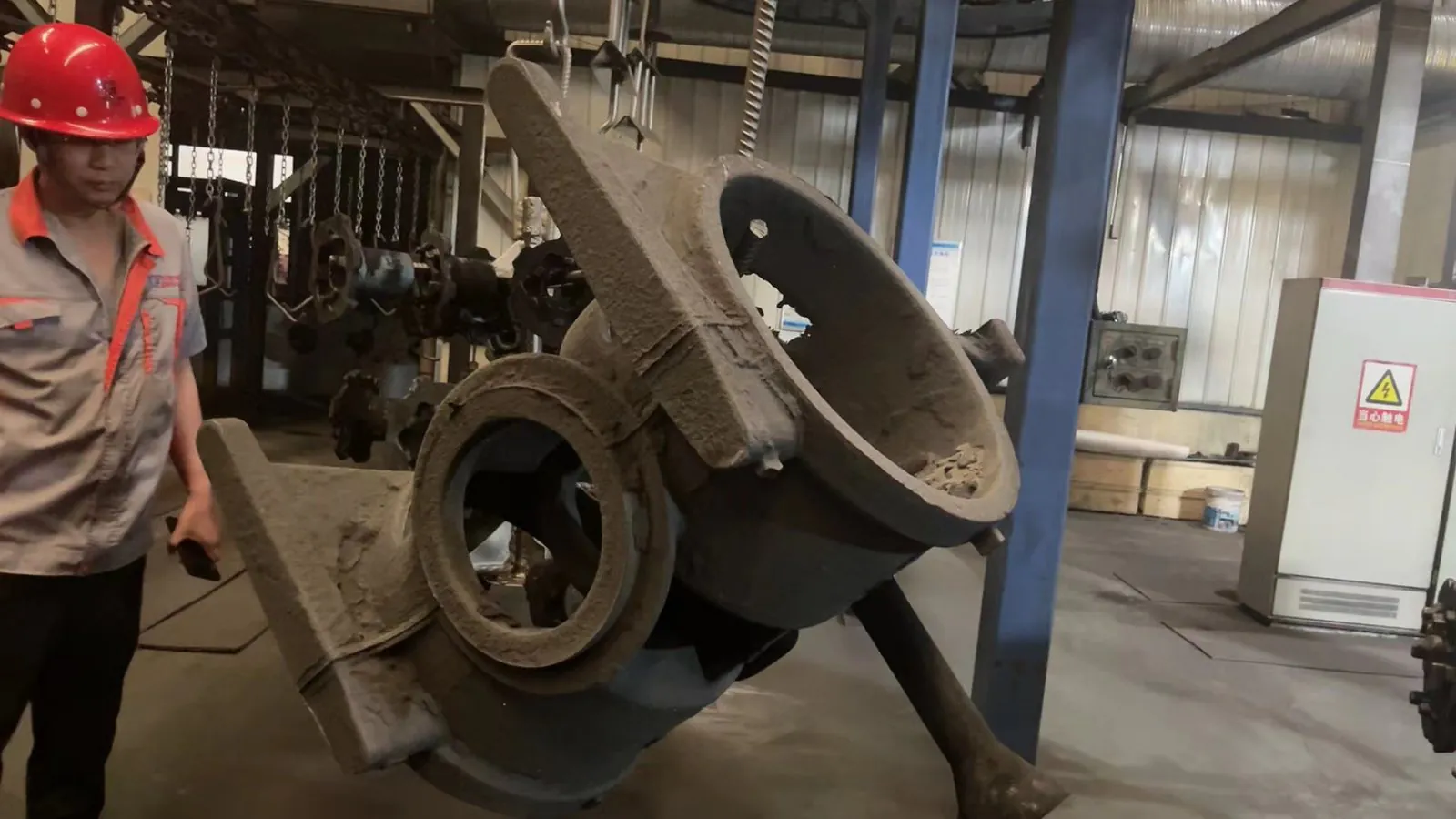
What ductile iron casting is, and when we quote it
Ductile iron is cast iron whose graphite grows as nodules instead of flakes. That single change is why it behaves like a metal rather than a brittle one: tensile strength from 400 MPa to 700 MPa with real elongation, on a foundry process that is still sand casting. We pour it in sand moulds that we print from your CAD file, which removes the pattern from the critical path.
Send us a drawing and a quantity. If the part is ferrous, thicker-walled, and the annual volume does not justify a pattern or a die, ductile iron in a printed sand mould is usually the cheapest sound route. If you need thin walls under about 4 mm, or volumes in the tens of thousands, we will tell you that a different process wins and point you at it.
This page is about the casting service. If what you need is the printed sand mould itself, or ductile iron is the wrong alloy for your duty, the links at the bottom of the page take you to the right service.
Why ductile iron, and not grey iron or cast steel
Three ferrous options land on the same foundry floor. Picking between them is a design decision, not a price decision, so it is worth being precise about what separates them.
Against grey iron. Grey iron is cheaper and damps vibration better, and for a rigid machine base it is still the right answer. What it does not have is elongation. Its flake graphite acts as an internal crack, so it fails without warning; ductile iron's nodules blunt the crack tip and give you 2% to 18% elongation before fracture, plus roughly double the tensile strength. Anything that sees impact, fatigue or a pressure boundary should not be grey iron.
Against cast steel. Steel is stronger and weldable. But steel shrinks far more on solidifying and has no graphite expansion to offset it, so it needs much heavier feeders and a bigger yield loss — and it pours about 100 °C hotter, which is harder on the mould. Ductile iron's graphite expansion during solidification partly feeds the shrinkage, so the rigging is lighter, the yield is better, and it machines considerably more freely. For a thick-walled housing or a pump body, ductile iron usually lands cheaper than the steel equivalent.
Against a printed sand mould in another alloy. The mould-making side is identical across all of them — the same printed sand, the same no-pattern economics. So choose the alloy on the duty, not on the supply route.
| Property | Ductile iron | Grey iron | Cast steel |
|---|---|---|---|
| Graphite form | Nodules (spheroidal) | Flakes | 없음 |
| Tensile strength | 400–700 MPa | 150–350 MPa | 450–650 MPa |
| Elongation | 2–18% | Under 1% | 12–25% |
| Shrinkage on solidifying | Partly offset by graphite expansion | Partly offset | Full, heavy feeders needed |
| Machinability | Free-cutting | Excellent | Harder on tooling |
| Vibration damping | Good | Best | Poor |
| Weldability | Limited, needs procedure | Poor | Good |
| Pick it when | Impact, fatigue or pressure duty on a thick-walled part | Rigidity and damping, no tensile duty | Highest strength or a welded assembly |
The ductile grades we pour
We pour QT400, QT450, QT500 and up to QT700, plus grey iron HT250 for the parts that do not need ductility. QT grades are Chinese national standard (GB/T 1348) designations, and the number carries the specification: the first figure is minimum tensile strength in MPa, the second is minimum elongation. So QT400-18 guarantees 400 MPa and 18% elongation.
Most overseas drawings call the same material by its ASTM A536 designation. The table below is the cross-reference our application engineers use when they read your drawing.
| Grade | Tensile, min | Elongation, min | Matrix | Nearest ASTM A536 | Typical duty |
|---|---|---|---|---|---|
| QT400-18 | 400 MPa | 18% | Ferritic | 60-40-18 | Low-temperature impact, pressure-retaining bodies, wind hubs |
| QT450-10 | 450 MPa | 10% | Ferritic–pearlitic | 65-45-12 | General engineering housings, pump and valve bodies |
| QT500-7 | 500 MPa | 7% | Pearlitic | 70-50-05 | Gears, brackets, transmission parts |
| QT600-3 | 600 MPa | 3% | Pearlitic | 80-55-06 | Higher-load gears and crankshaft-class parts |
| QT700-2 | 700 MPa | 2% | Pearlitic, heat treated | 100-70-03 | Maximum strength where ductility is secondary |
| ADI | To grade | To grade | Austempered | A897 | Wear plus toughness: gears, camshafts, wear plates |
| HT250 | 250 MPa | Not specified | Grey iron | Class 35 / GJL-250 | Machine bases, covers, non-pressure housings |
The elongation figure is what separates these grades in service, not the tensile figure. A drawing that specifies QT500-7 because it looks stronger can be the wrong call on a part that sees thermal cycling or impact — QT400-18 is the tougher material despite the lower number. Send us the duty and we will say which grade we would pour.
How the mould is made: printed sand, no pattern
A conventional ductile iron job starts with a pattern. Someone cuts a wooden or metal copy of your part, and that pattern is what sets your lead time and your minimum order quantity. It is also the reason a single casting is normally uneconomic.
We delete that step. Your CAD model is printed directly as a sand mould and as sand cores on a binder-jetting sand printer, using furan resin at 1.5–2.5% by weight. The mould arrives at the pouring floor in days rather than weeks, and the mould-making cycle drops by about 70% against the traditional route. Because no pattern exists, there is nothing to amortise: one casting costs what one casting costs.
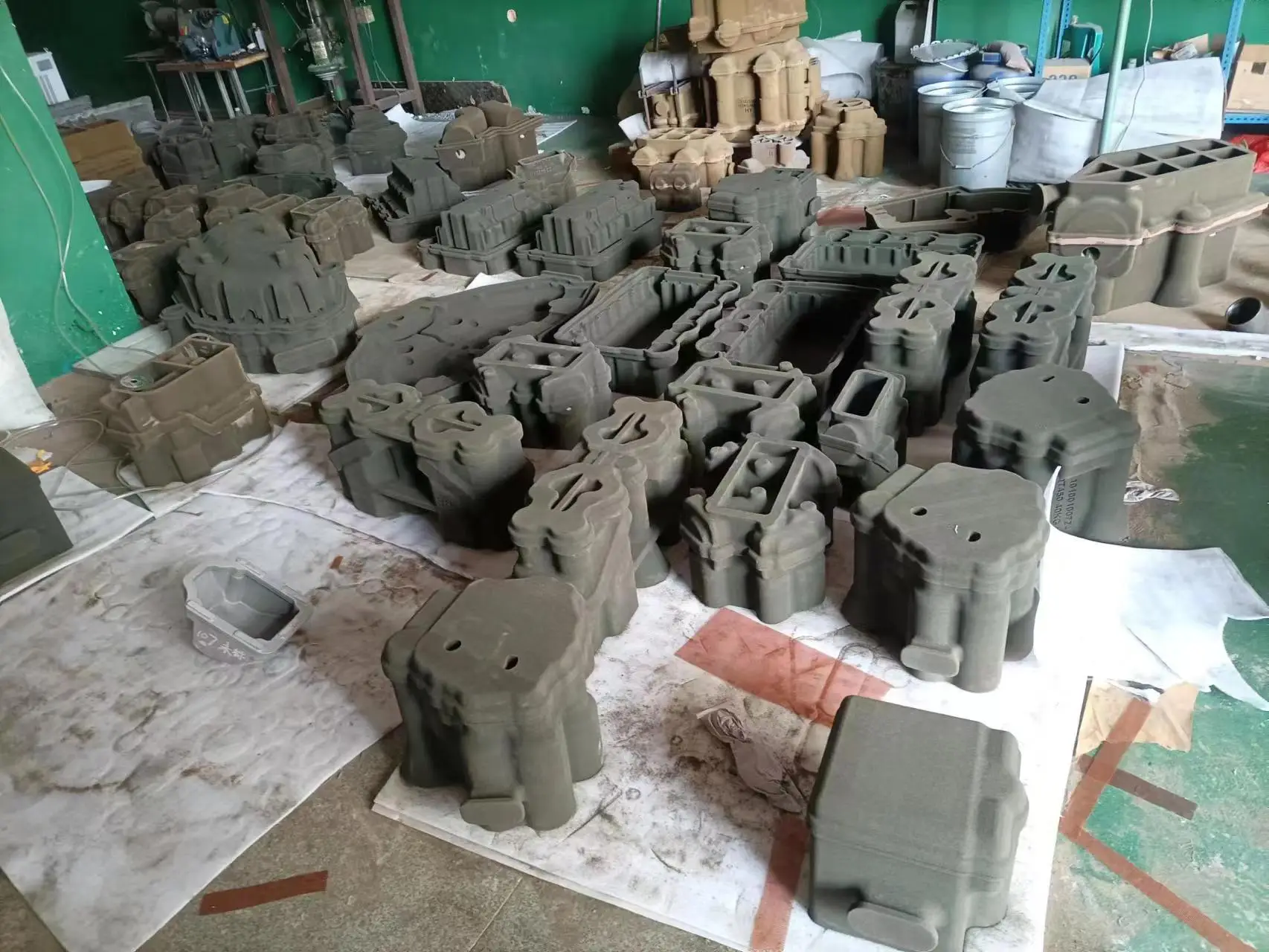 01 · Print
Mould and cores printed from CAD
The outer mould and every internal core are printed in one setup. No pattern, no core box, no draft angle to design around.
 02 · Assemble
Cores set as one assembly
Printed cores are glued into the mould as a single assembly, so internal passages and water jackets have no joint line and no core print to leak past.
 03 · Pour and finish
Poured, knocked out, machined
Iron is poured into the mould under gravity, then the casting is knocked out, shot blasted, heat treated and machined to the faces that need it.
What we can cast: size, weight, tolerance
These are the real limits of the iron line, not a marketing range. If your part sits outside them, say so in your enquiry and we will tell you straight away rather than after a week of quoting.
| 매개변수 | Capability | Note |
|---|---|---|
| Largest single pour | 2 t | One casting, iron |
| Maximum envelope | 3 m | Largest dimension of the finished casting |
| Annual iron capacity | 1,000 t | Across the iron casting line |
| As-cast tolerance | CT8–CT12 | Sand casting, ISO 8062 |
| As-cast surface | Ra 12.5–25 µm | Printed mould surface, before machining |
| Minimum practical wall | About 4 mm | Thinner walls need a machined or die-cast route |
| Minimum order quantity | 1 piece | No pattern cost to amortise |
Machining, heat treatment, surface treatment and inspection all run in the same chain, so you receive a finished part rather than a raw casting. That includes CNC machining from 3-axis to 5-axis, and nine inspection methods with CMM and 3D scanning.
The iron foundry behind every ductile iron casting
Ductile iron is poured on our own iron and steel line, not bought in and resold. Composition, heat treatment and inspection all stay inside the same iron foundry, and the records ship with the casting.
- Melting and composition. Medium-frequency induction melting, with a spectrograph sample taken from every heat before it is poured. The magnesium treatment that turns flake graphite into nodules fades with time, so the window between treatment and pour is kept short — this is the step that decides whether the casting is ductile iron at all.
- Mould and cores from our own printers. The printed sand mould and every core come off the binder-jetting printers on the same site, so the mould does not travel between suppliers before it is filled. Gravity pouring on the iron line, to 2 t per pour.
- Heat treatment on site. Stress relief, normalising, and austempering where an ADI grade is specified — in our own furnace, not at a subcontractor. A hardness or matrix specification is met before the part is machined, not after.
- Testing and records. Tensile and hardness testing per heat, dimensional inspection on a coordinate measuring machine, and non-destructive testing before shipping. The heat number stays with the casting so composition and process records can be traced back, and they are exported with the part.
- Scale. Across the group our iron foundry pours roughly 4,000 tonnes of iron a year. Ductile iron work is quoted from a few kilograms up to 2 t per casting, with no pattern cost at any point in that range.
Defects ductile iron is prone to, and what we do about them
Ductile iron is a more forgiving casting alloy than steel in one respect and a less forgiving one in another. The graphite expansion that cuts your feeder weight is also what makes the riser design less intuitive, and the magnesium treatment that creates the nodules is what introduces dross and fade. All six of these are designed out at the rigging and melting stage rather than inspected out afterwards.
- 01
Shrinkage porosity
Graphite expansion offsets some of the contraction, but not all of it. A heavy section isolated from a feeder still pulls a void.
What we do. Size risers against the actual modulus of each section rather than a rule of thumb, and use chills where the geometry will not feed.
- 02
Graphite flotation
In a very heavy section the nodules float, leaving a graphite-rich layer at the top and a weak, brittle zone beneath it.
What we do. Control carbon equivalent for heavy sections and avoid holding the melt above the temperature where flotation starts.
- 03
Dross and slag inclusions
Magnesium treatment creates a slag that floats. Carried into the cavity it becomes a hard inclusion that shows up at machining.
What we do. Quiescent pouring basin and a properly sized runner system, plus slag traps, so the first metal into the cavity is clean.
- 04
Spheroidisation fade
The magnesium that makes the nodules boils off over time. Hold the melt too long and the last castings of a heat come out as grey iron, not ductile.
What we do. Treat late in the sequence and cap the time between treatment and pour, with a nodularity check on the casting.
- 05
Gas porosity
Two sources: moisture in the sand, and nitrogen from the binder. Both show up as blowholes under the surface, in the last place to freeze.
What we do. Dry printed moulds, hold nitrogen in the binder below 5% for iron, and vent the mould rather than relying on the sand to breathe.
- 06
Chill and carbides at thin edges
A thin section against a cold mould surface solidifies white, forming carbides that destroy machinability and toughness.
What we do. Balance the carbon and silicon against the section thickness, and pre-heat or insulate the mould where the geometry goes thin.
Heat treatment, machining and inspection
A ductile iron casting straight out of the mould is rarely the part you install. The as-cast matrix depends on how the section cooled, and the dimensional result depends on residual stress that will move when you cut it. So the chain does not stop at knock-out.
Heat treatment
Stress relief before machining so faces stay where you cut them. Normalising where a pearlitic grade or a consistent hardness is specified. Austempering for ADI, where the duty needs wear resistance and toughness together.
Machining
CNC machining from 3-axis to 5-axis in the same chain, so a face that has to be flat, concentric or dowelled is cut after the stress relief rather than before it. Ductile iron machines freely, which is one of the reasons it undercuts steel on total part cost.
Surface treatment
Shot blasting to clean the as-cast skin, plus the coating or painting your drawing calls for. As-cast surfaces come off a printed mould at around Ra 12.5–25 µm, noticeably better than a traditional sand surface because the mould itself is printed rather than rammed.
Inspection
Nine inspection methods in house, including CMM and 3D scanning, plus non-destructive testing and a chemical analysis on the heat. You get the dimensional report and the material certificate with the parts, not on request afterwards.
A casting that is going to be machined all over should be stress relieved first. Rushing that step is the most common cause of a part that measured true at the foundry and does not fit at assembly.
Iron castings we have poured
Housings, bodies and structural parts, poured into printed sand moulds and finished in the same chain. The variety is the point: because there is no pattern, a different part every week costs nothing extra.

Ring housingsPoured and cleaned, awaiting machining 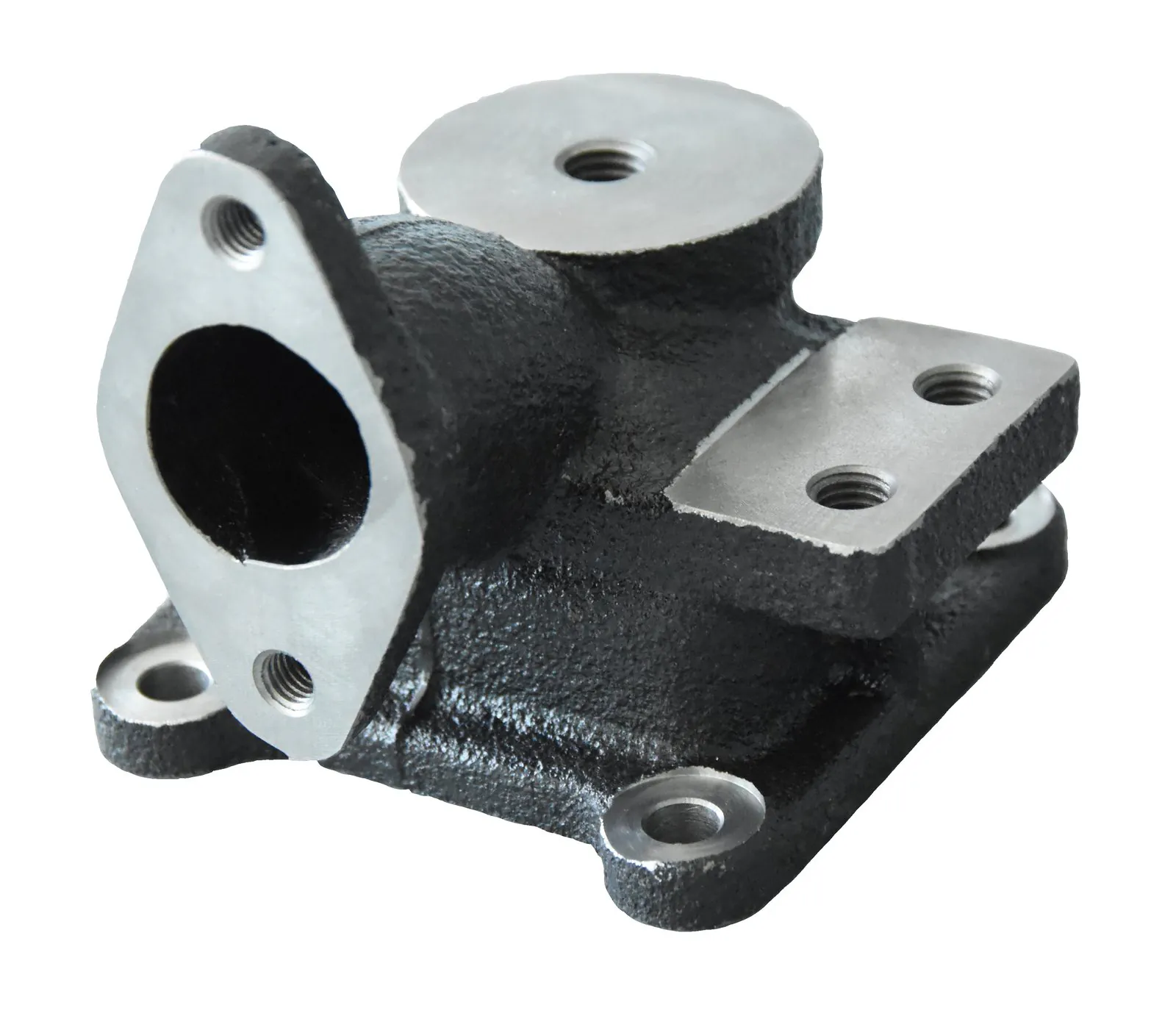
Cast iron elbowAs-cast, printed sand mould 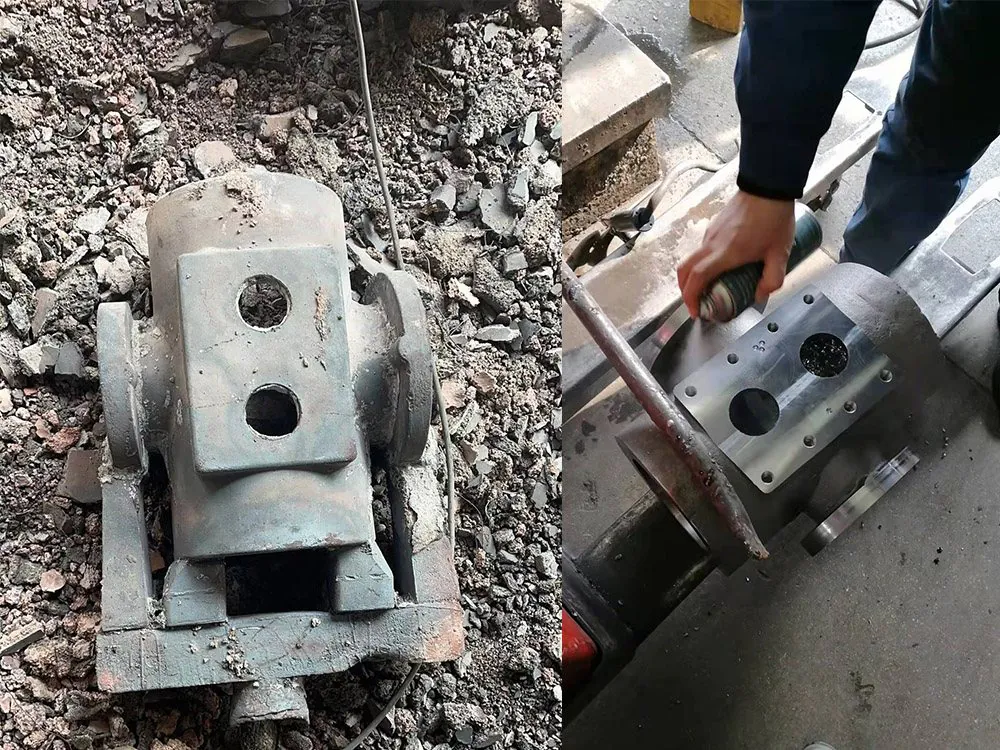
Ship valve bodiesPoured and knocked out 
Controller housingPressure-tight, machined all over 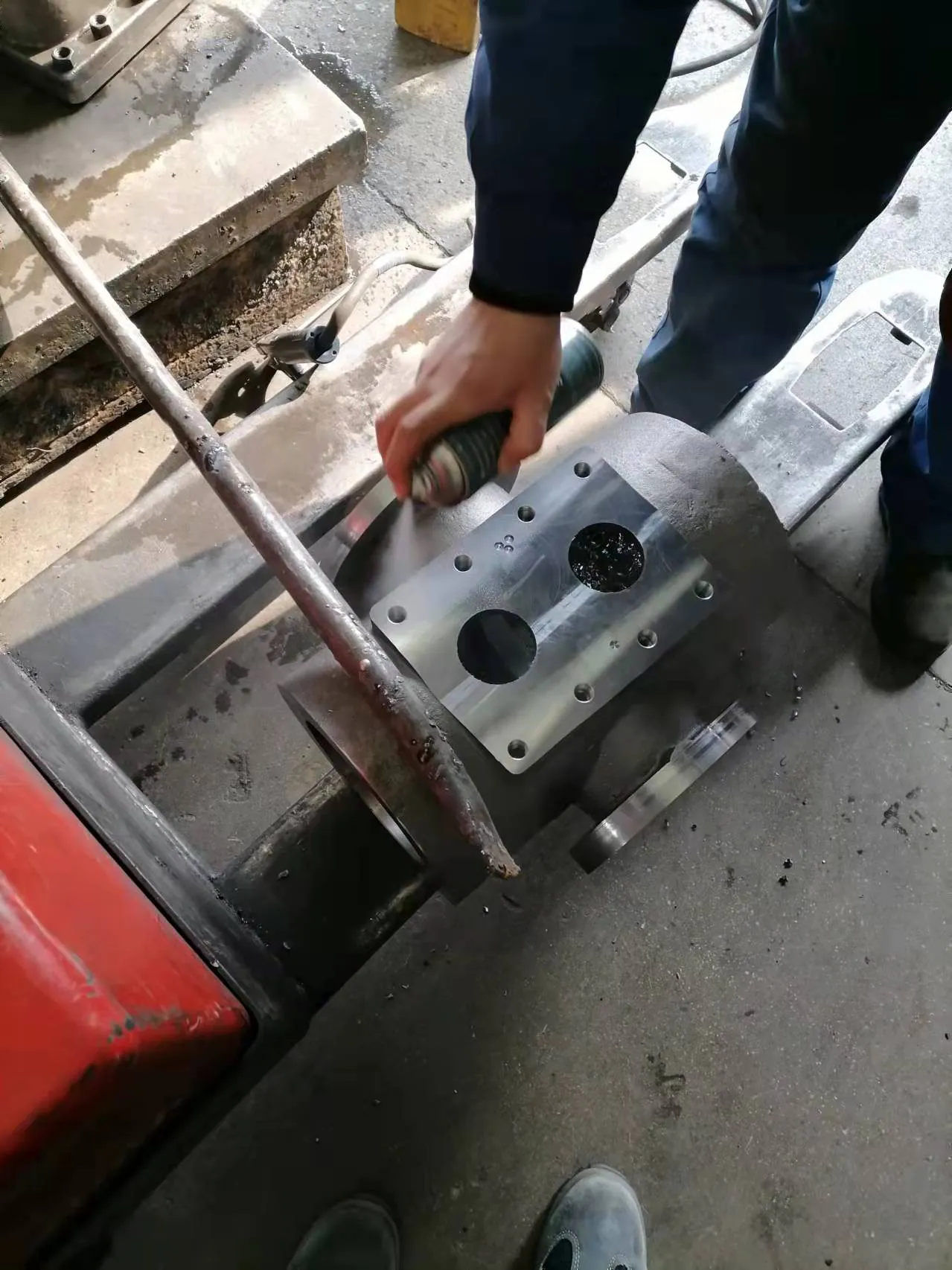
Machined valve bodyMachined after stress relief 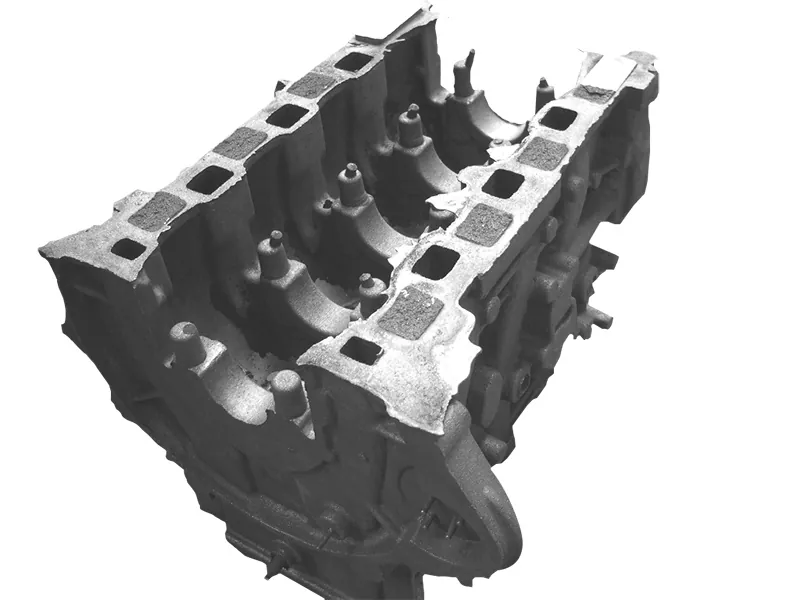
엔진 블록As-cast and machined faces
Case: a QT400 ductile iron engine block in 45 days
A customer needed an engine block in ductile iron for a development programme. The part is 520 × 430 × 426 mm in QT400, and the conventional route would have meant a pattern first, which put the programme behind before a single casting existed.
- The job
QT400 engine block, 520 × 430 × 426 mm
Outer mould printed in sand, cores printed and assembled, poured under gravity. No pattern was made at any stage.
- The result
5 castings delivered in 45 days
About 70% off the mould-making cycle against the traditional route, with the first casting available for testing long before a pattern would have been cut.
That is the pattern for most ductile iron work we see: a part that is too big or too complex to machine from solid, in a quantity too small to justify a pattern. Printing the mould moves the whole programme forward by the pattern lead time.
The printers that make ductile iron moulds
We build the machines as well as run them, so the equipment on our own iron line is the equipment we sell to foundries. Two models cover the ductile iron work: one for moulds and cores up to about a metre, one for the large housings.
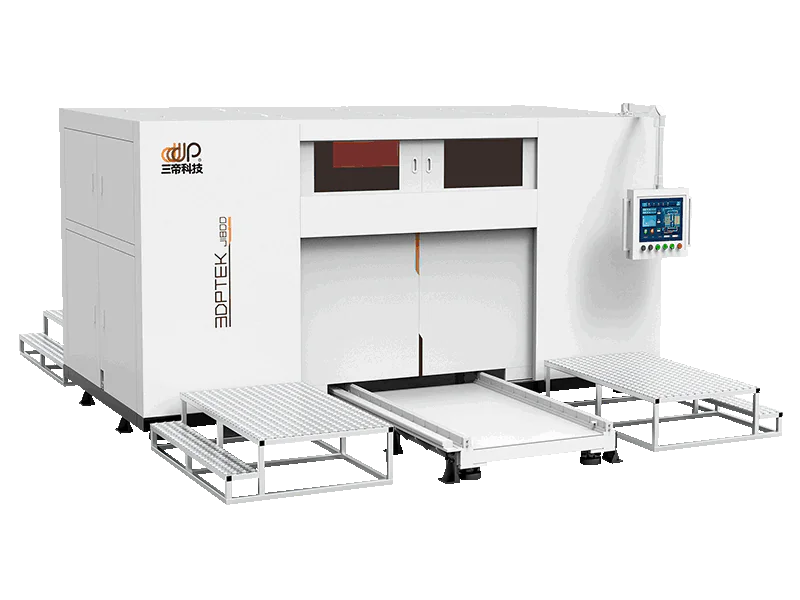
3DPTEK-J1800
The workhorse. Covers most ductile iron moulds and cores, and every one-off pattern you would otherwise have to make.

3DPTEK-J4000
Large format. For the moulds behind oversized iron castings, printed in one piece instead of assembled from sections.

Both machines print silica or ceramic sand with furan or phenolic resin. Furan is the one that suits iron. That is the same chemistry a traditional no-bake line runs, so a printed mould behaves like a mould your foundry already knows.
Where ductile iron pays off
Ductile iron wins wherever a part needs steel-like strength in a shape too complex to machine from solid, at a quantity too small to justify a pattern. In practice that is these:
Pump and valve bodies
Pressure-retaining walls, internal passages and flanges in one casting. QT450-10 or QT400-18, depending on the pressure and temperature duty.
Engine blocks and cylinder heads
Water jackets and oil galleries that a machined part cannot have. This is what the 45-day case above was.
Transmission and gearbox housings
Bearing bores, ribs and mounting faces in a single part, with the stiffness that comes from a closed section.
Gears, brackets and levers
QT500-7 and QT600-3 for the parts that see load and wear but need some give rather than none.
Hydraulic and controller housings
Complex internal geometry, pressure-tight, machined all over. The controller housing in the gallery is this family.
Heavy machinery and wind parts
Hubs, beds and frames where the section is thick and the weight is high. QT400-18 for the low-temperature impact duty.
There is also a family of parts where ductile iron is simply the cheaper way to get a shape: an oversized bracket, a one-off machine bed, a pump body for a single installation. Those never justified a pattern before. They do now.
What we do not do
It is more useful to know where a supplier stops than to read a list of what they claim. These are the cases where we are the wrong answer, and we will say so in the first reply rather than after a week of quoting.
We do not die cast
High-pressure die casting is a different process with a different cost structure, and it is the right answer above roughly 10,000 parts a year. We do not run it, and we will not quote a die-cast part as if sand casting were equivalent.
We are not the cheapest route at high annual volume
A printed mould is economic because there is no pattern. Once a pattern or a die pays back over tens of thousands of parts a year, a traditional foundry or a die caster will beat us on piece price. Our advantage is the first part, not the hundred-thousandth.
We do not hold walls under about 4 mm in iron
Sand casting has a minimum practical wall, and iron is less forgiving than aluminium. If your geometry is thin-walled and intricate, investment casting or a machined part is the better route and we will point you at it.
We do not pour titanium or superalloys as iron
Titanium, Inconel and the nickel superalloys are real capabilities here, but they run through investment casting or metal 3D printing, not through the iron line. Ask for the right route rather than the same one.
Choosing the right route for your part
If ductile iron is not the answer, one of these is. Each one runs the same printed-mould or printed-pattern chain, so switching route does not cost you the lead time you were trying to save.
- sand casting service
Ferrous casting in general, grey iron and steel included.
- aluminium casting
Non-ferrous instead: lighter, with better thermal conductivity.
- stainless steel casting
When corrosion resistance is the governing duty.
- precision investment casting
Thin walls, fine detail, tight tolerance, small parts.
- sand mould and core printing
When you need the printed mould or core itself as a product.
- 신속 주조
When the programme is the constraint and the alloy is secondary.
- materials guide
To check the alloy against the rest of the range.
- Cast steel casting
The other ferrous route — carbon, low-alloy and stainless, by sand or wax.
- Bronze and brass casting
Non-ferrous alternative where wear, marine duty or a bearing is the driver.
- Gravity casting
When the part is aluminium or copper and a printed sand mould is the cheaper route.
Not sure which one? Send the drawing and the duty, and let our application engineers make the call. We print the part before you commit to tooling, so the route is tested rather than argued.
Ductile iron casting questions
What is the difference between ductile iron and cast iron?
"Cast iron" usually means grey iron, where the graphite forms flakes. Ductile iron treats the melt with magnesium so the graphite forms nodules instead. That one change roughly doubles tensile strength and gives the material real elongation, so it bends instead of cracking. Both are still sand cast.
What does QT400-18 mean?
It is a GB/T 1348 grade. QT stands for the Chinese term for ductile iron, 400 is minimum tensile strength in MPa, and 18 is minimum elongation in percent. QT400-18 is a ferritic, tough grade. Its nearest ASTM A536 equivalent is 60-40-18.
Can you cast ductile iron without a pattern?
Yes, and that is the whole point of this service. The sand mould and the cores are printed directly from your CAD file, so no pattern is made. There is nothing to amortise, which is what makes a single casting economic.
What is the largest ductile iron casting you can make?
2 t for a single pour, in an envelope up to 3 m on the largest dimension. If your part is larger, send it anyway and we will tell you whether it splits into sections or goes elsewhere.
How long does a ductile iron casting take?
It depends on the part, but the mould-making cycle runs about 70% shorter than the traditional route because there is no pattern. The QT400 engine block case above went from drawing to five finished castings in 45 days.
Which ductile iron grade should I specify?
Specify by duty rather than by the biggest number. QT400-18 for impact and low temperature, QT450-10 for general pressure-retaining bodies, QT500-7 and QT600-3 where load and wear dominate. Send us the duty and we will say which one we would pour, and why.
Do you do ADI?
Yes, austempered ductile iron is available. It needs a specific austempering treatment after casting rather than a simple normalise, so tell us the wear and toughness requirement on the drawing and we will confirm the grade and the treatment route with the quote.
Is ductile iron machinable?
Very. It machines considerably more freely than cast steel because the graphite acts as a lubricant at the cutting edge. That is a large part of why the total part cost is often lower than the steel equivalent, even when the raw casting is not.
What tolerance can you hold on a ductile iron casting?
CT8 to CT12 as cast, to ISO 8062, with an as-cast surface around Ra 12.5 to 25 µm. Anything tighter is achieved by machining, which we do in the same chain after stress relief.
Is there a minimum order quantity?
One piece. There is no pattern cost to spread across a batch, so a single casting is a legitimate order. Serial production is welcome too, but it is not what the process is optimised for.
Send a drawing and we will tell you if ductile iron is right
Send the CAD file, the alloy callout if you have one, and the quantity. Our application engineers will come back with the grade we would pour, the route, and a price — and if a different process is the better answer, that is what we will tell you.
Your file stays confidential. Nothing is subcontracted: the mould is printed, the iron is poured, the casting is heat treated, machined and inspected in the same chain.