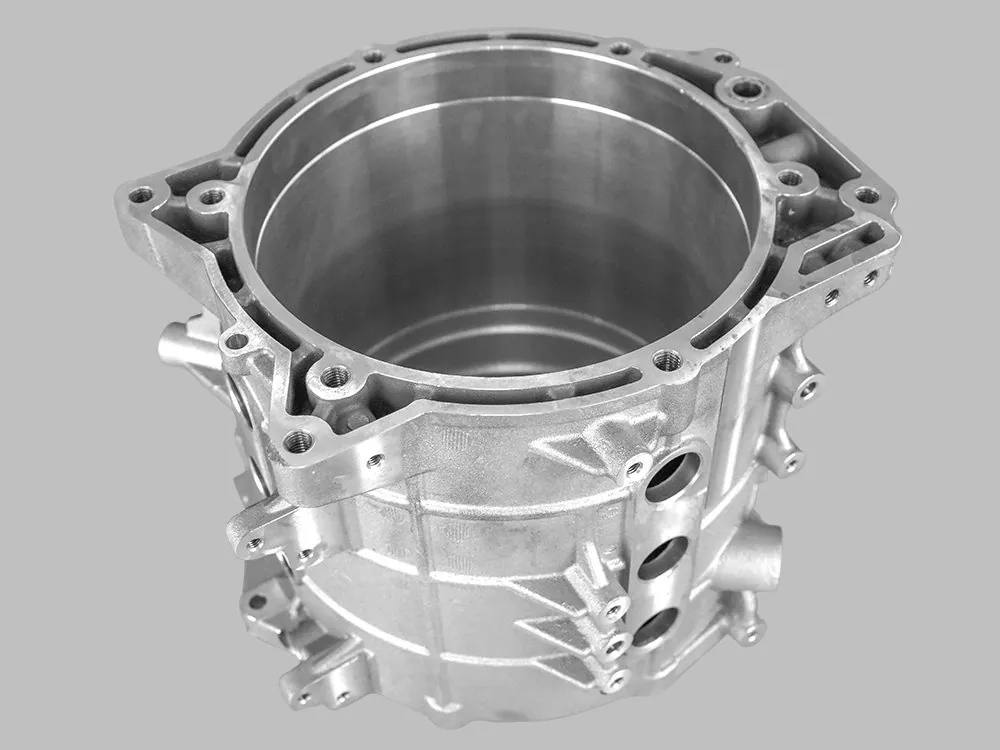
3D Printer for Metal: Binder Jetting vs SLM, and What Each Costs

A metal 3D printer builds parts from metal powder in one of two ways: binder jetting deposits a binder into the powder and sinters the green part to full density in a furnace, or SLM melts each layer with a laser on the build plate itself. Industrial systems run US$120,000–570,000, roughly RMB 0.85–4.05 million ex-works, depending on build envelope, process, laser or printhead count, gradient capability and whether the debind-and-sinter furnace is included.
Key takeaways
- There are only two families of metal 3D printer. Almost every difference in price, speed and part quality follows from which one you pick.
- Binder jetting reaches full density in the sintering furnace, not on the build plate — so the furnace is part of the system, not an accessory.
- Per-part cost falls faster with binder jetting at volume; SLM wins on density and alloy range straight off the plate.
- Build envelope is the single largest price driver, larger than the process itself.
- Gradient capability — two alloys fused in one part — exists only on the SLM side, and it is the one capability no conventional process can substitute.
Two families of metal 3D printer
The distinction that matters to a buyer is not brand or model — the full metal 3D printer range splits along exactly this line. It is whether the metal is melted during the build or after it. That single fact determines the alloys available, the density you get, the post-processing route and the cost curve at volume.
Binder jetting — print the shape, sinter to density
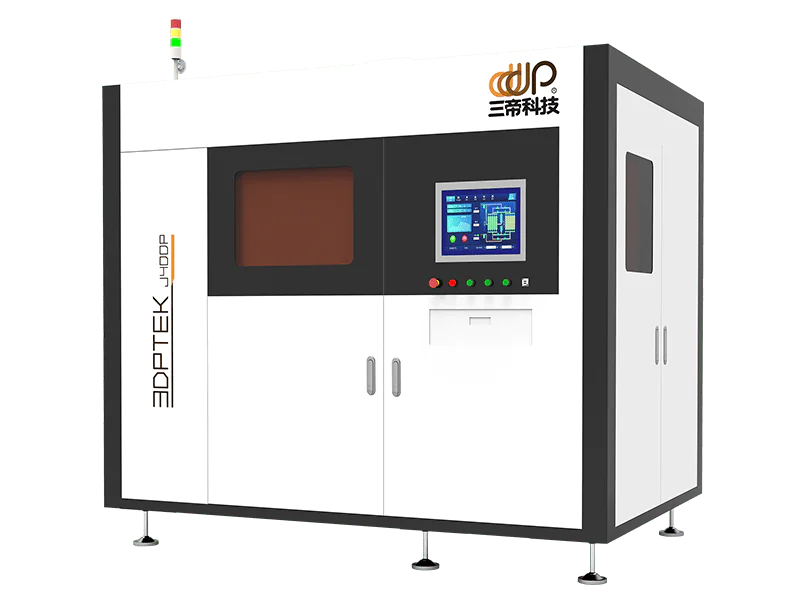
A printhead moves across the powder bed depositing a liquid binder, binding one layer at a time. The result is a “green” part — the correct geometry, held together but porous, at roughly 55–67% of final density. The part then goes through two thermal steps: debinding, which removes the binder, and sintering, which closes the porosity to about 99% of theoretical density.
The consequence is architectural. The printer is fast because it does not melt anything; the Leitfaden zum Binder-Jetting-Verfahren covers the thermal cycle in detail. The furnace does the metallurgy. Throughput per machine is high, and cost per part at volume is the lowest of any metal process — but only if the furnace cycle is filled, because an empty furnace run costs almost as much as a full one.
SLM — melt each layer with a laser
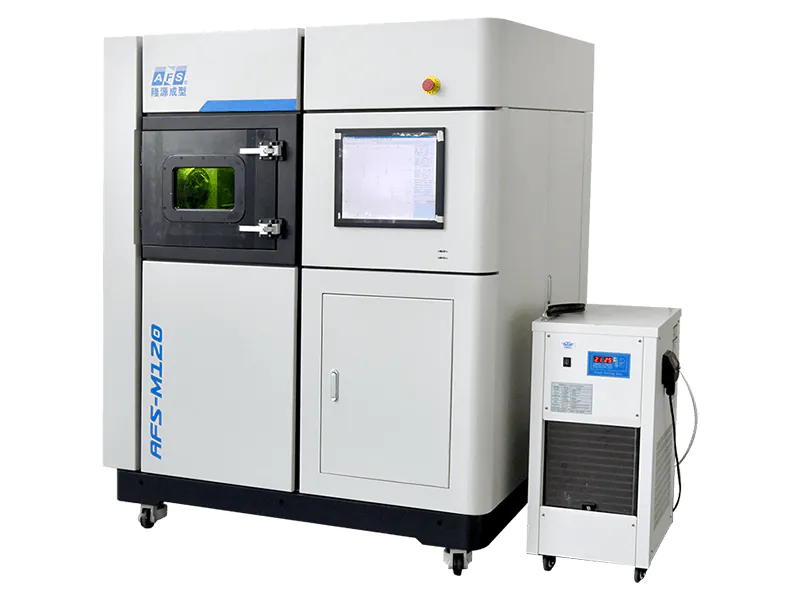
Selective laser melting fuses each layer completely with a fibre laser, typically 400–1000 W, in an inert atmosphere. The part comes off the plate at 99.5–99.9% relative density, with mechanical properties close to wrought material after stress relief and heat treatment.
SLM requires support structures on overhangs, because there is no powder bed holding the geometry up during the build — the surrounding powder supports it, but the part must be anchored to the plate. Those supports are removed by hand or by machining, and they are a real cost line, not a detail.
| What matters | Binder-Jetting | SLM |
|---|---|---|
| How it forms | Printhead deposits binder into powder; debind and sinter in a furnace | Laser fully melts each layer on the plate |
| Density off the machine | Green, roughly 55–67% | 99.5–99.9% |
| Density after processing | ~99% after sintering | Unchanged — already dense |
| Supports | None — the powder bed supports every overhang | Required, and removed afterwards |
| Bauzeit | High — one pass per layer regardless of area | Slower — area-dependent, laser-bound |
| Furnace needed | Yes, debind and sinter, quoted separately | No — heat treatment only, for stress relief |
| Legierungsreihe | Stainless, tool steel, CoCr, nickel, copper, ceramic | Stainless, titanium, aluminium, CoCr, nickel, tool steel, copper |
| Multi-alloy in one part | Not currently | Yes — gradient in X, Y and Z |
| Cost per part at volume | Lowest of any metal process | Higher, but no furnace step |
Which metal parts can each process make?
Both processes produce functional metal parts. The differences show up on specific geometries, and it is worth checking your part against each one before choosing.
| Part feature | Binder-Jetting | SLM | Warum |
|---|---|---|---|
| Thin walls below 0.5 mm | Limited | Better | Sintering distortion limits thin green sections |
| Fine internal channels, 0.3–1 mm | Good | Good | Both print channels the powder can be cleared from |
| Large single parts, 300 mm and above | Strong | Envelope-limited | Binder jetting systems are built around large beds |
| High part count in one build | Strong | Moderate | Binder jetting fills the bed without laser time cost |
| Gradient or multi-alloy | Not available | Available in X-Y-Z | Requires multiple powder feeds on the SLM platform |
| Ceramic parts | Available | Not applicable | Same binder jetting platform, silicon carbide |
| Wrought-equivalent fatigue properties | After sintering and HIP | After heat treatment | Both need a thermal step to reach design allowables |
Thin walls and fine channels
Both processes print internal channels, which is the main reason either is chosen over machining. The difference is the lower limit: SLM holds a 0.3 mm channel more reliably, because the part never goes through a shrink-and-sinter cycle. Binder jetting imposes a sintering allowance, typically 15–20% linear shrinkage, so thin features must be designed thicker to survive.
Large single parts
Binder jetting systems are generally built around larger beds, and because the process is not laser-time-bound, filling a large bed costs little more than filling a small one. When the part is 300 mm or larger in a single direction, the choice is usually made by the envelope rather than by metallurgy.
Multi-alloy or gradient parts
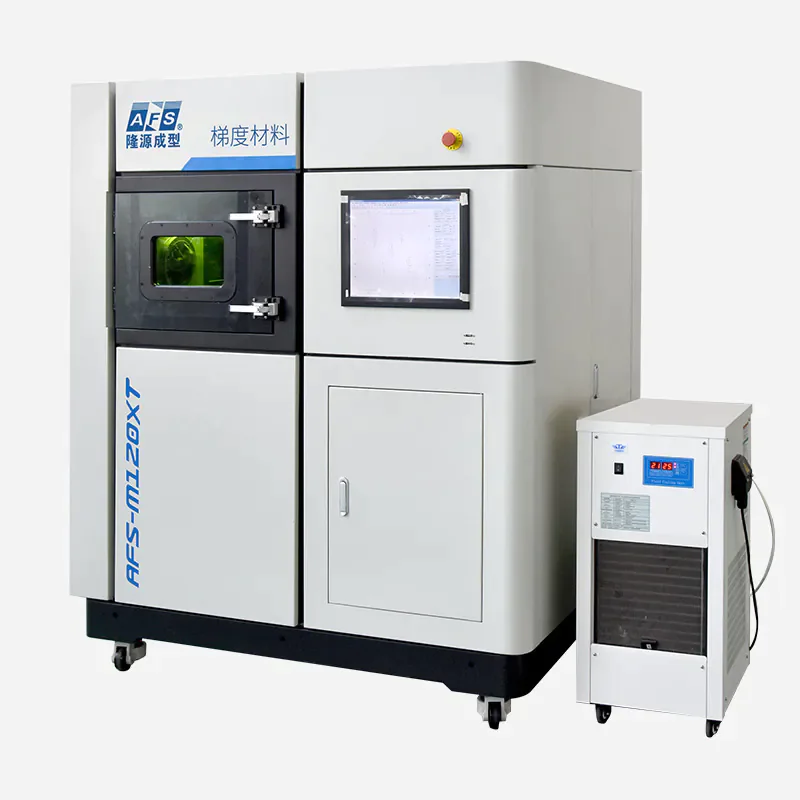
Gradient metal — two alloys fused in one monolithic part, with the transition controlled in X, Y and Z — is available on the SLM side only. It removes the weld or braze joint that conventional manufacturing creates between dissimilar metals, which is usually the failure initiation site. For parts that must be hard on one face and corrosion-resistant on the other, no other process produces a single piece.
Which machine fits which job
Five machines cover the range that most buyers are choosing between. Two routes use binder jetting, three use SLM — one of those adds in-process CNC machining. The right starting point is the job, not the model number.
| Modell | Process | Bauraum | Energy / heads | Durchsatz | Built for |
|---|---|---|---|---|---|
| 3DPTEK-J400P | Binder-Jetting | 380 × 380 × 300 mm | 3 or 6 heads · 1200 dpi | 3.6 L/h metal | MIM-line replacement |
| 3DPTEK-J800P | Binder-Jetting | 800 × 500 × 400 mm | 4 heads · up to 1200 dpi | 8 L/h metal · 12 L/h SiC | Large-format production |
| AFS-M120 | SLM | 120 × 120 × 150 mm | 1 × 500 W IPG | — | Compact single-alloy work |
| AFS-M120XT | SLM | 120 × 150 × 150 mm | 1 × 500 W IPG · dual powder | X + Z gradient | High-temperature and refractory alloys |
| AFS-M300XAS | SLM + CNC | 300 × 300 × 250 mm | 2 × 500 W IPG | X-Y-Z gradient, 4+ powders | Hybrid additive plus in-process machining |
Build volume and throughput are the figures published for each system. Price is not shown against a model — configurations change the number more than the model number does.
Read the table this way: if the part is a batch of identical components and cost per part is the constraint, start with the J400P or J800P. If the part needs to be fully dense with no furnace step, start with the M120. If it needs two alloys fused into one piece, only the M120XT and M300XAS do that. See the full metal 3D printer range for the other models and their datasheets.
What drives the price
Quotes for metal 3D printers vary by more than four times across the industrial range — our metal 3D printer cost breakdown goes deeper on the per-part side. Five factors account for almost all of it, and only one of them is brand.
Build envelope — the largest single factor
Frame size, powder handling, recoater mechanics, gas flow and the inert atmosphere system all scale with the bed. A machine with twice the build volume is not twice the price — it is typically two to three times the price, because the enclosure, the powder circuit and the material handling all change class.
Process — binder jetting and SLM share almost no hardware
A binder jetting system is a precision printhead, a powder spreader and a large frame. An SLM system is a laser, a scanner, an optical train and a gas-tight chamber. Comparing their prices is comparing two different machines that happen to make the same category of part. Binder jetting also carries a furnace cost that SLM does not.
Laser or printhead count
On the SLM side, every additional laser adds a laser source, an optical path and a scanning strategy to keep the beams from interfering. Two lasers is a substantial step; four is another. On the binder jetting side, printhead count drives throughput the same way, but the cost increment per head is lower.
Gradient capability
Feeding two or more powders into one build requires separate hoppers, separate recoating paths and software that controls the composition transition. It is added tooling, not a software option, and it is priced accordingly. Where a part genuinely needs it, it is also the only way to make that part.
The debind-and-sinter furnace
Binder jetting produces a green part, so the furnace is part of the production system. Depending on the alloy and the required atmosphere, a sintering furnace can represent a significant fraction of the total line cost — and it should be quoted in the same conversation as the printer, not discovered afterwards.
Taken together, these five factors put industrial metal 3D printers in the range of US$120,000 to US$570,000, approximately RMB 0.85 to 4.05 million ex-works, depending on configuration. A machine configured for a small envelope, one laser and a single alloy sits at the bottom of that range; a large-envelope, multi-laser, multi-powder system with a matched furnace sits at the top.
Throughput: the number that decides the business case
Machine price is a capital question. Throughput is the operating question, and it usually decides whether the investment pays back.
| Measure | Binder-Jetting | SLM |
|---|---|---|
| What limits throughput | Furnace batch size, not the printer | Laser time, layer area and part height |
| Parts per build, small parts | Hundreds, nested in the bed | Dozens, limited by laser time |
| Typical production rate | 8 L/h of metal on a mid-size system | Area-bound; roughly 20–60 cm³/h per laser |
| Cost per part at 1,000+/year | Lowest of any metal process | Higher per part, higher value per part |
| Labour per build | Depowder, furnace load and unload | Depowder, support removal, machining, heat treat |
Cost per part at volume
At volume, binder jetting is commonly reported as 3–5× cheaper per part than SLM. The gap comes from three places: the build runs without laser time cost, the powder bed needs no supports, and the parts nest densely. That is the reason MIM lines evaluating a switch look at binder jetting first — the economics are compared against injection moulding, not against machining.
SLM’s advantage is different. It removes the furnace from the critical path, it works in alloys that sinter poorly, and it can produce gradient parts. For a low-volume, high-value part — a conformal-cooled tool insert, a titanium bracket, a gradient wear surface — the higher per-part cost is not the deciding number.
Alloys you can actually buy
Alloy availability decides more projects than density does, because a process that cannot run your material is not a candidate regardless of its other merits.
| Familie | Qualified grades | Typische Anwendung | Binder-Jetting | SLM |
|---|---|---|---|---|
| Stainless steel | 304, 316L, 17-4PH | Corrosion-resistant functional parts, marine and food equipment | Yes | Yes |
| Titan | Ti6Al4V | Aerospace and medical, where strength-to-weight decides | Limited | Yes |
| Tool steel | H13, 4140, 2709 | Moulds and dies, including conformal cooling | Yes | Yes |
| Cobalt-chrome | CoCrMo | Wear surfaces, biomedical, hard half of a gradient part | Yes | Yes |
| Nickel superalloy | Inconel 625, 718 | Hot-section and high-temperature service | Yes | Yes |
| Aluminium | Al alloys | Lightweight housings and heat-transfer parts | Limited | Yes |
| Copper and tungsten | Cu, W alloys | Thermal management, electrical contacts, radiation shielding | Yes | Yes |
| Keramik | Silicon carbide | Wear parts and kiln furniture | Yes | Not applicable |
Across the platform, more than 30 alloys are qualified. They run on an open material model: powder can be sourced from certified third parties, and the process parameters are published rather than locked to a single supplier.
What to ask before you buy
Four questions separate a machine that pays back from one that becomes a parts department.
Powder lock-in
Ask whether the machine runs certified third-party powder. A closed system ties your cost per part to one supplier for the life of the machine, and removes any negotiating position on material price. This is the single most expensive detail in a metal 3D printing purchase, and it is rarely the first question asked.
Parameter ownership
Ask who owns the process parameters for each alloy. If they are published, a second machine can run the same parts. If they are not, every future site, every replacement machine and every service bureau becomes a new qualification project.
Is the sintering furnace included?
For binder jetting, ask explicitly. A printer quote without a furnace is an incomplete production line, and the furnace is where the part becomes metal.
Who runs the machine for you first?
Ask whether the supplier will print your parts before you commit. A supplier that operates its own production foundries can be measured on its own yield, not on a demo part. Five owned manufacturing centres running the same machines commercially is a different kind of reference from a showroom sample.
Have a part and a volume? Send the model — our application engineers will run it both ways where both apply, and tell you which route the economics favour. Binder jetting metal service · Metal 3D printing service
Frequently asked questions
How much does a metal 3D printer cost?
Industrial metal 3D printers run US$120,000–570,000, roughly RMB 0.85–4.05 million ex-works, depending on configuration. Build envelope, process, laser or printhead count, gradient capability and whether a debind-and-sinter furnace is included account for most of the spread.
Can a 3D printer make a fully dense metal part?
Yes, by both routes. SLM produces 99.5–99.9% relative density directly on the build plate. Binder jetting produces a green part at 55–67% density, which reaches about 99% after debinding and sintering. Hot isostatic pressing can lift both further where design allowables require it.
Do I need a furnace with binder jetting?
Yes. The printer only forms the shape. Debinding removes the polymer binder and sintering closes the porosity — without the furnace the part is not metal in any usable sense. The furnace is part of the production line and should be quoted with the machine.
Which is faster, binder jetting or SLM?
Binder jetting is faster per machine on part count, because the build is not laser-time-bound and parts nest densely in the bed. SLM is faster to a finished metal part when the furnace cycle is the bottleneck, since it needs no sintering step.
Can one machine print two alloys in one part?
On the SLM side, yes — multi-powder feeding produces composition gradients in X, Y and Z within a single monolithic part, with no weld or braze joint. Binder jetting does not currently offer this. It is the one capability in metal 3D printing that no conventional process can substitute.