
Sand 3D Printer Europe: CE Compliance, Sand Reclamation and EU Funding Routes

European foundries are the oldest customers of industrial sand 3D printing, yet most buyers on the continent still pay two to four times what equivalent equipment costs from a Chinese manufacturer. A 1,800 × 1,000 × 800 mm binder jetting system from ExOne or voxeljet lands in a German or Italian foundry in the hundreds of thousands of euros, while the same build volume from 3DPTEK sits in a lower price band with identical furan and phenolic binder compatibility. That gap matters more in Europe than anywhere else, because the economics of sand casting here are defined by pattern cost and lead time. Delivery, CE certification, installation and local support are all covered in this guide, written for European foundry managers who want the machine decision on the table without the marketing.
The European foundry market in 2026
Europe remains the densest concentration of casting capacity in the Western world, and the numbers from the European Foundry Federation (EFF) 2024 annual report tell you exactly where the industry stands. Germany alone operates 514 foundries employing roughly 64,500 people, and produced about 3.36 million tonnes of castings in 2024. Italy runs 861 foundries at 1.63 million tonnes. France follows at 330 foundries and 1.42 million tonnes. Poland, the fastest-growing casting country in Central Europe, counts 455 foundries and 667,000 tonnes. Germany, Türkiye, France, Spain and Italy together account for roughly 82 percent of all ferrous tonnage in Europe.
What matters for this guide is not the headline tonnage but the direction. Every major European casting country reported declining production in 2024 — Germany down 14 percent, Italy down 12.3 percent, France down 6.8 percent, Poland down 11.5 percent. The reasons are familiar to anyone running a foundry on the continent: energy prices that never returned to pre-2022 levels, tightening environmental regulation, and Chinese foundries competing on price in exactly the segments European shops used to own. Foundries are not shrinking because they are bad at casting. They are shrinking because they are losing jobs that require fast, low-volume, complex parts — the jobs sand 3D printing is built for.
That is why the conversation among European foundry managers has shifted from “should we look at 3D printed molds?” to “how fast can we get one running?” The foundries that adopted binder jetting early — the BMW Landshut light-metal plant uses ExOne binder jetting in series production, and voxeljet demonstrated a fully automated sand printing line at GIFA 2023 in Düsseldorf — are not treating it as a lab curiosity. They are running it as production equipment and pricing jobs they could not have quoted before. The adoption curve differs sharply from other regions, and our Руководство для покупателей 3D-принтеров для печати песком covers the selection framework if you are starting from scratch.
What a sand 3D printer actually costs in Europe
Let’s be direct about pricing, because this is where the market gets confusing. List prices are rarely the number that matters, and published figures vary so widely with configuration that a single number misleads more than it helps. The table below shows the machines a European foundry can actually buy today, with relative price positioning rather than fake-precise quotes. For the 3DPTEK line we follow the same planning ranges our published cost guide uses; for Western-brand machines the ranges are public-market estimates that buyers consistently report. Exact pricing depends on configuration, binder supply contracts and whether you add automation (job-box handling, unpacking stations, reclamation loops) — which is why the only honest answer is a formal quotation.
| Производитель | Модель | Объем сборки | Ценовое позиционирование | Delivery to Europe | Система материалов |
|---|---|---|---|---|---|
| 3DPTEK | J1800 | 1 800 × 1 000 × 700 мм | Средний диапазон, зависит от конфигурации | 6–8 недель | Открыть |
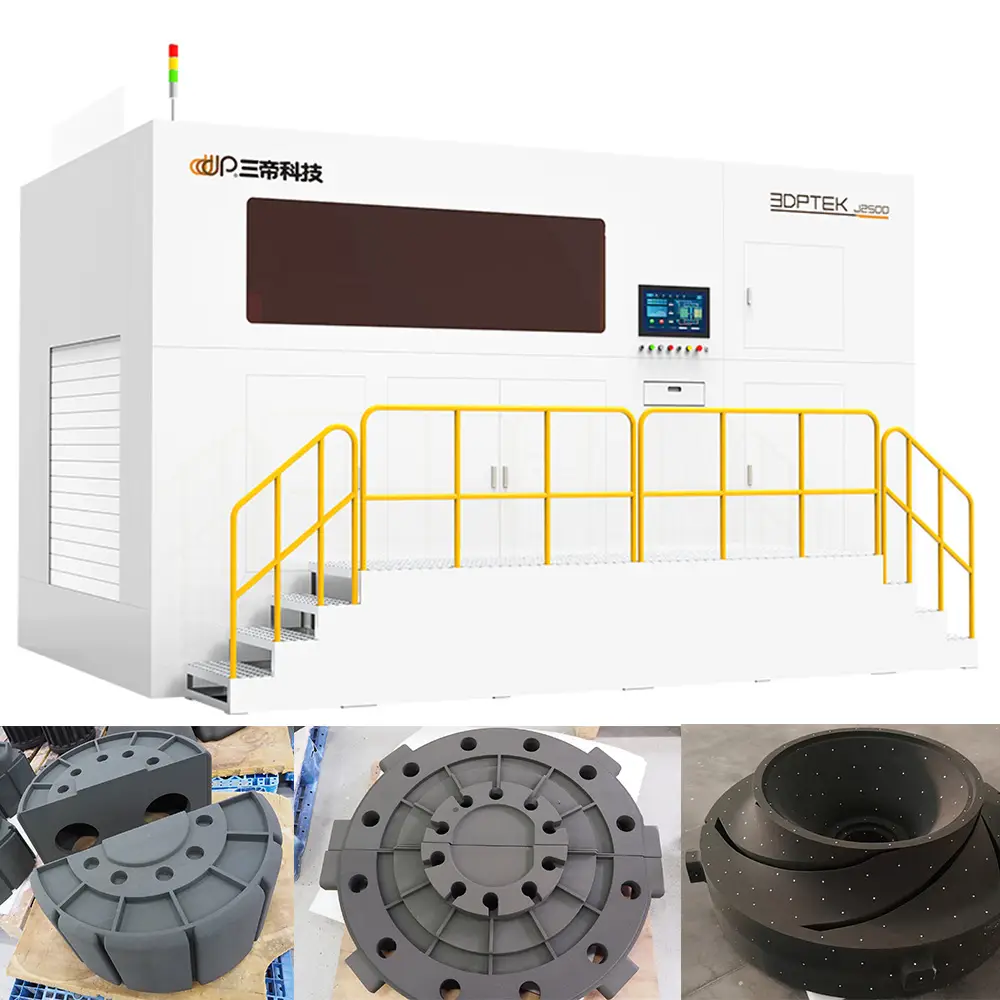
| 3DPTEK | J2500 | 2 500 × 1 500 × 1 000 мм | Средний и большой диапазон, зависит от конфигурации | 2 месяца | Открыть |
| 3DPTEK | J4000Pro | 4 000 × 2 500 × 1 500 мм | Крупноформатный, класс с семизначным показателем | 2–3 месяца | Открыть |
| ExOne (Desktop Metal) | S-Max Pro | 1800 × 1000 × 800 мм | Примерно в 2–3 раза больше, чем у J1800 (по общепринятым оценкам) | 4–7 месяцев | Полузакрытый |
| voxeljet | VX1000 | 1000 × 600 × 500 мм | Самая высокая стоимость на единицу объёма в группе (по общедоступным оценкам) | 6–9 месяцев | Закрыто |
A few honest observations about that table. First, the voxeljet VX1000 is the smallest machine here (1,000 × 600 × 500 mm) yet carries the highest per-build-volume cost — a published academic purchase record from a South African foundry program showed the VX1000 costing the equivalent of roughly €750,000 once delivered and installed, and European buyers report similar magnitudes. Buyers with an existing voxeljet relationship get continuity, but they pay for it. Second, ExOne’s S-Max Pro is a genuinely mature machine with a strong installed base — the price premium buys proven software and process documentation, not more build volume. Third, the 3DPTEK J1800 sits in the same build-volume class as the S-Max Pro at a fraction of the price, with an open material system we’ll come back to, because that is the detail that changes your five-year cost more than the purchase price does. If you want the full head-to-head on where the cost difference actually comes from, our Анализ соотношения затрат и выгод западных и китайских 3D-принтеров breaks it down line by line, and our полное руководство по расходам gives the complete breakdown of machine, consumables and per-mold costs.
The 3DPTEK lineup for European foundries
3DPTEK builds three binder jetting platforms that cover the range European foundries actually need, plus SLS platforms for precision cores. For most jobbing and production foundries on the continent, the decision comes down to the J1800 and the J2500.

Этот J1800 (1,800 × 1,000 × 700 mm) is the entry point that covers pump bodies, valve housings, gear cases, impellers and small-to-medium engine components. It is the machine a 30-to-200-tonne-per-month foundry can justify on pattern cost alone. Pattern elimination matters more in Europe than almost anywhere else: a machined pattern for a complex core that costs €3,000–€15,000 in Germany, with a 4-to-8-week lead time, disappears entirely. The J1800 sits in 3DPTEK’s mid-range price band — a planning figure, not a quote — which our cost guide lays out alongside the full per-mold economics.
Этот J2500 (2,500 × 1,500 × 1,000 mm) is the workhorse for mid-size and larger foundries serving automotive, energy and heavy machinery. It handles engine blocks, transmission cases, large valve bodies and structural castings up to about 2.5 metres. This is the model we recommend first to most European buyers because it covers roughly 90 percent of the parts a foundry will be asked to quote — typically at a fraction of the cost of an equivalent Western-brand platform in the same size class.
Этот J4000Pro (4,000 × 2,500 × 1,500 mm) exists for one reason: parts over 2.5 metres that have to be cast as a single piece — wind turbine housings, large energy components, marine diesel blocks. In this class your realistic alternatives are a used VX4000 or a very long wait; the J4000Pro is the only new large-format system a European foundry can get in under three months. Large-format platforms like this sit in the seven-figure class at 3DPTEK, exactly as they do at voxeljet. For the full specification comparison across the line, see our Страница с ассортиментом 3D-принтеров Sand, or our ranked comparison of every machine on the market.
Delivery, CE certification and installation in Europe
Timing is where the price gap compounds. A European foundry that orders an ExOne or voxeljet machine today is looking at four to nine months before the crate arrives — and that is before installation, which typically takes another two to four weeks with their engineers on site. 3DPTEK ships to EU ports in six to eight weeks for the J1800 and roughly two to three months for the larger platforms. Installation engineers travel to your foundry for setup, operator training and process qualification, typically one to two weeks on site.
On compliance: 3DPTEK machines are built to CE standards for the European market, with full documentation for the Machinery Directive and CE declaration of conformity included in the handover package. Electrical specification is 380 VAC / 50 Hz as standard — the European grid — and the machines run standard industrial furan (furan no-bake) and phenolic binder systems, so your existing binder supply chain keeps working. If you are buying under a framework that requires a specific certificate, ask us during quotation; we provide the documentation set before shipment.
Materials: the open-system question European buyers should push on
Here is the question we get from every European foundry that has been burned by a proprietary material contract: do I have to buy your sand and binder forever? The answer for 3DPTEK is no, and it is the single biggest TCO difference versus the Western platforms.
3DPTEK machines run any commercially available silica sand with AFS grain fineness 50–80, chromite sand for high-temperature applications, and ceramic sand where surface finish demands it. European foundry sands — German H32/H34 quartz sands, French and Italian washed silica sands, Polish quartz sands — have all been validated on our machines. Binder is the same furan or phenolic chemistry you already use for conventional core shooting; you buy it from your existing chemical supplier, not from us.
ExOne runs a semi-closed system where the machine is certified on a narrower binder set, and voxeljet’s VX1000 is a closed system with proprietary binder consumables. Over a five-year period at two-shift operation, the open system on a 3DPTEK machine typically saves a five-figure sum in consumables alone compared with proprietary binder pricing — a number worth more than most discounts you will negotiate on the machine itself. Our detailed Анализ открытых и закрытых материальных систем подробно объясняет весь математический процесс.
Sand reclamation and environmental pressure
European foundries face environmental rules that most of the world does not, and sand 3D printing turns out to be a help rather than a burden. The spent furan-bonded sand from 3D printed molds is the same chemistry as your conventional no-bake sand, which means it flows into your existing sand reclamation loop — thermal reclamation burns off the binder and returns silica sand for re-use, and the same disposal and reclamation routes you already have keep working.
Two additional points matter for EU compliance. First, binder jetting eliminates the pattern shop’s wood, resin and machining waste entirely, and several European foundries we work with cite that as a real factor in customer audits. Second, if you are casting for customers under CBAM or EU sustainability reporting, the ability to document a digital, low-waste mold path is becoming a competitive requirement in tenders, not a nice-to-have. It is one of the quieter reasons the technology is spreading through German and Nordic casting clusters.
ROI for a European foundry: the numbers that matter
Let’s put real numbers on it, because European labor and pattern costs change the ROI math versus other regions. A mid-size European foundry producing 200–500 casting parts per month typically spends €60,000–€180,000 per year on patterns and core boxes, and loses four to eight weeks of lead time on every new part while tooling is made. With a J2500, pattern cost goes to zero and new-part lead time drops to three to five days from CAD to mold.
At those figures, a J2500 pays for itself in 12 to 24 months on pattern savings alone — faster in Europe than in most regions, because European pattern costs are the highest in the world. When you add rush-order premiums (European OEMs pay a premium for rapid casting like everywhere else, only higher), iteration on casting design and the ability to quote jobs that need complex internal geometry, payback is often under 12 months. Use our Калькулятор безубыточности по показателю рентабельности инвестиций (ROI) to model your own volume; it takes pattern cost, lead time and binder pricing as inputs.
Service and support across Europe
The honest question every European buyer asks: if this machine is made in China, who fixes it when something breaks? The answer is a support structure built around European time zones. Remote diagnostics respond within 24 hours. Critical on-site issues are typically addressed within 48–72 hours by engineers flying from Beijing or via our regional partners. Spare parts are air-freighted with 3–5 day lead times, and the full installation and training package means your own team can handle routine maintenance and most process issues themselves after the first month.
We also hear from European foundries that are not ready to buy a machine but want to validate the process first. 3DPTEK runs its own casting facilities and offers a sand mold printing service — send a CAD file, and we print the mold, cast the part and ship it to you. That is how most of our European customers start: prove the part, then buy the machine. See the rapid prototype casting service for the details.
How European foundries are using it, country by country
The adoption pattern differs across Europe, and it is worth matching the machine to the market you serve. German foundries — the largest national group with 514 plants — are driven by automotive and mechanical engineering, and they adopt binder jetting fastest for complex cores and EV-related housing work. Italian foundries (861 plants, with aluminium casting the dominant non-ferrous segment at over 80 percent of output) use 3D printed molds for pump, valve and small-batch automotive aluminium parts. French foundries lean on it for aerospace subcontracting and energy components. Polish and Czech foundries, which export roughly half their production, use it to compete on speed and complexity against both Western incumbents and Chinese imports. Turkish foundries, exporting 69 percent of their turnover, treat it as a quoting weapon for European OEM buyers.

We have also written dedicated buyer’s guides for the largest European casting countries, with local data, sand sources and delivery specifics: sand 3D printer Germany, sand 3D printer Italy, sand 3D printer France, sand 3D printer Spain и sand 3D printer UK. Each covers the machine selection, pricing and support picture for that market specifically.
In every one of those markets the pattern is the same: the foundry that can quote a complex casting in five days instead of six weeks wins the order. Binder jetting is how that happens.
Financing and EU funding options
European foundries often have access to capital routes that make the machine decision easier than the sticker price suggests. National and EU programmes for industrial digitalisation — modernisation funds, energy-efficiency grants, and in some regions direct subsidies for additive manufacturing adoption — can cover a meaningful share of the investment. German foundries have used federal digitalisation support, Italian shops have tapped regional innovation programmes in Lombardy and Veneto, and Polish foundries have applied EU cohesion funding. The paperwork varies by country and by year, but the principle is consistent: buying a sand 3D printer is a qualifying digital-manufacturing investment in most European jurisdictions.
If your foundry prefers not to tie up capital at all, 3DPTEK offers phased payment structures for European buyers — typically 30 percent at order, 40 percent at factory acceptance test, and 30 percent at installation — and leasing arrangements through partner financial institutions. The practical effect is that a J1800 can be in production for a monthly cost in the same range as the pattern spend it eliminates. Run the numbers in our Калькулятор безубыточности по показателю рентабельности инвестиций (ROI), and factor in your country’s depreciation rules: sand 3D printing equipment generally qualifies for the same industrial asset treatment as any other casting machinery.
Часто задаваемые вопросы
How much does a sand 3D printer cost in Europe?
Published machine prices vary too much with configuration to quote responsibly in an article, which is why every serious supplier — including 3DPTEK — prices per order. As a planning guide: 3DPTEK’s J1800 sits in a mid-range price band, the J2500 in a mid-to-large range, and large-format platforms like the J4000Pro in the seven-figure class. Western-brand equivalents (ExOne S-Max Pro, voxeljet VX1000) are reported by buyers at roughly two to four times those levels for comparable build volumes. Contact 3DPTEK for a firm quotation in EUR.
Which sand 3D printers are available in Europe?
The practical options for a European foundry are the 3DPTEK J1800, J2500 and J4000Pro (binder jetting, open material systems), the ExOne S-Max Pro, and the voxeljet VX1000 series. 3DPTEK machines accept standard European foundry sands and standard furan/phenolic binders, so they integrate with your existing material supply chain.
How long does delivery to Europe take?
3DPTEK delivers to EU ports in 6–8 weeks for the J1800 and 2–3 months for the J2500 and J4000Pro, including manufacturing, sea freight and customs clearance. Installation and operator traning take 1–2 weeks on site. ExOne and voxeljet lead times are typically 4–9 months.
Are 3DPTEK machines CE certified for the European market?
Да. Песочные 3D-принтеры 3DPTEK изготовлены в соответствии со стандартами CE для европейского рынка; в комплект поставки входят документация по Директиве о машиностроении и декларация о соответствии CE. Стандартные электрические характеристики: 380 В переменного тока / 50 Гц.
Can I use European foundry sand in a 3DPTEK sand 3D printer?
Yes. The open material system accepts commercially available silica sand (AFS 50–80), chromite sand and ceramic sand from any supplier. German H32/H34, French, Italian and Polish foundry sands have been validated on 3DPTEK machines, and you can use your existing furan or phenolic binder from any chemical supplier. No proprietary consumables contract.
How does 3DPTEK compare with ExOne and voxeljet for European foundries?
3DPTEK offers the same binder jetting technology at significantly lower cost, with an open material system, 6–8 week delivery and CE-certified machines. ExOne and voxeljet have longer installed bases and proven process documentation, which matters for buyers who need brand continuity. For most European foundries, the total five-year cost of a 3DPTEK J1800 or J2500, including consumables savings, is roughly half that of the equivalent Western platform.
Начать работу
Whether you run a 50-tonne jobbing foundry near Brescia or a 5,000-tonne automotive caster in Baden-Württemberg, the machine economics work the same way. Связаться с 3DPTEK for a quotation in EUR, or explore the полная линейка 3D-принтеров на песке. Send us your part drawing — we will tell you which machine fits, what it costs delivered to your door, and how fast you can be casting without a pattern.


