
Aluminum castings, poured in the foundry that prints the moulds
Aluminum is the metal we pour most. Ten thousand tonnes a year across our own foundries, in gravity, low-pressure, differential-pressure and liquid-squeeze routes, heat treated to T5 or T6, machined and inspected before it ships. Send a drawing and we will tell you which route holds your tolerance at the lowest cost.
Aluminum casting is the process of pouring molten aluminum into a mould formed in sand, plaster or steel, then letting it solidify into the shape of the part. We run six routes for it — gravity, low-pressure, differential-pressure, liquid squeeze, permanent mould and plaster-mould precision casting — across foundries that pour more than ten thousand tonnes of aluminum a year. If you just need to know which route suits your part, send the drawing and we will tell you.
Six ways we pour aluminum
Aluminum is cast by more routes than any other metal we pour, because the choice between them is driven by wall thickness, section size and how much pressure the part has to hold. These are the six we run.
Gravity casting
Metal poured under its own weight into a sand or metal mould. The cheapest route and the most forgiving, which is why it carries most structural aluminum housings, covers and brackets. Wall sections of 8 mm and up, CT8 to CT12 as cast.
Low-pressure casting
Metal pushed up a riser tube by gas pressure, so the cavity fills from the bottom with far less turbulence than gravity. That is what makes it the standard for leak-tight parts: pump bodies, valve bodies, motor housings and compressor casings. Our low-pressure machines run a piece every two minutes.
Differential-pressure casting
Controlled pressure on both sides of the mould, used for the thinnest and most demanding aluminum work. It is slower and more expensive than low pressure, so it is reserved for parts where nothing else holds the wall.
Liquid squeeze casting
Metal poured into an open die and squeezed while it solidifies. The pressure removes the shrinkage porosity that would otherwise sit in a heavy section, giving a denser part than any sand route. We run 30 kg squeeze machines.
Permanent mould casting
A machined steel mould instead of sand, in either gravity or low-pressure form. Better surface and tighter tolerance than sand, with a die cost that only pays off above a certain volume. We will tell you where that volume sits for your part.
Plaster-mould precision casting
Gypsum plaster moulds for fine detail and thin walls that sand cannot reproduce. Used where a part needs investment-casting surface quality but is too large or too few for a wax route.
Every one of those routes is fed by moulds and cores we can print, which is what removes the pattern from the schedule: how sand casting works here, và printed moulds and cores in detail.
Alloys we cast
Ninety percent of the aluminum we pour falls into four families. They are not interchangeable: the silicon content decides how well the metal fills a thin section, and the magnesium and copper decide what heat treatment can do afterwards. International designation comes first, with the Chinese grade alongside, so the specification reads the same on both sides of the border.
| Designation | Chinese grade | What it is for | Temper |
|---|---|---|---|
| A356 / AlSi7Mg | ZL101A | The general-purpose casting alloy. Good fluidity, weldable, responds strongly to T6. Covers most pump, valve, housing and bracket work. | F, T5, T6 |
| A360 / AlSi10Mg | ZL104A | Higher silicon, better thin-wall filling and casting soundness. Used for complex housings and covers where the metal has to reach a long way. | F, T6 |
| ZL114A | ZL114A | Higher-strength variant of the A356 family, specified where the part carries real load rather than only holding geometry. | T5, T6 |
| T6061 wrought | 6061 | Not a casting alloy, but we machine and assemble to it where a part mixes cast and wrought sections. | T6 |
| A380 / ADC12 family | YZAlSi11Cu3 | Copper-bearing high-pressure die-casting alloy. Available for permanent-mould work; we do not run high-pressure die casting. | F |
Why T6 is usually the difference between a casting and a part
As-cast aluminum is soft. Heat treatment is what turns it into something a design engineer can specify with confidence — and getting it wrong is invisible until the part is loaded in service.
Heat treatment runs in the same chain as the casting, in a 2 m diameter furnace, alongside a 25 t heat-treatment and ageing furnace. That matters because quench delay is a process variable, not a shipping decision: the part does not leave the site between pouring and ageing.
Tolerance, finish and wall thickness
Casting drawings for aluminum are usually specified to a dimensional tolerance grade from GB/T 6414, the Chinese adoption of ISO 8062-3. Lower numbers are tighter.
| Route or feature | As-cast tolerance grade | Surface roughness, as cast |
|---|---|---|
| Low-pressure and gravity, no-bake sand | DCTG 8 to 12 | Ra 12.5 to 25 |
| Permanent mould, gravity or low pressure | DCTG 7 to 9 | Ra 6.3 to 12.5 |
| Plaster-mould precision casting | DCTG 5 to 8 | Ra 3.2 to 6.3 |
| Our standard working range | CT8 to CT9 | Ra 3.2 to 12.5 |
| Minimum wall thickness | 4 mm small section | 10 to 15 mm safer over a large one |
Two caveats that decide real projects. First, thin walls and tight tolerance pull against each other: the thinner the section, the faster it freezes, and the more the as-cast grade drifts. Second, wall thickness is a filling question before it is a strength question — at 4 mm the metal has to reach the far end of the cavity before it solidifies.
Where a feature genuinely needs better than CT8, the economical answer is almost always to machine that feature and leave the rest as cast. Chasing a tighter as-cast grade across a whole part costs more than the machining would have.
Defects we prevent
Aluminum oxidises faster than steel and absorbs hydrogen when it is molten, which is why its defects look different from a steel foundry's. These are the ones we design against.
| Defect | What causes it in aluminum | What we do |
|---|---|---|
| Gas porosity | Hydrogen absorbed by the melt and released as it freezes, worse in humid conditions and with wet charge material. | Degassing plus a vacuum hydrogen meter reading before the pour, not a visual check after it. |
| Shrinkage porosity | Heavy sections freezing last with no feed path. Aluminum shrinks about twice as much as steel, so it is less forgiving. | Feed calculation per section, chills on thermal nodes, or liquid-squeeze casting where the section is genuinely heavy. |
| Oxide inclusions | Aluminum oxide films folded into the metal by turbulence during filling. | Bottom-fill gating on low-pressure work, filtered runners, and a controlled pour rate rather than a fast one. |
| Hot tears | Restraint during contraction, made worse by sharp internal corners and by mould strength that is too high. | Radiused corners, controlled mould hardness, and alloy chemistry verified per heat. |
| Leak paths | Interconnected porosity that only reveals itself under a pressure test. | Low-pressure or squeeze routes for leak-tight parts, plus pressure testing before the part ships. |
| Dimensional drift after machining | Residual stress releasing when metal is removed, or the wrong temper for the service temperature. | T7 over-ageing where stability matters more than peak strength, and stress relief before final machining. |
Our aluminum foundry: where your casting is poured
This is an aluminum foundry first, not a sideline added to a steel plant. Our two largest bases are aluminum plants, and between them they carry the bulk of the ten thousand tonnes. Melting is the constraint that gets overlooked: a 1 t tiltable furnace feeding low-pressure machines, which is why transfer time and pouring temperature are controlled rather than assumed.
Hebei Daming
20,000 t / yearAluminum castings for industrial machinery and general engineering, from liquid squeeze through to gravity. Our largest aluminum base, with a 5 m+ envelope.
Henan Pingdingshan
5,000 t / yearHigh-voltage cast-aluminum enclosures for the transmission industry, plus large thin-wall housing work. Sole China supplier of GIS housings to two Korean majors.
Shaanxi Xianyang
1,800 t / yearAluminum, copper and steel, with 50+ casting and machining units and the metallurgical laboratory on site.
Guangxi Yulin
2 million parts / yearHigh-volume aluminum components serving South China and the ASEAN market.
Shandong Rizhao
multi-lineAutomotive aluminum and mixed-metal work, with SLM, 3DP and CNC machining on the same site.
The printers that make the moulds
Two models cover most of our aluminum mould and core work. Both are binder-jetting machines running silica or ceramic sand with furan or phenolic resin, and both are ours — we build them rather than buy them.
3DPTEK-J1800
The workhorse for small and medium aluminum moulds, cores and one-off patterns.
- Build size
- 1800 x 1000 x 700 mm
- Đầu in
- 8
- Build rate
- 18 to 23 s / layer
- Độ chính xác
- ±0,3 mm
3DPTEK-J2500
For large single moulds and multi-part cores printed in one build.
- Build size
- 2500 x 1500 x 1000 mm
- Đầu in
- 12
- Build rate
- 16 to 20 s / layer
- Độ chính xác
- ±0,3 mm
Where aluminum pays off
Aluminum gets specified for two reasons: weight, or thermal and electrical behaviour. Both show up in the same handful of industries, and each one asks something different of the casting.
New energy and EV
Motor housings, battery enclosures and inverter casings, where a water jacket has to be cast as a sealed channel and the part has to be light. Low-pressure plus T6 is the usual route.
High-voltage transmission
GIS and switchgear enclosures, cast in aluminum for conductivity and pressure-tightness. Wall thickness and leak rate decide the process, not the alloy.
Máy bơm, van và thiết bị hàng hải
Bodies and impellers that must not leak and must resist corrosion. Low-pressure and squeeze routes, pressure tested before dispatch.
Automotive and industrial
Engine blocks, gearbox cases, brackets and cylinder heads — the volume end of the business, where pattern amortisation decides between printed and permanent tooling.
Aluminum castings we have poured
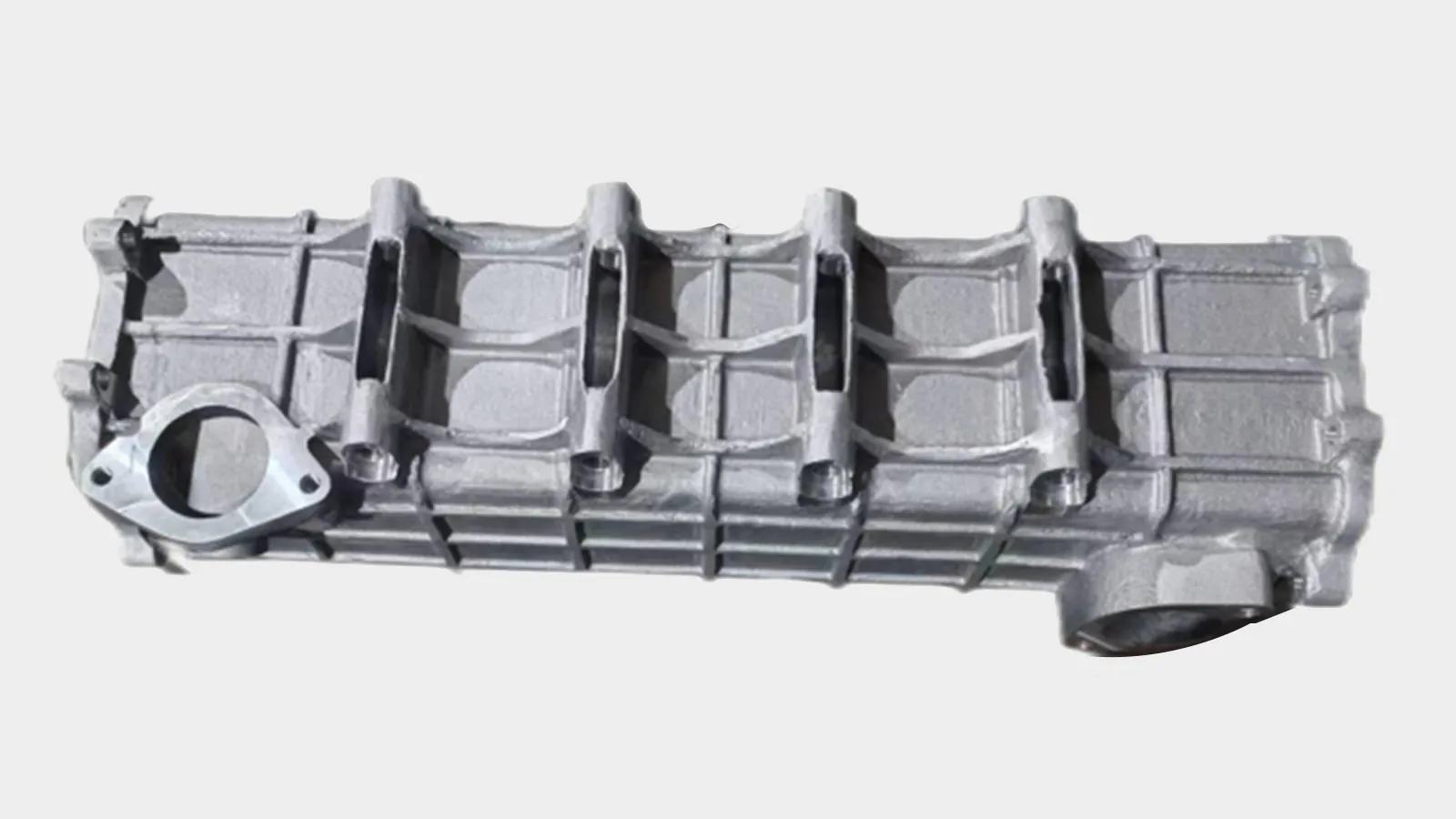
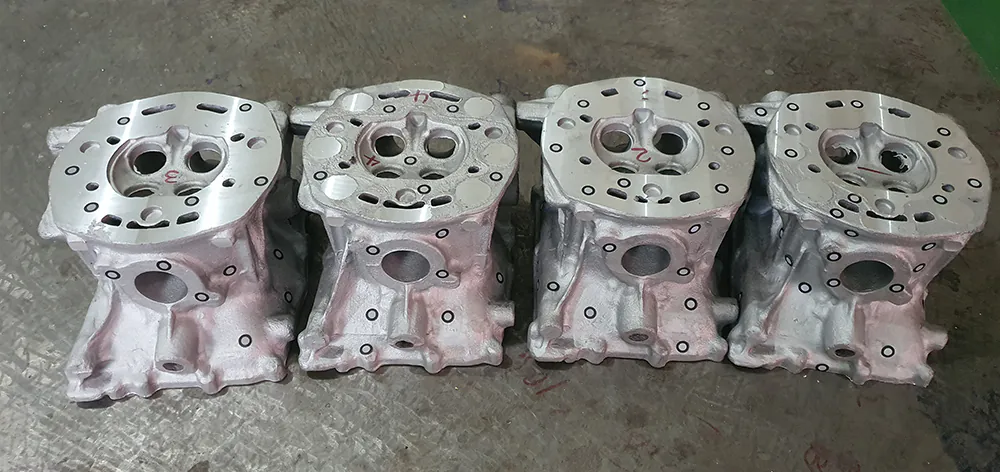
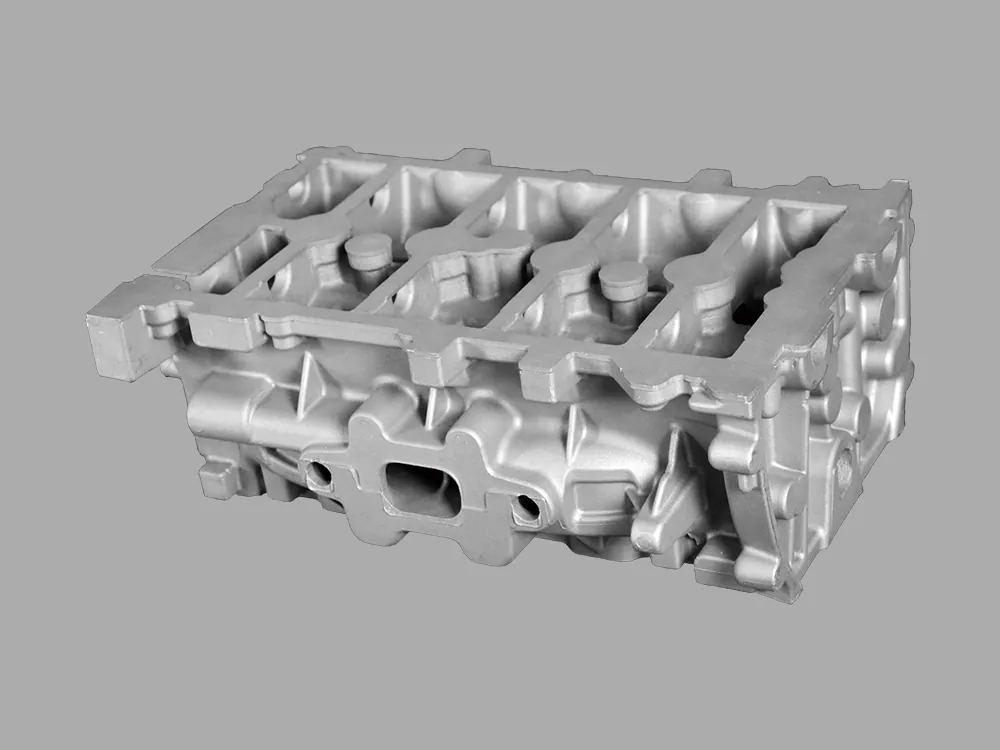
A sample of recent aluminum work. Every one of these started as a CAD file and a printed mould or core, and the ones that hold pressure were leak tested before they left the foundry.



Sand casting or investment casting for your part?
Both routes start from a printed pattern or mould, so the choice is not about tooling. It comes down to how fine the detail is and how many parts you need.
Sand casting
- Larger parts, thicker sections, structural geometry
- CT8 to CT12 as cast, Ra 12.5 to 25
- Lowest cost per part from one piece upward
- Envelope to 5 m in aluminum
Investment casting
- Thin walls, fine detail, complex internal passages
- DCTG 4 to 9, Ra 3.2 to 12.5
- Better surface, so less machining allowance
- Best economics on smaller, higher-value parts
We run both, so the recommendation is not a sales preference. If your part sits between them, we will quote both and tell you which one we would put it on.
Welding, machining and leak-tightness
Three things decide whether an aluminum casting becomes a usable part, and all three are easier to design in than to fix afterwards.
Leak-tightness
Aluminum castings are frequently specified to hold pressure — a water jacket, a hydraulic body, a gas enclosure. Interconnected porosity is what defeats them, so leak-critical parts go on low-pressure or squeeze routes rather than gravity, and are pressure tested before they ship rather than after they are assembled.
Machining
Aluminum cuts fast, which tempts people into leaving minimal allowance. That is the wrong trade: an aluminum casting moves slightly as internal stress releases, so the allowance has to cover both the as-cast tolerance and the movement. We agree the allowance at quotation, per face.
Welding and assembly
Most aluminum casting alloys weld acceptably, but heat-treatable grades lose strength in the heat-affected zone and recover only partly. Where a casting will be welded into an assembly, we pick the temper with that in mind rather than defaulting to T6.
Choosing the process for your part
Three questions settle it in most cases, and none of them require you to know the process names first.
How many parts, and will the design change?
One to a few hundred, or anything still being iterated — printed moulds, and no pattern cost to write off when the drawing changes. Thousands with a frozen design — a permanent mould, because the die amortises.
Does it have to hold pressure or stay leak-tight?
If yes, low-pressure casting or liquid squeeze, not gravity. This is the single most common reason a first article fails a pressure test, and it is decided by the route before any alloy is chosen.
How fine is the detail?
Ra 25 and CT12 is fine for most housings. If the part needs thin walls or fine internal passages, it probably belongs on an investment route instead — see the comparison above.
Related casting routes
- Low pressure casting
Filled from below and held under pressure — the route for gas-tight aluminium housings.
- Gravity casting
Aluminium and copper poured by gravity into a printed mould, to a 5 m envelope.
- Ductile iron casting
When the part needs iron rather than aluminium: QT400 to QT700.
- Cast steel casting
Carbon, low-alloy and stainless steel by the sand or wax route.
- Bronze and brass casting
Copper alloys for bearing, marine and architectural duty.
Questions we get before a first aluminum order
What aluminum alloys do you cast?
Mainly the A356 and A360 families, which we know as ZL101A, ZL104A and ZL114A, plus 6061 where a part mixes cast and wrought sections. A356 responds strongly to T6 and covers most pump, valve and housing work.
What is the maximum size and weight?
Up to 1 t for a single casting, and an envelope to 5 m in aluminum. Beyond that the part has to be split or the process changed, and we will say which.
What tolerance can you hold as cast?
CT8 to CT9 is our standard working range for aluminum, at Ra 12.5 to 25. Where a feature needs better than that, the economical answer is usually to machine the feature rather than tighten the whole casting.
Do you heat treat in house?
Yes. T5, T6 and T7 run in the same chain as the casting, in a 2 m diameter furnace plus a 25 t heat-treatment and ageing furnace. Quench delay is a process variable we control rather than a shipping decision.
Can you machine and inspect before shipping?
Yes. CNC machining, coordinate measuring to PEE 5.18 µm, X-ray, ultrasonic and spectrographic verification all happen before the part leaves, with records.
What is the smallest batch?
One piece. Printing the mould removes the pattern, which is what makes a single aluminum casting economic.
How fast is the first part?
Printed-mould work runs from CAD to a poured and heat-treated aluminum casting in about 20 days on a small batch. Permanent-mould work adds the die lead time.
Do you do high-pressure die casting?
No. We run gravity, low-pressure, differential-pressure, liquid squeeze, permanent mould and plaster-mould precision casting. If your part is designed for high-pressure die casting, we are the wrong supplier and will tell you so.
Send the drawing, get a route and a price
Send a model and we will come back within 24 hours with the casting route we would run, the alloy and temper we would specify, the machining allowance we would leave, and a price. If aluminum is the wrong metal for the part, we will say so.