
Có thể tái sử dụng khuôn cát in 3D không? Giải thích về quy trình tái chế cát
The Direct Answer
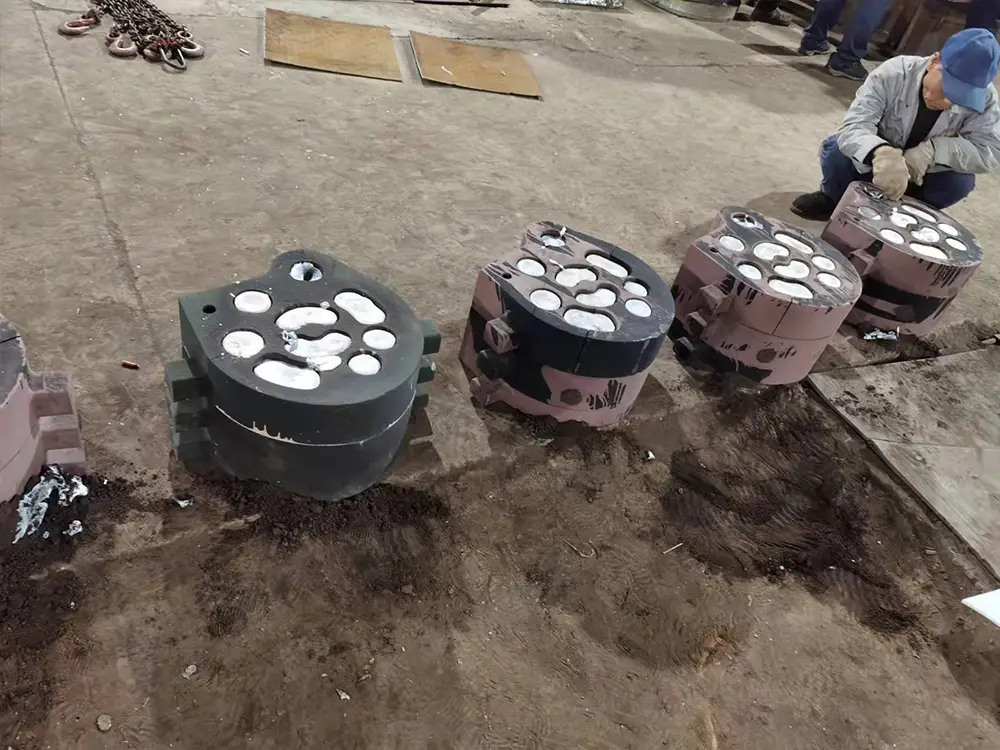
No — a 3D printed sand mold cannot be reused, because it is single-use by design. The moment molten metal enters the cavity, the mold has finished its job: the organic binder burns out at pour temperatures, the facing sand sinters and fuses to the casting, and the remaining structure shatters during shakeout. That is not a flaw specific to 3D printing — it is how every sand mold works, whether printed by a binder jetting machine or rammed by hand. What changes with sand 3D printing is everything around the mold. The sand comes back through reclamation at roughly 95% or better, and the CAD file, the print parameters, and the process settings that created the mold are reusable an unlimited number of times, with zero tooling cost per iteration. The physical mold is consumed. The digital mold and the sand are not.
For a buyer coming from pattern tooling, “reuse” usually means the tool itself. A machined pattern costs roughly €3,000–€15,000 and carries a 4–8 week lead time, and it only earns its keep if you pour hundreds of parts from it. A printed sand mold has no such hurdle: you print one mold, pour it once, and the geometry still exists as a file, ready to print again tomorrow. That mental shift — from physical tooling to digital geometry — is the whole story of patternless casting, and our Hướng dẫn mua máy in 3D bằng cát covers the equipment side in detail for anyone new to the process.
The useful way to think about reuse in binder jetting is as three separate loops running on different time scales: the sand loop, which cycles in hours to days; the machine setup loop, which cycles in days to weeks as parameters are re-applied; and the design loop, which cycles in months to years as CAD revisions accumulate. This article explains why the mold itself cannot come back, what the reclamation loop actually recovers, and which assets a foundry should treat as its permanent, reusable capital.
Why a 3D Printed Sand Mold Can’t Be Reused
A sand mold is a one-shot vessel. Its only job is to hold a cavity geometry rigidly while molten metal fills it, solidifies, and cools. Everything that happens in that window is hostile to the mold’s survival — and the mold is deliberately engineered to be sacrificed. Understanding the three failure mechanisms makes the economics of the process much clearer.
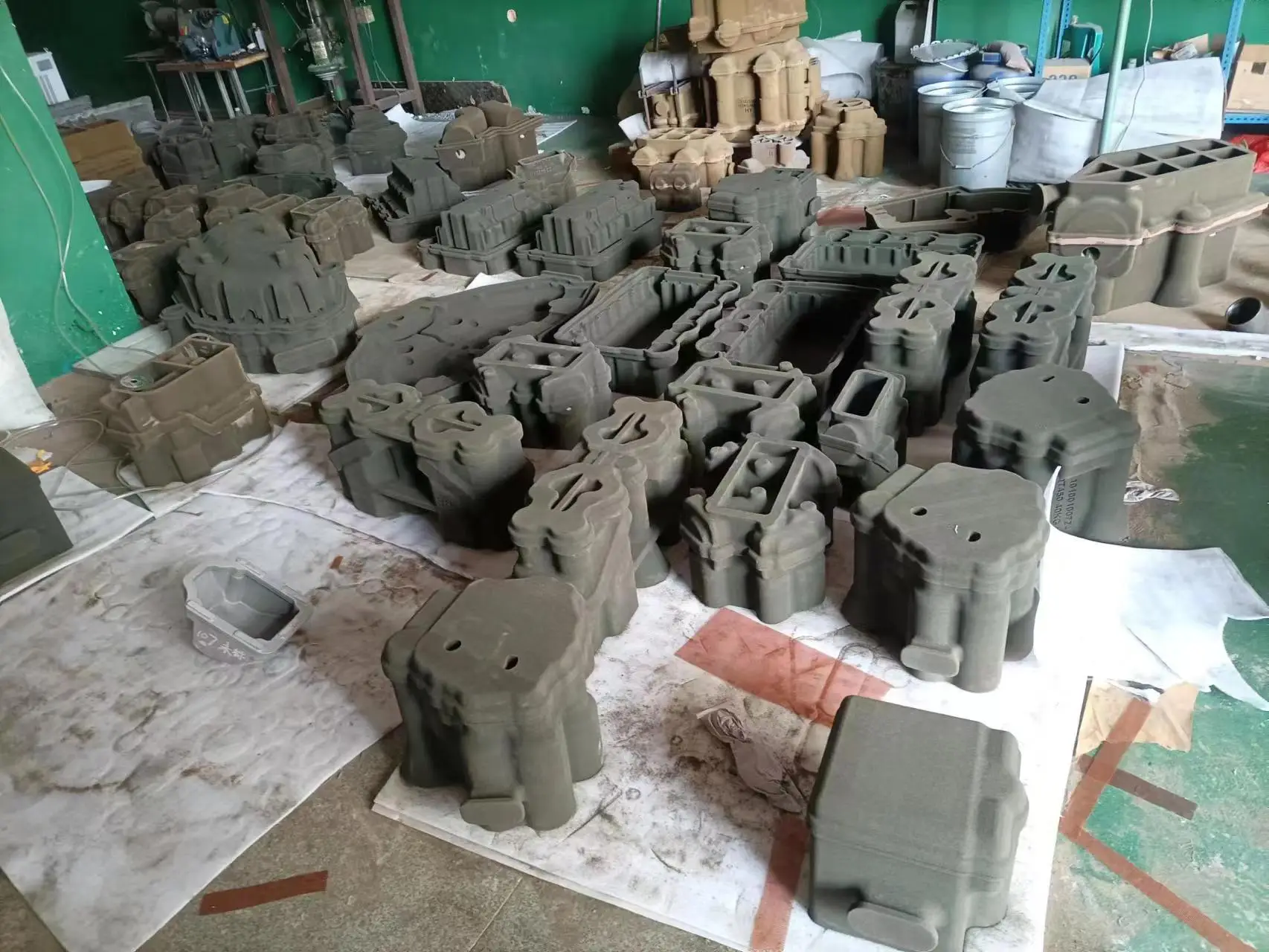
The first mechanism is chemical. A binder jetting mold is held together by a few percent of organic binder by weight, typically furan or phenolic systems in the same family used across the foundry industry. Pouring temperatures run roughly 700 °C for aluminum, 1,100–1,300 °C for copper alloys, and 1,300–1,500 °C for iron and steel. The binder begins decomposing at a few hundred degrees and is fully burned out long before the metal solidifies. Once the binder is gone, the sand has no structural role left — it is simply a bed of grains surrounding the cooling casting.
The second mechanism is thermal and mechanical. The mold face sees a thermal shock that sinters and partially vitrifies the surface sand, and the liquid metal infiltrates the first few grain layers. When the casting is lifted, a crust of fused sand comes with it. Shakeout then finishes the job: vibratory grids and lump breakers shatter the mold into individual grains and lumps. None of this is a process defect. It is the identical lifecycle of a greensand or no-bake mold, which is why no foundry anywhere reuses a spent mold as a mold.
The consequence for the buyer is a mindset change rather than a capability loss. On a traditional line, the reusable asset is the pattern and the consumable is the sand; with binder jetting, the pattern and the core box cease to exist as physical objects and the geometry becomes the reusable asset. For the mechanics of a build from file to pour-ready mold, our article on how sand 3D printing works walks through the machine side, and the binder jetting vs traditional tooling comparison shows where the pattern’s cost and lead time actually sit in the total.
The practical consequence is that nobody measures a printed sand mold for longevity the way they measure a pattern. The quality bar is different by design: the mold only needs to survive one pour, and it needs to do that reliably. Foundries printing molds for pump and valve castings, marine components, or aerospace development parts pour early and iterate aggressively, adjusting gating and risering on the file rather than on a physical tool. Every pour is diagnostic data, and the fix is a new print, not a new pattern — which is exactly why binder jetting suits development programs that would drown in tooling cost under a conventional workflow.
What CAN Be Reused: The Digital Mold, Core Boxes, and Sand
Once you stop treating the mold itself as the reusable unit, binder jetting turns out to be full of assets that are reused more often — and more cheaply — than any physical tool ever was.
The CAD file is the permanent mold. It stores the cavity geometry, the gating and risering design, the core prints, and every tolerance decision. A design change takes minutes in the file instead of 4–8 weeks of pattern work; every revision and every variant can be printed again tomorrow, and the same file feeds simulation, quoting, and future production runs. In traditional casting, the pattern locks in a geometry and any change means re-cutting tooling. Here, geometry is version-controlled data that never wears out — the wider shift that turns a foundry into what we call a digital casting operation.
The print parameters are reusable process knowledge. A qualified parameter set — layer thickness in the 0.28–0.4 mm range, binder saturation, recoater speed, drying and venting, packing density — is validated once for a given alloy and geometry family, then inherited by every subsequent mold of that type. Nothing is re-learned per job, and each improvement to the parameter set compounds across every future build. That is a form of reuse pattern tooling cannot offer at all.
Core boxes are reused in a different sense: binder jetting prints cores directly from the file, so the physical core box disappears and the “core box” becomes a digital file you can reprint as many times as the production run needs. For foundries that still want a physical core box for very high-volume core shooting, the same CAD can print a master core box pattern once — in days, not weeks — and that tool is then reused for thousands of cores. Patterns, meanwhile, are not needed at all, which is exactly what the patternless workflow is about. If you want this capability in-house rather than through a bureau, our sand mold and sand core 3D printing service page describes what we deliver and how the process support works.
That reusability extends across the machine park, not just across jobs. A parameter set qualified on one platform is carried to the next machine as a recipe, so a foundry that grows from a single J1800 to a two- or three-machine line inherits its own proven settings instead of re-deriving them. The open material system matters here: because the machines accept standard foundry sands and standard binders, process knowledge stays valid when the shop scales, and the reclamation loop stays compatible with the same sand supply. What a foundry accumulates over years is not a warehouse of tools but a library of files, recipes, and cast histories — all of it reusable, none of it wearing out.
Sand Reclamation Explained
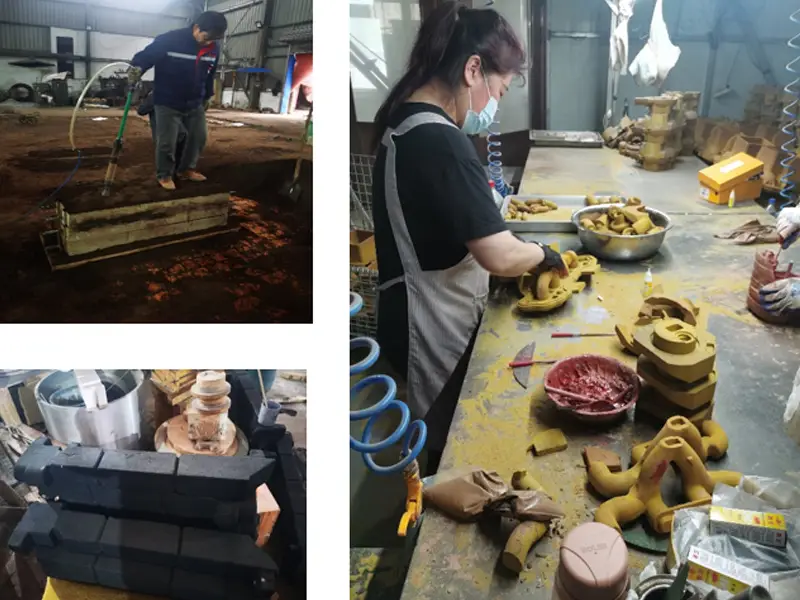
Reclamation is the loop that brings roughly 95% of the sand back into the next build. The spent sand that survives shakeout is not waste — it is a feedstock. The reclamation line cleans it, conditions it, and returns it to the printer, and the table below shows each stage of that loop.
| Reclamation stage | What happens | Recovery |
|---|---|---|
| Shakeout | Casting and mold separate on vibratory grids; spent sand falls through as free-flowing grains. | Essentially all loose sand enters the line; the ~95%+ loop begins here. |
| Crushing and screening | Lumps from the mold face are crushed; oversized agglomerates, fused crust, and metal contamination are screened out and rejected. | Removes fines, dust, and crust; typical loss is the first few percent. |
| Thermal or mechanical reclamation | Thermal units burn off residual binder at 700–800 °C; mechanical units scrub grain surfaces by attrition. Both restore surface chemistry for fresh binder. | ~95%+ of input sand survives with acceptable grain size and cleanliness. |
| Binder system refresh | Reclaimed sand is re-coated with fresh binder and catalyst; a small addition of new sand maintains the grain size distribution. | Full-strength molding sand at a fraction of virgin sand cost. |
| Reuse in new molds | Conditioned sand is loaded into the printer and recoated for the next build; the cycle repeats. | Every print cycle reuses the same ~95% of the sand mass. |
Where does the other 5% go? Into dust and fines that escape the screens, fused crust that sticks to the casting, floor spillage, and sand whose grain surface has degraded past usefulness after repeated thermal cycles. A well-run loop tops up with a small percentage of new sand each cycle, which is why the number is quoted as roughly 95% rather than 100%. Reclamation is not free — the equipment, energy, and binder refresh all cost something — but every tonne recovered replaces a tonne that would otherwise be bought, transported, and eventually disposed of.
Which reclamation path fits depends on the binder. Furan and phenolic systems both reclaim well; thermal reclamation gives the cleanest grain surfaces and suits high-throughput lines, while mechanical attrition suits smaller foundries with lower volume. Binder choice interacts directly with the machine’s material system, and since reclamation economics depend on running standard foundry sands and standard binders, our comparison of open vs closed material systems is worth reading before you commit to a platform.
The sand grade itself survives the loop. Reclamation preserves the grain size distribution and shape of the original sand, which is what keeps mold quality consistent build after build — the reconditioned sand behaves like the virgin sand it replaces, so print parameters and packing behavior stay stable. That consistency is the quiet reason reclamation is so widely adopted: it is not only a cost save, it is a quality stabilizer. A foundry that skips reclamation is not just spending more on sand; it is introducing a new variable into every build, which is exactly what a process shop does not want when it is chasing repeatable castings.
Cost and Sustainability Impact
The cost impact of reclamation is easy to state: sand is the largest consumable by weight in binder jetting, and reclaiming roughly 95% of it turns that line item from a serious budget line into a minor one. A full build on a J1800 (1,800 × 1,000 × 700 mm) holds about 1.4 m³ of sand; a J2500 (2,500 × 1,500 × 1,000 mm) holds nearly 3.1 m³. Multiply that by job count and the raw-sand bill grows quickly — or does not, if the loop is running. Reclamation also removes the disposal cost of spent mold waste, which in some regions is charged as industrial waste by the tonne.
The pattern side of the math matters just as much. Every printed mold replaces a pattern that would have cost €3,000–€15,000 and taken 4–8 weeks — whether you print ten molds or ten thousand, that cost is simply gone, and it never recurs because the file is the tool. The complete consumable and per-part breakdown lives in our sand 3D printing cost guide, and our break-even analysis shows how many molds a machine needs to print before it pays for itself; both assume the ~95% reclamation loop, and without it the consumable math would look very different.
At the machine level, this is where the total cost of ownership gap shows up. Five-year TCO for the J1800 or J2500 runs roughly half that of an equivalent Western platform — against public estimates for machines like the ExOne S-Max Pro or the voxeljet VX1000 — and consumables are part of that gap alongside the open material system. 3DPTEK prices the J1800 in the mid range, configuration-dependent, the J2500 in the mid-to-large range, and the J4000Pro in the large-format, seven-figure class, and the reclamation loop is standard practice across all three platforms.
Reclamation also smooths the payback curve. Because per-mold consumables stay low, the margin per printed mold stays high, and the savings compound with every cycle: a machine that consumes less sand per job reaches its payback point sooner, and each subsequent job is cheaper than the last. For shops scaling from prototypes to production batches, the loop is what keeps unit economics stable while volumes climb — the same reason reclamation is treated as standard practice rather than an optional extra on the J1800, J2500, and J4000Pro platforms. It is the difference between a process that looks attractive on paper and one that actually delivers the margins the cost models promise.
The Environmental Angle
The environmental case for the reclamation loop is straightforward: every tonne of reclaimed sand is a tonne not quarried, washed, dried, and transported. Sand mining carries its own footprint — extraction, processing energy, trucking — and replacing most of that flow with an on-site loop concentrates the environmental benefit exactly where the waste would otherwise be generated.
The waste comparison against pattern tooling is equally lopsided. A pattern’s life ends with disposal of wood, resin, or machined metal; printed sand molds generate no tooling waste because there is no tooling. The Hướng dẫn đúc cát không khuôn walks through that workflow end to end for teams planning to adopt it, and combined with the digital mold model discussed earlier, the result is a process where the heavy assets of conventional casting — pattern shops, core box machining, tool storage — shrink to files on a server.
One honest caveat: thermal reclamation is the energy-hungry step, running furnaces at 700–800 °C, and binder jetting is not an energy-free process. The right comparison is against the alternative — mining and transporting new sand on one side, machining and eventually disposing of pattern tooling on the other. Operators quote roughly 95% reclamation as the working figure across binder systems, with exact numbers varying by site, binder, and reclaim equipment, and the loop is where most of the process’s sustainability advantage concentrates.
Request a formal quotation. Our sales engineers will take your mold geometry, run the reclamation and consumable math for your alloy and production volume, and tell you honestly whether binder jetting pays for your mix — including what a reclamation loop adds to the capital picture. Send it via the contact page, or start with the 3DPTEK sand 3D printer line to see which build volume fits your casting program.

Được viết bởi đội ngũ kỹ sư của 3DPTEK — chính là đội ngũ đang vận hành các xưởng đúc và máy in 3D bằng cát của chúng tôi trong quá trình sản xuất hàng ngày. Giới thiệu về 3DPTEK.
Các câu hỏi thường gặp
Các khuôn cát in 3D có thể tái sử dụng được không?
Không. Bản thân khuôn được thiết kế để chỉ sử dụng một lần: quá trình rót kim loại làm cháy chất kết dính và phá hủy cấu trúc khuôn, còn quá trình lắc khuôn sẽ làm vỡ khuôn thành nhiều mảnh — chu kỳ sử dụng giống như bất kỳ khuôn cát nào. Những gì được tái sử dụng là mọi thứ xung quanh khuôn: khoảng 95% cát thu hồi, cùng với tệp CAD và các thông số in, những thứ này có thể tái sử dụng vô thời hạn mà không tốn chi phí chế tạo khuôn.
Có thể tái chế được bao nhiêu phần trăm lượng cát này?
Roughly 95% or better with a properly run reclamation loop. Losses come from dust and fines, fused crust that sticks to the casting, and spillage; operators typically top up with a small percentage of new sand each cycle to maintain the grain size distribution. Exact figures depend on the binder system and the reclamation equipment.
Tái sinh cát là gì?
Sand reclamation is the process of recovering spent molding sand so it can be reused. After shakeout, the sand is crushed and screened to remove lumps and contamination, treated thermally or mechanically to clean the grain surfaces, refreshed with new binder, and returned to the printer for the next build. It is the loop that makes the ~95% reuse figure possible.
How long does a 3D printed sand mold last?
It does not need to last — it is designed for one pour. The useful lifetime is measured in hours, from printing to pouring, and the geometry lives on in the CAD file afterward, reprintable any number of times. The question that matters for planning is build time and throughput, not mold durability.
Is the CAD file reusable?
Yes, indefinitely. The file stores the full mold and core geometry, and it can be modified, re-validated, and reprinted at no tooling cost — a change that would cost weeks of pattern work in traditional casting takes minutes in the file. This digital reuse is the biggest single advantage of the process.
Does reclamation lower the cost per mold?
Yes — it is the main consumable lever. Sand is the largest consumable by weight in binder jetting, and reclaiming roughly 95% of it collapses the per-mold sand cost while also cutting disposal fees. Combined with the elimination of pattern tooling, this is what drives the favorable economics covered in our cost guide and break-even analysis.


