
Sand 3D Printer Korea: Shipbuilding, Defense and the Root-Industry Digital Push
South Korean foundries sit at the sharp end of the global casting industry — supplying the world’s largest shipbuilders, major automakers and a defense sector that is actively reshoring critical parts — yet most still buy sand 3D printing from Western brands at a premium that has nothing to do with machine quality. A 1,800 × 1,000 × 800 mm binder jetting system from ExOne or voxeljet lands in a Korean foundry at hundreds of thousands of dollars, while 3DPTEK ships the same build-volume class from China at a fraction of that cost, with export-compliant build quality, open materials and delivery in weeks. This guide covers what Korean foundries actually pay, how delivery and support work, and how to match the machine to your parts — written for Korean foundry owners and process engineers from Changwon and Busan to Incheon and Ulsan.

The Korean foundry market in 2026
Korea’s casting industry is the foundation — the “root industry” (뿌리산업) — under the country’s entire manufacturing base, alongside forging, welding and surface treatment. The government’s own survey, reported by the Ministry of Trade, Industry and Energy, shows the sector generated sales of 261.54 trillion won (approximately $181.6 billion) in 2024 across casting, forging, welding and surface treatment, with an operating profit margin of 4.7 percent. The same survey flags the sector’s central problem: a labor shortage of 22,662 workers in labor-intensive processes, led by casting, and persistent difficulty attracting young workers.
That combination — a strategic industry, thin margins, and a shrinking workforce — is exactly the environment where sand 3D printing wins. Korean foundries supply engine components and propellers to the world’s largest shipbuilders (HD Hyundai Heavy Industries, Hanwha Ocean, Samsung Heavy Industries), complex castings to automakers, and critical parts to a defense sector under active domestic-content mandates. These are high-mix, low-volume, quick-turn workloads — the jobs patternless sand casting handles better than any other process.
The adoption is already happening at the highest level. In January 2023, the Korean Register (KR) — the country’s classification society — granted approval of manufacturing process for a steel casting made from a 3D-printed sand mold at HD Hyundai Heavy Industries. The approved process eliminates the wood pattern entirely, pouring liquid metal directly into a 3D-printed sand mold, and KR’s approval confirms the product meets existing marine classification regulations. That is not a lab experiment; it is a regulatory green light for production marine castings.
What a sand 3D printer actually costs in Korea
Let’s be direct about pricing, because this is where the market gets confusing. List prices are rarely the number that matters, and published figures vary so widely with configuration that a single number misleads more than it helps. The table below shows the machines a Korean foundry can actually buy today, with relative price positioning rather than fake-precise quotes. For the 3DPTEK line we follow the same planning ranges our published cost guide uses; for Western-brand machines the ranges are public-market estimates that buyers consistently report. Exact pricing depends on configuration, binder supply contracts and whether you add automation (job-box handling, unpacking stations, reclamation loops) — which is why the only honest answer is a formal quotation.
| Produsen | Model | Volume Bangunan | Penetapan Harga | Delivery to Korea | Sistem Material |
|---|---|---|---|---|---|
| 3DPTEK | J1800 | 1.800 × 1.000 × 700 mm | Kelas menengah, tergantung konfigurasi | 6–8 minggu | Buka |
| 3DPTEK | J2500 | 2.500 × 1.500 × 1.000 mm | Kelas menengah hingga besar, tergantung konfigurasi | 2 bulan | Buka |
| 3DPTEK | J4000Pro | 4.000 × 2.500 × 1.500 mm | Format besar, kelas tujuh digit | 2–3 bulan | Buka |
| ExOne (Desktop Metal) | S-Max Pro | 1800 × 1000 × 800 mm | Sekitar 2–3 kali lipat dari J1800 (perkiraan umum) | 4–7 bulan | Setengah tertutup |
| voxeljet | VX1000 | 1.000 × 600 × 500 mm | Biaya per volume tertinggi di antara kelompok tersebut (perkiraan publik) | 6–9 bulan | Tutup |
A few honest observations about that table. First, the voxeljet VX1000 is the smallest machine here yet carries the highest per-build-volume cost — a published academic purchase record showed the VX1000 costing the equivalent of roughly €750,000 once delivered and installed. Second, ExOne’s S-Max Pro is a genuinely mature machine with a strong installed base — the price premium buys proven software and process documentation, not more build volume. Third, the 3DPTEK J1800 sits in the same build-volume class as the S-Max Pro at a fraction of the price, with an open material system that changes your five-year cost more than the purchase price does. If you want the full head-to-head on where the cost difference actually comes from, our Analisis biaya-manfaat printer 3D Barat versus Tiongkok menjelaskannya baris demi baris, dan kami panduan biaya lengkap memberikan rincian lengkap mengenai biaya mesin, bahan habis pakai, dan biaya per cetakan.
The 3DPTEK lineup for Korean foundries
3DPTEK builds three binder jetting platforms that cover the range Korean foundries actually need, plus SLS platforms for precision cores. For most Korean jobbing and production foundries, the decision comes down to the J1800 and the J2500.
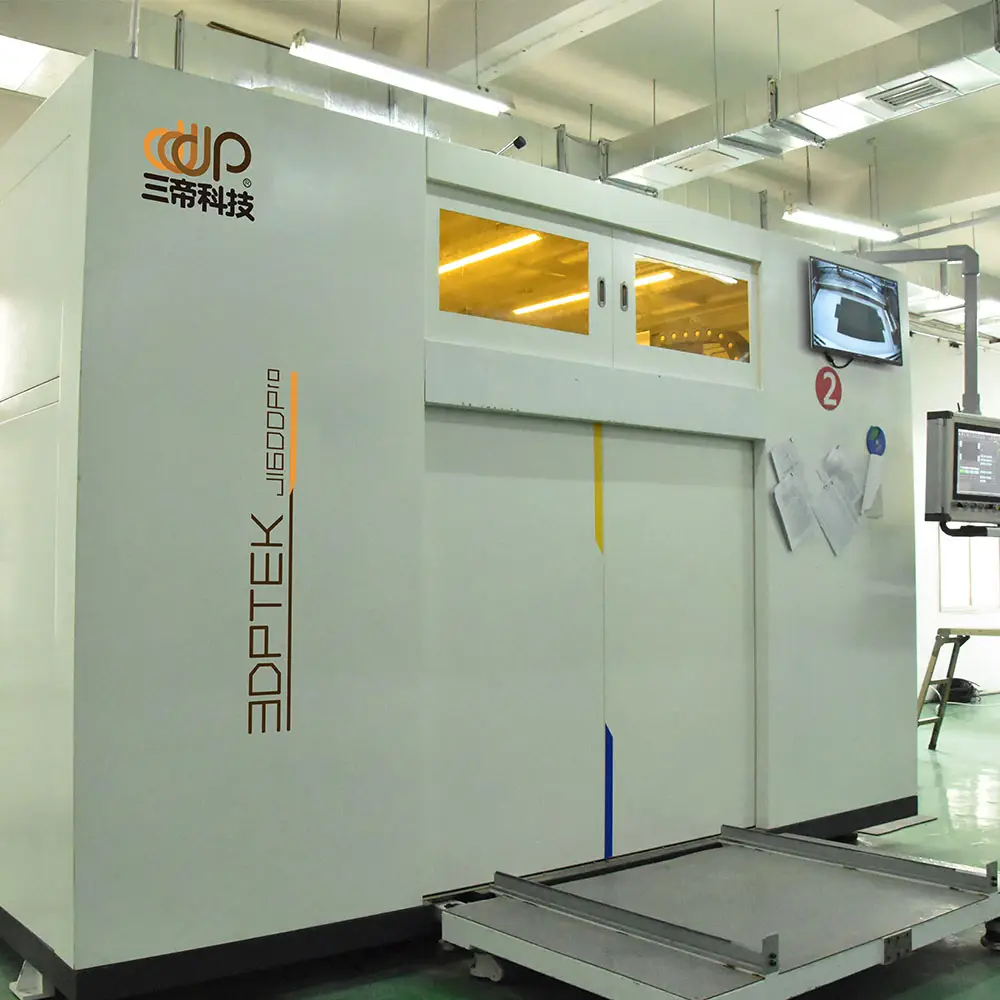
Yang J1800 (1,800 × 1,000 × 700 mm) is the entry point that covers pump bodies, valve housings, gear cases, impellers and small-to-medium engine components. It is the machine a small-to-mid-size Korean foundry can justify on pattern cost alone. Pattern elimination matters in Korea as much as anywhere: a machined pattern for a complex core costs thousands of dollars with a 4-to-8-week lead time, and it disappears entirely. The J1800 sits in 3DPTEK’s mid-range price band — a planning figure, not a quote — which our panduan biaya disajikan bersamaan dengan analisis kelayakan finansial per cetakan secara lengkap.
Yang J2500 (2,500 × 1,500 × 1,000 mm) is the workhorse for mid-size and larger Korean foundries serving shipbuilding, automotive and machinery. It handles engine blocks, transmission cases, large valve bodies, propeller-related castings and structural parts up to about 2.5 metres. This is the model we recommend first to most Korean buyers because it covers roughly 90 percent of the parts a foundry will be asked to quote — typically at a fraction of the cost of an equivalent Western-brand platform in the same size class.
Yang J4000Pro (4,000 × 2,500 × 1,500 mm) exists for one reason: parts over 2.5 metres that have to be cast as a single piece — large marine components, wind turbine housings, big energy castings. In this class your realistic alternatives are a used VX4000 or a very long wait; the J4000Pro is the only new large-format system a Korean foundry can get in under three months. Large-format platforms like this sit in the seven-figure class at 3DPTEK, exactly as they do at voxeljet. For the full specification comparison across the line, see our Halaman jajaran printer 3D Sand, atau kami perbandingan berdasarkan peringkat dari setiap mesin yang ada di pasaran.
Delivery, compliance and installation in Korea
Timing is where the price gap compounds. A Korean foundry that orders an ExOne or voxeljet machine today is looking at four to nine months before the crate arrives — and that is before installation, which typically takes another two to four weeks with their engineers on site. 3DPTEK ships to Korean ports (Busan, Incheon, Pyeongtaek) in six to eight weeks for the J1800 and roughly two to three months for the larger platforms. Installation engineers travel to your foundry for setup, operator training and process qualification, typically one to two weeks on site.
On compliance: 3DPTEK machines are built to international electrical and safety standards for export, with full documentation included in the handover package. Electrical specification is 380 VAC / 50 Hz as standard for export machines, with 60 Hz options arranged for facilities that need them. The machines run standard industrial furan (furan no-bake) and phenolic binder systems, so your existing binder supply chain keeps working. If you are buying under a framework that requires a specific certificate, ask us during quotation; we provide the documentation set before shipment. For marine-class foundries, the KR approval path shown by HD Hyundai Heavy Industries is available for parts made with 3D-printed molds — your process engineering team works with us to document the mold path for classification review.
Materials: the open-system question Korean buyers should push on
Here is the question we get from every Korean foundry that has been burned by a proprietary material contract: do I have to buy your sand and binder forever? The answer for 3DPTEK is no, and it is the single biggest TCO difference versus the Western platforms.
3DPTEK machines run any commercially available silica sand with AFS grain fineness 50–80, chromite sand for high-temperature applications, and ceramic sand where surface finish demands it. Korean foundry sands — from domestic silica suppliers serving the Changwon and Busan casting clusters — have been validated on our machines. Binder is the same furan or phenolic chemistry you already use for conventional core shooting; you buy it from your existing chemical supplier, not from us.
ExOne mengoperasikan sistem semi-tertutup di mana mesinnya disertifikasi untuk menggunakan rangkaian bahan pengikat yang lebih terbatas, sedangkan VX1000 dari voxeljet merupakan sistem tertutup dengan bahan pengikat eksklusif. Selama periode lima tahun dengan operasi dua shift, sistem terbuka pada mesin 3DPTEK biasanya menghemat jumlah hingga lima digit hanya dari bahan habis pakai saja dibandingkan dengan harga bahan pengikat eksklusif — angka yang nilainya lebih besar daripada sebagian besar diskon yang akan Anda negosiasikan untuk mesin itu sendiri. Analisis terperinci kami analisis sistem material terbuka versus tertutup menjelaskan perhitungan matematisnya secara lengkap.
Shipbuilding, defense and the root industry’s digital transition
The strategic case for sand 3D printing in Korea has never been stronger. The government is investing heavily in the root industries — including 640 billion won in a single announced program to strengthen casting, forging and other foundational sectors — precisely because they are the base of shipbuilding, automotive and defense. And the labor shortage (22,662 unfilled positions) means foundries must do more with fewer people, which is exactly what patternless casting delivers: one operator can run a print that would have taken a pattern shop weeks.
The marine angle is the most advanced. HD Hyundai Heavy Industries’ KR-approved 3D-printed-mold steel casting proved the process works for classification-grade marine parts, eliminating the wood pattern. And the sector’s own leaders are explicit about the direction: Samyoung Machinery, a casting-based engine component maker, has adopted sand 3D printing for high-mix low-volume production, cutting mold-making lead times from 3–6 months to about a day, reducing assembly work with one-piece molds, and cutting manual shop-floor work by up to 70 percent. It is also participating in localization of special-purpose defense engine parts. That is the pattern Korean foundries are following: digital transition is the answer to the root industry’s competitiveness problem.
ROI for a Korean foundry: the numbers that matter
Let’s put real numbers on it. A mid-size Korean foundry producing 200–500 casting parts per month typically spends $60,000–$180,000 per year on patterns and core boxes, and loses four to eight weeks of lead time on every new part while tooling is made. With a J2500, pattern cost goes to zero and new-part lead time drops to three to five days from CAD to mold.
At those figures, a J2500 pays for itself in 12 to 24 months on pattern savings alone. When you add rush-order premiums from shipbuilders and OEMs, iteration on casting design and the ability to quote jobs that need complex internal geometry, payback is often under 12 months. Use our kalkulator ROI titik impas untuk membuat model volume produksi Anda sendiri; perhitungan ini menggunakan biaya pola, waktu tunggu, dan harga bahan pengikat sebagai masukan.
Service and support across Korea
The honest question every Korean buyer asks: if this machine is made in China, who fixes it when something breaks? The answer is a support structure built around Korean and East Asian time zones. Remote diagnostics respond within 24 hours. Critical on-site issues are typically addressed within 48–72 hours by engineers flying from Beijing or via our regional partners. Spare parts are air-freighted with 3–5 day lead times, and the full installation and training package means your own team can handle routine maintenance and most process issues themselves after the first month.
We also hear from Korean foundries that are not ready to buy a machine but want to validate the process first. 3DPTEK runs its own casting facilities and offers a layanan pencetakan cetakan pasir — send a CAD file, and we print the mold, cast the part and ship it to you. That is how most of our Korean customers start: prove the part, then buy the machine. See the layanan pengecoran prototipe cepat untuk detailnya.
How Korean foundries are using it, region by region
The adoption pattern differs across the country. The Changwon cluster — Korea’s machinery and industrial heartland — uses binder jetting for pump, valve and general machinery castings where quick iteration wins orders. The Busan and Ulsan region, home to the shipbuilders, uses it for engine components and large marine castings, following the KR-approved path. Incheon and Gyeonggi foundries serving automotive and electronics use it for complex cores and prototype work. Defense suppliers across the country use it for the localized, low-volume special-purpose parts that domestic-content mandates demand. In every region the pattern is the same: the foundry that can quote a complex casting in five days instead of six weeks wins the order.

Financing and government support for Korean buyers
Korean foundries have access to capital routes that make the machine decision easier than the sticker price suggests. The government’s root industry programs — including the 640 billion won strengthening initiative and related smart-factory support under the Ministry of Trade, Industry and Energy — can cover a meaningful share of digital manufacturing investment. The paperwork varies by program and year, but the principle is consistent: a sand 3D printer is qualifying manufacturing equipment, and digital transition is an explicit national priority for the root industries.
If your foundry prefers not to tie up capital at all, 3DPTEK offers phased payment structures for Korean buyers — typically 30 percent at order, 40 percent at factory acceptance test, and 30 percent at installation — and leasing arrangements through partner financial institutions. The practical effect is that a J1800 can be in production for a monthly cost in the same range as the pattern spend it eliminates. Run the numbers in our kalkulator ROI titik impas untuk membuat figur Anda sendiri.
Pertanyaan yang Sering Diajukan
How much does a sand 3D printer cost in South Korea?
Harga mesin sangat bervariasi tergantung konfigurasinya sehingga sulit untuk memberikan perkiraan harga yang akurat dalam sebuah artikel; itulah sebabnya setiap penyedia yang profesional — termasuk 3DPTEK — menetapkan harga berdasarkan pesanan. Sebagai panduan perencanaan: 3DPTEK J1800 berada di kisaran harga menengah, J2500 di kisaran menengah hingga besar, dan platform format besar seperti J4000Pro berada di kelas harga tujuh digit. Produk sejenis dari merek Barat (ExOne S-Max Pro, voxeljet VX1000) dilaporkan oleh pembeli memiliki harga sekitar dua hingga empat kali lipat dari kisaran tersebut untuk volume cetak yang sebanding. Hubungi 3DPTEK untuk penawaran harga yang pasti.
Which sand 3D printers are available in South Korea?
The practical options for a Korean foundry are the 3DPTEK J1800, J2500 and J4000Pro (binder jetting, open material systems), the ExOne S-Max Pro, and the voxeljet VX1000 series. 3DPTEK machines accept standard Korean foundry sands and standard furan/phenolic binders, so they integrate with your existing material supply chain.
How long does delivery to South Korea take?
3DPTEK delivers to Korean ports in 6–8 weeks for the J1800 and 2–3 months for the J2500 and J4000Pro, including manufacturing, sea freight and customs clearance. Installation and operator training take 1–2 weeks on site. ExOne and voxeljet lead times are typically 4–9 months.
Are 3DPTEK machines compliant for the Korean market?
Yes. 3DPTEK sand 3D printers are built to international electrical and safety standards for export, with full documentation in the handover package. Standard export specification is 380 VAC / 50 Hz, with 60 Hz options arranged at quotation. For marine-class parts, the KR approval path used at HD Hyundai Heavy Industries is available — our process engineers help document the 3D-printed-mold path for classification review.
Can I use Korean foundry sand in a 3DPTEK sand 3D printer?
Yes. The open material system accepts commercially available silica sand (AFS 50–80), chromite sand and ceramic sand from any supplier. Sands from domestic suppliers serving the Changwon and Busan casting clusters have been validated on 3DPTEK machines, and you can use your existing furan or phenolic binder from any chemical supplier. No proprietary consumables contract.
How does 3DPTEK compare with ExOne and voxeljet for Korean foundries?
3DPTEK offers the same binder jetting technology at significantly lower cost, with an open material system, 6–8 week delivery and export-compliant machines. ExOne and voxeljet have longer installed bases and proven process documentation, which matters for buyers who need brand continuity. For most Korean foundries, the total five-year cost of a 3DPTEK J1800 or J2500, including consumables savings, is roughly half that of the equivalent Western platform.
Mulailah
Whether you run a jobbing foundry in Changwon or a large shipbuilder supplier in Ulsan, the machine economics work the same way. Hubungi 3DPTEK untuk mendapatkan penawaran harga, atau jelajahi jajaran lengkap printer 3D berbasis pasir. Kirimkan gambar komponen Anda kepada kami — kami akan memberi tahu Anda mesin mana yang cocok, berapa biayanya termasuk pengiriman ke alamat Anda, dan seberapa cepat Anda bisa mulai melakukan pengecoran tanpa menggunakan cetakan.


