
SLS 3D Printer Cost in 2026: What Foundries Actually Pay
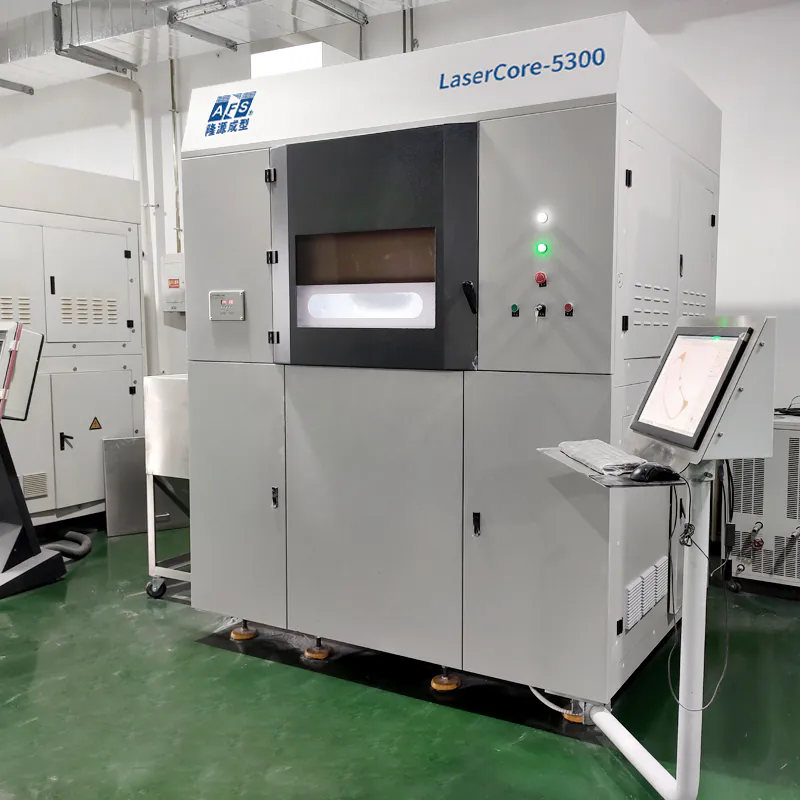
An industrial SLS machine for foundry work prints two things: coated sand for molds and cores, and PSB wax for investment casting patterns. That is why the purchase price is only part of the story. The number that matters over five years includes powder, laser time, labour and the tooling you no longer buy.
Below are the three price bands we quote most often, what recurs every month, how to work out a cost per part, and the expenses that show up after installation.

The Direct Answer
An industrial SLS system for foundry work costs $200,000 to $1M or more. Build chamber size and laser configuration decide which band you land in, and the machine accounts for roughly 45% to 60% of five-year cost of ownership. Coated sand and PSB wax run at about $1 to $6 per kilogram for SLS-grade powder, depending on grade and region. Machine time is usually the larger line: industrial platforms are commonly costed at $30 to $70 per hour for amortisation, against published polymer SLS shop rates of around EUR 110 to EUR 150 per hour.
Against binder jetting, the two processes overlap on outer molds and separate on cores and patterns. The binder jetting side of the same comparison is in our 3D sand printing cost breakdown, written to the same outline as this page.
What Drives the Cost of an SLS System
Machine, consumables, labour, and the building it sits in. In that order of magnitude.
A larger chamber needs a heavier frame, longer linear rails and more powder handling, so price does not track build volume in a straight line. A comparable industrial polymer SLS work cell is quoted near EUR 500,000, and laser and optics depreciation alone runs about EUR 25 to EUR 40 per hour of operation.
Consumables are a monthly line, not a purchase. Coated sand and PSB wax both have a price per kilogram, a refresh ratio, and a share that comes back as reclaimed powder. Wax infiltration adds a smaller amount again for pattern work.
Labour scales with builds, not parts. Depowdering, breakout, infiltration and inspection happen once per build, which is the reason nesting density decides your cost per part more than any other single factor.
Energy is modest but real. A sand or wax SLS build draws 10 to 20 kW while running, so an eight hour build consumes roughly 80 to 160 kWh. Extraction, compressed air and any chiller are part of the same electrical load.
Machine Cost: The Three Bands We Quote Most Often
| Band | Price | Build volume | Configuration | Typical ROI |
|---|---|---|---|---|
| Entry level | $200K – $400K | 500 – 800 mm | Single laser | 12 – 18 months |
| Mid range | $400K – $700K | 800 – 1,200 mm | Dual material (sand + wax) | 8 – 14 months |
| Large format | $700K – $1M+ | 1,000 – 1,500+ mm | High power, multi laser | 6 – 12 months |
These bands are indicative, not a quotation. Duty, freight, installation and service rates vary by country and by supplier, and a change of laser power or powder handling moves the price outside the band. Price the exact configuration locally.
The step from entry to mid range is not mainly about size. It is about running both material systems on one platform, so a pattern shop and a mold shop can share one machine instead of two.

Our three platforms sit inside those bands:
| AFS-500 | LaserCore-5300 | LaserCore-6000 | |
|---|---|---|---|
| Build volume (L x W x H) | 500 x 500 x 500 mm | 700 x 700 x 500 mm | 1,050 x 1,050 x 650 mm |
| Build speed | 80 – 200 cm3/h | 150 – 400 cm3/h | 80 – 300 cm3/h |
| Layer thickness | 0.08 – 0.35 mm | 0.08 – 0.35 mm | 0.08 – 0.35 mm |
| Dimensional accuracy | +/-0.1 mm up to 100 mm, +/-0.1% above | same | same |
| Laser | CO2 RF, 55 W / 120 W | CO2 RF, 55 W / 120 W | CO2, 120 W |
| Materials | Coated sand, PSB wax, engineering plastics | Coated sand, PSB wax | Coated sand, PSB wax |
| Max scan speed | 6 m/s | 6 m/s | 6 m/s |
Full specifications are on the SLS 3D printer page.
Two Consumable Lines on One Machine
Every AFS and LaserCore platform prints both materials. You change the powder, not the machine. One capital purchase then covers two product lines, and one spare parts inventory covers both.
What to ask for when you compare quotes:
- Powder price per kilogram, quoted separately for coated sand and for PSB wax. General foundry grade resin coated sand trades near $300 to $400 per tonne on Chinese export listings. SLS-grade coated sand is a finer, tighter specification product and usually prices at $1 to $3 per kilogram. PSB pattern wax is a specialty consumable and generally runs $4 to $12 per kilogram, depending on filler content and grade.
- Refresh ratio: how much virgin powder goes into each build, and how much unsintered powder comes back. For coated sand, expect virgin make-up around 20% to 40%.
- Wax infiltration consumables, if you print patterns. Budget the medium at 5% to 10% of the powder cost for the same build.
- Shelf life and storage. Powder that has expired is a write-off rather than a consumable, so ask what the storage conditions cost you.

Powder and wax are commodities. Prices move with resin, oil and freight, differ by grade and order size, and a quote for your specific material can sit outside these ranges. Use them to sanity-check a supplier quote, not to set one.
A Worked Example: Per-Part Cost Math
The table below uses the same line items as our binder jetting cost page, so the two can be compared row by row. Machine and labour rates come from that page. Powder figures are the planning ranges above.
Take one build of 24 cores: eight hours, 120 kg of powder in the chamber, and a virgin make-up of 30%, which means 36 kg of fresh powder is consumed.
| Line item | Basis | Cost |
|---|---|---|
| Coated sand, fresh make-up | 36 kg at $1.50/kg | about $54 |
| PSB wax or infiltration medium | 4 kg at $8/kg | about $32 |
| Energy | about 120 kWh at $0.10/kWh | about $12 |
| Labour, depowder to inspection | 2.5 h at $30 – 50/h | $75 – 125 |
| Machine amortisation | 8 h at $30 – 70/h | $240 – 560 |
| Total per build | $413 – 783 | |
| Per core | total divided by 24 | $17 – 33 |
This is a worked illustration, not a price. Energy, labour and amortisation rates differ by country, and amortisation depends on your own purchase price and utilisation. Re-run the table with your local rates before it goes into a business case.
Two levers show up every time we build this table with a customer. Utilisation comes first: the same build cost spread over 24 cores instead of eight changes the per-part figure more than any powder negotiation, and that is the argument for nesting in three dimensions and mixing jobs in one build. Machine time comes second: build height and scan strategy decide the cost, and a slightly thicker layer or a better part orientation beats a powder discount.
Why Utilisation Beats Speed
Published build speed is a headline, not a cost. The AFS-500 moves 80 to 200 cm3/h, the LaserCore-5300 moves 150 to 400 cm3/h, but what you pay for is sintered volume as a share of the chamber you rented for that build. A fast machine at 25% fill loses to a slower machine at 70% fill.
So ask three questions before you buy: how much of the chamber your part mix can realistically fill, how much leftover powder comes back, and how many builds per week the shop can turn around including depowdering and infiltration.
SLS vs 3D Sand Printing
The two processes are usually presented as rivals and often work together.
Binder jetting prints large outer molds and cores quickly and cheaply per litre. Our published per-mold math for a J2500-class build lands at $325 to $715 all in, against $5,000 to $20,000 and three to six weeks for traditional tooling.
SLS wins where geometry is difficult: deep internal channels, thin walls, dense nesting, and cores that have to survive handling. It is also the one process of the two that prints wax patterns for investment casting.
Most production foundries we work with run both. SLS makes the internal cores and wax patterns, binder jetting makes the outer molds, and the two assemble into one mold package. If this is your first machine rather than your second, our buyer’s guide covers that decision.


SLS Wax Patterns vs Wax Injection Tooling
For investment casting the comparison is not SLS against another printer. It is SLS against a wax injection die.
| SLS PSB wax patterns | Wax injection | |
|---|---|---|
| Tooling | None | $3,000 – $25,000 per die, depending on size and slides |
| Time to first part | Same day to a few days | 4 – 10 weeks including die manufacture and trials |
| Design change | One reprint | New die or die modification |
| Economic volume | Low to medium, changing designs | High volume, stable design |
| Geometry | Internal channels and thin walls, no draft constraint | Limited by die release |
Die cost and lead time move with part size, slide count, supplier country and how busy the toolroom is. Treat the figures above as an order-of-magnitude comparison against printing rather than a tooling quote.
The break-even is arithmetic: divide the die cost by the saving injection gives you per pattern at volume, then compare that with the pattern count you actually expect. For typical foundry pattern sizes the crossover usually sits between 300 and 1,000 patterns per year per part number. Pattern shops with a mixed order book tend to keep an SLS platform alongside their injection presses rather than choose between them.
Buy a Printer or Outsource
Both SLS machines in the current range are listed with their build chamber and laser configuration — LaserCore-5300 for larger builds and AFS-500 for the compact end. The price bands above apply to both; configuration, not the model number, decides where in the band a given machine lands.
Outsource while the volume is unpredictable, buy when the queue is steady. If you cannot fill three to five builds a week with work you currently buy in, the service route is cheaper, because you pay for capacity only when you use it. We run both, so the quote you get from us is not an argument for one side: it is the same estimating model either way.
- Wax 3D printing service for patterns and shells
- Sand mold and core 3D printing service for molds, cores and mold packages
The Costs People Forget
Installation and commissioning, including cranage and floor preparation.
Extraction and powder handling in a controlled area. Coated sand and PSB wax both need managed handling, and this is a capital line rather than a rounding error.
Spare optics and windows. Laser windows are a wear item on any SLS platform, and recoater parts follow.
Software and training. Our platforms run AFSWin, developed in house and shared with our binder jetting line, so the CAD to part pipeline carries over. That only saves money if you plan for it.
Insurance and downtime. Budget 1% to 2% of machine value per year, and decide in advance what you do when the machine is down during a peak.
How to Get an Accurate SLS Quote
Send these seven things and the quote will land close to the invoice.
- Part envelope for the largest part, and the typical wall thickness.
- Material: coated sand or PSB wax, and whether you need both.
- Layer height you can accept, given the drawing tolerance.
- Annual volume, and whether it is steady or spiky.
- Part mix per build, if you already nest parts.
- Whether wax infiltration, mold assembly or shell building is in scope.
- The destination market, since documentation and certification differ.
Frequently Asked Questions
How much does an industrial SLS 3D printer cost? Between $200,000 and $1M or more, depending on build chamber and laser configuration. Entry systems with 500 to 800 mm chambers sit at $200K to $400K, dual-material mid range systems at $400K to $700K, and large format high power platforms at $700K and above. Prices vary by country and configuration, so read them as bands rather than list prices.
Is SLS cheaper than binder jetting? Not per litre of build volume, and not for large outer molds. SLS is the cheaper route for internal cores, thin walls, dense nesting, and for shops that also need wax patterns, because one machine does both.
What does SLS powder cost? Coated sand and PSB wax are different chemistries at different prices. What matters is cost per kilogram together with the refresh ratio and the reclamation rate. As a planning guide, SLS-grade coated sand runs $1 to $3 per kilogram against roughly $300 to $400 per tonne for general foundry grade resin coated sand, and pattern wax runs $4 to $12 per kilogram. Ask for both figures separately and model a year of production rather than one build.
How long does an SLS build take? Between 80 and 200 cm3/h on the AFS-500, 150 to 400 cm3/h on the LaserCore-5300, and 80 to 300 cm3/h on the LaserCore-6000. Real build time also includes heating, cooling and depowdering, so we quote in builds per week rather than cm3/h.
Can one SLS machine print both sand and wax? Yes. Every AFS and LaserCore platform prints both materials, and the switch is a powder change rather than a machine change.
What is the payback period? Twelve to eighteen months on entry level systems, eight to fourteen on mid range, and six to twelve on large format, based on replacing bought-in tooling and outsourced pattern work. The model behind those ranges is in our ROI guide and break-even analysis.
Conclusion
Two numbers decide an SLS purchase. The band you buy into follows from chamber size and laser configuration. Your build utilisation follows from how well the part mix nests and how many builds the shop turns around each week. Powder price and quoted speed matter much less than either. Send us a part list and we will run the table above on your own numbers.
Your Local Cost Worksheet
Every figure in this guide is a planning range. Your own number depends on where you buy, what you pay for power and labour, and how full you keep the chamber. The table below collects every cost item the article mentions, so you can replace the guide figure with a local one and build a first-year estimate on your own numbers.
Fill the last column from your own quotes and tariffs. Multiply recurring items by your own build count. Where you do not have a figure, leave the cell blank rather than guess: a worksheet with three gaps is more useful than one with three invented numbers.
| Cost item | Type | What drives it | Guide figure | Your figure |
|---|---|---|---|---|
| Machine | ||||
| SLS platform | One-time | Chamber size, laser power, single or dual material | $200K – $1M+ | |
| Import duty and freight | One-time | Destination country, HS code, Incoterm | not in guide | |
| Installation and commissioning | One-time | Cranage, floor preparation, power connection | not in guide | |
| Extraction and powder handling area | One-time | Room volume, filtration class, air handling | not in guide | |
| Software and operator training | One-time | Operators to certify, CAD pipeline | not in guide | |
| Spare optics, windows, recoater parts | Annual | Laser hours, material abrasiveness | not in guide | |
| Insurance | Annual | Machine value | 1% to 2% of machine value | |
| Maintenance contract and downtime cover | Annual | Contract terms, laser hours | not in guide | |
| Floor space | Monthly | Square metres required, local rent | not in guide | |
| Consumables, per build | ||||
| Coated sand, fresh make-up | Per build | Powder price, refresh ratio, powder mass in the chamber | $1 – $3 per kg, 20% to 40% virgin | |
| PSB wax | Per build | Pattern volume, filler grade | $4 – $12 per kg | |
| Wax infiltration medium | Per build | Pattern count, handling strength required | 5% to 10% of powder cost | |
| Energy | Per build | Average draw 10 to 20 kW, build hours, local tariff | 80 – 160 kWh per 8 h build | |
| Labour and machine time, per build | ||||
| Depowder, breakout, inspection | Per build | Builds per week, operator rate | 2 to 3 h at $30 – 50/h | |
| Machine amortisation | Per build | Purchase price, write-off period, utilisation | $30 – 70/h | |
| Alternative you are replacing | ||||
| Wax injection die | One-time | Part size, number of slides, toolroom load | $3,000 – $25,000 | |
| Die lead time | One-time | Toolroom queue | 4 to 10 weeks | |
| Traditional mold tooling | One-time | Pattern and core boxes | $5,000 – $20,000 | |
| Your results | ||||
| Parts per build | Per build | Nesting density, part size, chamber fill | 24 in the example above | |
| Cost per part | Per part | Build cost divided by parts per build | $17 – $33 in the example | |
| First-year cash out | Total | One-time items plus twelve months of recurring items | ||
| Break-even pattern count per year | Per year | Die cost divided by saving per pattern | 300 to 1,000 |
Send us the completed column and we will check it against our own production data. Most of the gaps we see are in the recurring half, not in the machine price.
Related Reading


